

You've got the email, the portal login, and the ceremony date circled on the calendar, but the phrase cap and gown for graduation suddenly covers a lot more than a black robe and a square hat. One school's package includes a tassel, another adds a hood, and a third expects you to order by degree level, height, and maybe even honors. The good news is that the system makes sense once you break it into pieces.
Table of Contents
- What to Expect When Ordering Your Graduation Regalia
- Where the Cap and Gown Tradition Comes From
- Bachelor's, Master's, and Doctoral Regalia Compared
- Anatomy of a Graduation Outfit
- Getting the Fit Right Before Commencement
- Buying, Renting, or Reusing Your Cap and Gown
- Ceremony Etiquette Every Graduate Should Know
What to Expect When Ordering Your Graduation Regalia
The first surprise for most graduates is that regalia is a set of parts, not a single item. Your school may route you through a campus bookstore, an official supplier portal, or an approved vendor, and each path asks for the same basics, your degree level, your height, and sometimes head size or honors information. If you're ordering for a graduate degree, the hood may be included or added separately, depending on the institution.
Ordering early matters because regalia is often tied to ceremony deadlines, group pickup windows, and shipping cutoffs. Campus programs sometimes coordinate bulk orders for departments or cohorts, while individual buyers have to choose between shipping to home and collecting onsite. If your schedule is tight, look closely at whether the vendor offers rush fulfillment or a late-order path, since those options can change both price and certainty.
A lot of confusion comes from what's standard and what's extra. At many schools, the basic bundle covers the gown and cap, while the tassel, hood, stole, or honors cords may be separate pieces. That's why it helps to read the order page like a checklist instead of a single product listing.
A practical way to reduce mistakes is to inspect everything as soon as it arrives. Check the size label, sleeve shape, hood colors, and any accessories against your school's instructions, then hang the gown so wrinkles can relax before ceremony day. If something looks off, don't wait until the morning of commencement to find out.
Practical rule: If the order page is vague, pause and verify the exact degree package before you pay. Most last-minute problems start with assuming every cap and gown set includes the same pieces.
For a simple example of how some schools present this process, see the ordering guidance in Grad Store's MIT regalia overview.
Where the Cap and Gown Tradition Comes From

A cap and gown look old because the tradition is old. Academic dress grew out of 12th-century medieval European universities, where scholars wore long clerical robes for warmth and distinction, then gradually turned those garments into visible markers of learning and status History.com. The cap followed its own path, moving from earlier head coverings to the square mortarboard most graduates recognize today Congressional Research Service.
From functional clothing to academic code
The robe fit the work of cold stone halls, but it also separated scholars from everyone else in the room. As universities grew, cut and color became more deliberate, so the outfit started to communicate affiliation at a glance. That is why modern regalia can feel ceremonial even when it is made from practical fabric.
In the United States, academic dress was standardized in 1895 through the Intercollegiate Code of Academic Costume, which set sleeve styles for bachelor's, master's, and doctoral degrees. The current American code dates to 1959, and the tassel became part of the standard student cap by the 19th century Congressional Research Service. Those changes explain why regalia still carries the look of tradition while functioning as a shared system.
Why the details still matter
The hood shows how tradition and information can sit in the same garment. Its form comes from older headwear, then from a piece that could signal field of study through color and lining. Hood colors and velvet trim still communicate discipline, institution, and degree level without any words.
A graduate in regalia is wearing a set of signals that universities have refined for centuries.
That is also why the ceremony feels both old and precise. The sleeve shape, the liner inside the hood, and the way the cap sits square on the head all carry meaning. Once you know what to look for, the outfit reads like a guide to the degree itself.
Bachelor's, Master's, and Doctoral Regalia Compared
Start with the silhouette, because that is what the ceremony audience reads first. Bachelor's regalia is the simplest, master's adds more structure, and doctoral attire becomes more elaborate so the degree level is clear at a glance. The details are not decorative extras. They are the parts that let the outfit speak the same academic language across campuses.
The degree-level framework comes from the standard academic costume system, which separates sleeve shapes, hood use, and other visual cues in the American tradition. If a school adds custom colors or institutional trimming, those details sit on top of the same basic structure.
Side-by-side comparison
| Component | Bachelor's | Master's | Doctoral |
|---|---|---|---|
| Gown shape | Pointed long sleeves | Long, closed sleeves | More formal cut with velvet detailing |
| Cap | Mortarboard | Mortarboard or tam | Mortarboard or tam |
| Hood | Often not worn at every institution | Common for graduate degrees | Standard and more prominent |
| Visual signal | Entry degree | Advanced degree | Highest earned degree |
| Trim detail | Usually minimal | Field-specific lining becomes important | Velvet panels and broader trim are common |
Bachelor's regalia usually looks the most restrained. The gown is straightforward, the cap is the familiar mortarboard, and the overall effect keeps attention on the stage, the name announcement, and the diploma moment. Master's regalia adds the hood more often, so the outfit carries more color and shows academic field more clearly.
Doctoral regalia stands apart because it has to read as ceremonial from a distance. Velvet panels, sleeve treatment, and broader hood trim make the garment visibly different even in a crowded arena. If you are deciding whether to buy or rent, that distinction matters, because doctoral pieces are often the most institution-specific. For campus-by-campus examples, Grad Store's doctoral regalia by university guide is a useful reference point.
Anatomy of a Graduation Outfit
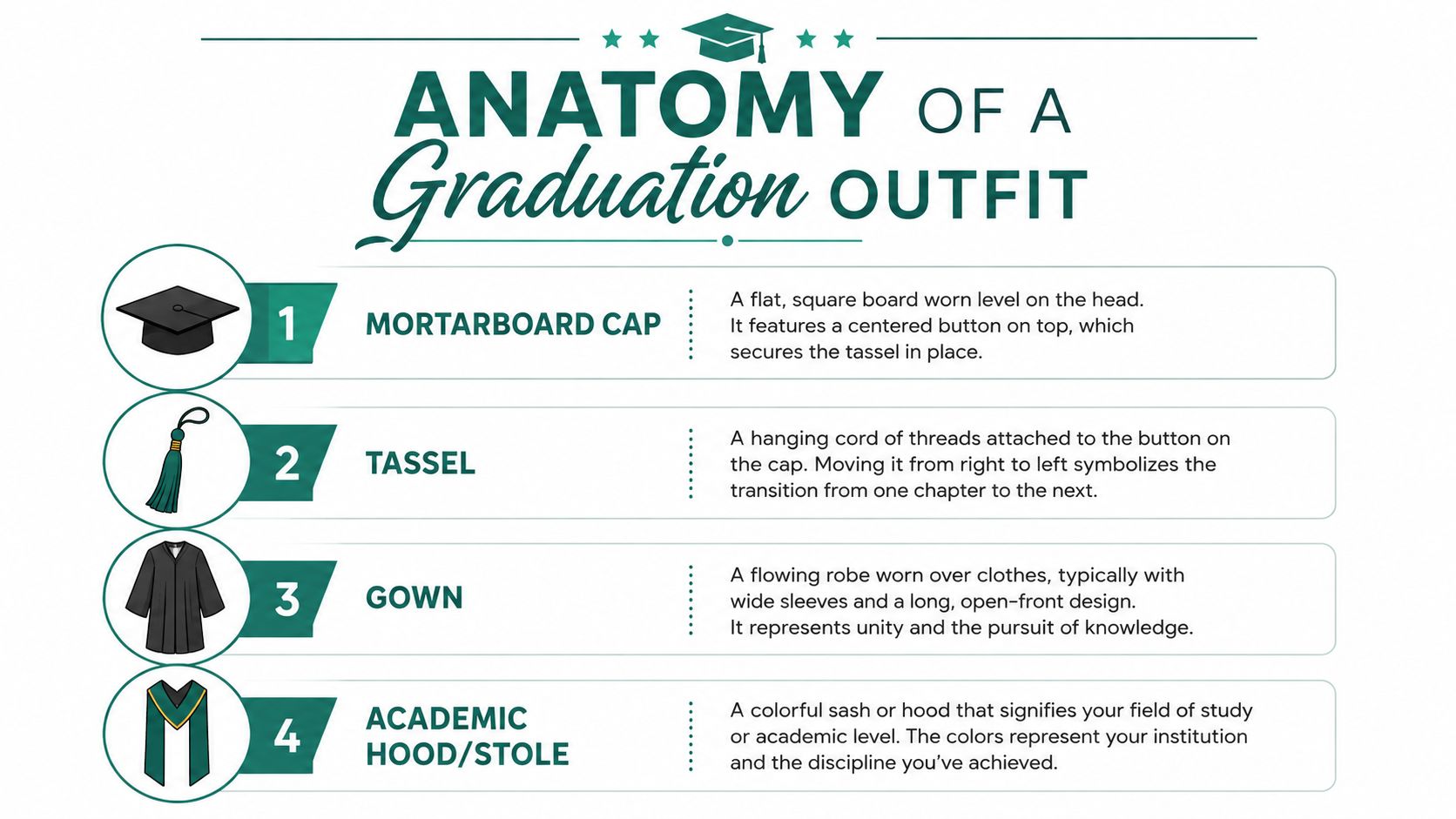
The outfit makes more sense once you name each piece in order. Start with the cap, then the gown, then the hood or stole, and finish with cords or tassel placement. If you're helping a graduate dress for the first time, that order keeps the process calm and prevents the common mistake of putting accessories on before the base layer is settled.
The cap, tassel, gown, and hood
The mortarboard is the flat square cap people picture first. Its centered button is the anchor point for the tassel, and the cap should sit level rather than tipped back. In some graduate programs, a tam replaces the mortarboard, especially for doctoral dress, and the shape is softer and more rounded.
The gown is the main visual field. Bachelor's gowns are usually simpler, while master's sleeves are fuller and doctoral gowns often add velvet trim and a more formal front. The gown should hang cleanly from the shoulders so the academic silhouette stays visible in photographs and movement.
The hood tells the viewer the degree field and, often, the institution colors through its lining. Its outer shell and inner colors turn outward over the shoulders, so the lining can be seen during the ceremony. That's why a hood needs careful placement, it's not just an accessory, it's the part that makes the outfit academically specific.
The smaller pieces that finish the look
Stoles, cords, and sashes sit on top of the gown and under, or alongside, the hood depending on your school's rules. Stoles often carry group, honor, or cultural significance, while cords usually mark academic distinction. The tassel is the moving marker, attached before the ceremony and shifted after conferral.
If a piece looks crowded, check the order of layers before you assume the size is wrong. Most fit problems are actually placement problems.
Once everything is on, the visual stack should read clearly, gown on the body, hood over the shoulders, cords and stole on top, cap last. That layered look is what gives commencement its formal structure and makes each degree level easy to recognize from the audience.
Getting the Fit Right Before Commencement
A first regalia order can feel uncertain because graduation sizing does not follow the rules of everyday clothing. Most gowns are sized by height and weight, not by chest alone, because the drape has to preserve the academic shape across the shoulders and sleeves Academichoods.com. The goal is a robe that falls cleanly, moves easily, and keeps its lines when you walk across the stage.
What to measure at home
Start with height in flat shoes, from the top of the head to the floor. Then measure the chest at the widest point under the arms, and if you are ordering doctoral regalia, check sleeve reach from the shoulder seam to the wrist. A second person helps, because these measurements are easier to take accurately when the arms are relaxed.
One published faculty size chart runs from 39 to 66, with height bands from 4'6"–4'8" up to 6'9"–6'11", and standard-fit options that generally cover up to 180 lbs, 270 lbs, or 330 lbs depending on size class. Those bands show why one graduate can wear a gown that skims the floor while another needs more room through the sleeves and chest.
What a good fit looks like
A gown that puddles at the floor is too long, and one that rides up the wrists is usually too short in the sleeve. The cap should sit level, not tilt backward, and it should feel secure without pressing into the forehead. If you are wearing a tam, hidden adjustment inside the band can help the fit feel steadier.
| Height | Weight Range | Gown Size |
|---|---|---|
| 4'6"–4'8" | Standard-fit range varies by class | Smaller size class |
| Mid-height graduates | Standard-fit range varies by class | Medium size class |
| Taller graduates | Standard-fit range varies by class | Larger size class |
Try the full outfit on at least a week before the ceremony. That leaves time to exchange a size that hangs wrong or sleeves that feel tight.
If something feels off, do not force it. A robe that looks smooth in the mirror but binds at the shoulders will feel worse on stage, and a cap that wobbles will show in photos. This is the part of commencement where a little patience saves a lot of stress.
Buying, Renting, or Reusing Your Cap and Gown
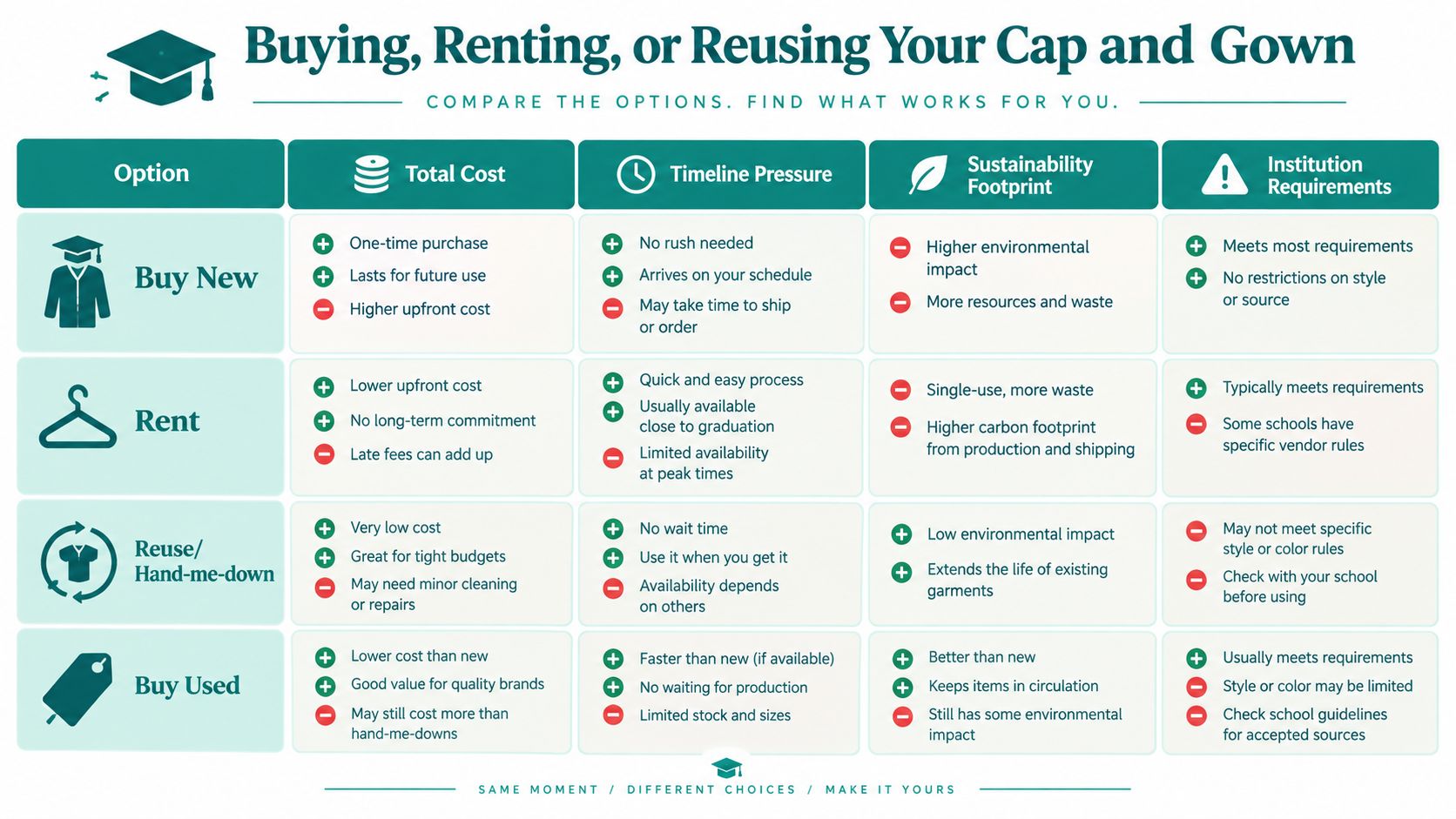
The best choice depends on four things, cost, timing, sustainability, and whether your school limits you to approved regalia. A graduate with one ceremony and a simple outfit may prefer rental, while someone keeping the gown for family photos or future ceremonies may want to buy. Reuse sits in the middle, and it's becoming a serious option for students who want less waste and less clutter.
How to choose without overthinking it
Buying makes the most sense when you want the set after graduation, especially if you'll attend more than one ceremony or plan to keep the gown as a family keepsake. It also helps when you need exact institutional matching, because you can compare the garment directly to your school's specifications. If your university uses a strict hood lining or color trim, ownership can reduce last-minute uncertainty.
Renting works best when the ceremony is single-use and the return window is clear. It also helps when you're confident about sizing and won't need to alter the outfit after delivery. The tradeoff is practical: late returns, damage, and missing pieces can quickly erase the savings if you're not careful.
Reusing is the quiet option most guides skip, but it matters. A university survey found that many students had regalia they still owned after graduation and had no plan to use again, which led the school to launch a reuse program so future students could borrow sets at no cost Chapman University. That kind of program gives students a place to borrow, donate, or pass along attire instead of treating it as one-time waste.
A simple decision lens
- Check the approved vendor list first: If your school requires a specific style, that narrows the decision immediately.
- Match the timeline to the delivery path: Tight deadlines favor in-stock or fast-fulfillment options.
- Think about the next use: If you'll wear it again, buying may make more sense than renting.
- Ask where reuse is accepted: Some campuses, alumni groups, and departments already run exchange closets.
A helpful practical example is to compare the outfit's lifecycle, not just the checkout total. Buying can serve multiple events, renting can reduce storage, and reuse can lower waste while still meeting ceremony standards. If you're unsure, treat the vendor list and school rules as the first filter, then choose the option that leaves you with the least ceremony-week stress.
Ceremony Etiquette Every Graduate Should Know
The easiest etiquette mistakes are the ones nobody mentions until you are already in line. Tassels get moved at the wrong time, caps get adjusted during the wrong moment, and hoods end up twisted because everyone around you is doing something slightly different. A few simple rules keep you from guessing on stage.
The three moments that matter most
Before conferral, the tassel stays on the right side. After the degree is officially granted, it moves to the left side, and that shift is one of the clearest visual signals of the ceremony American College of Education. For doctoral regalia, follow the hooding instructions from your faculty or marshal. The hood may be presented on stage instead of worn from the start, so the sequence can differ from bachelor's or master's regalia.
The cap usually stays on during processionals and the main ceremony unless your institution gives a specific cue to remove it. Keep your hands relaxed at your sides or lightly holding the program when you walk, and avoid fidgeting with the cap once you are seated. A neat gown and level cap photograph better than a constantly adjusted one.
What to do from arrival to recessional
- Arrive dressed and checked. Make sure the gown is zipped, the hood lies flat, and the tassel is on the correct side.
- Follow the marshal's line cues. Walk when your row is called, not before.
- Wait for the conferral moment. That is when the tassel moves and the ceremony becomes yours.
- Keep the cap level in photos. It should sit straight, not pushed back.
Respect the people beside you by moving only when the row moves. Most ceremony delays come from one graduate stepping out of sequence.
For a clear walkthrough of how to wear each part of your outfit, Grad Store's regalia wearing guide is a useful companion to your school's instructions. If you know the sequence before you walk in, the whole day feels calmer, and your attention stays on the milestone instead of the mechanics.