

""" You're standing in the hallway outside the bookstore or your department office, trying to decide whether the doctoral set on your screen is actually yours. The gown looks close enough. The hood seems right. But one wrong velvet color, one off tam, or one generic bundle that ignores your university's rules, and the whole set looks careless in photos and in procession.
That's the problem with doctoral regalia by university. It isn't just about buying a black gown and a hood. It's about matching a shared academic code to a school's exact overlay of colors, fabrics, and headwear so your set reads correctly at your ceremony. The candidates who get this right don't guess from product thumbnails. They verify the university spec, then order to that spec.
Table of Contents
- Why Doctoral Regalia Varies by University
- The Intercollegiate Code and University Overlays
- Reading the Doctoral Gown Specifications
- Hood Anatomy and University Color Signals
- Tam and Mortarboard Choices for Doctorates
- Major University Specifications Side by Side
- Ordering Logistics and Lead Times
- Verifying Your Set Matches Your University
- Quick Reference for Any U.S. University
- Doctoral Regalia Checklist Before You Order
Why Doctoral Regalia Varies by University
Doctoral regalia looks standardized from a distance because it rests on a common historical system. The roots go back to 14th- and 15th-century universities, especially Oxford and Cambridge, and the tradition was already in use in the United States during colonial times. The U.S. system later formalized those conventions through the 1895 Intercollegiate Code, with later refinements in 1986 clarifying the use of dark blue for the Ph.D. degree (Michigan Western regalia history).
That shared code is only half the story. Universities still layer their own identity onto the standard silhouette, and that's where candidates get tripped up. A generic doctoral listing may be technically close, yet still wrong for your school because the hood lining, velvet color, gown facing, or tam style doesn't match what your commencement office expects.
The mistake candidates make most often
They buy a “doctoral” set as if doctoral meant one universal style. It doesn't. The hood carries the clearest school signal, and in many cases it matters more than the gown because the lining identifies the awarding university while the velvet trim points to the discipline.
Practical rule: treat the gown, hood, and headwear as one specification set. If one piece is off, the whole look is off.
That's why doctoral regalia by university needs to be ordered like a specification problem, not like apparel shopping. Start with the university page, then check the degree level, then check the exact hood lining and approved tam or mortarboard. If the vendor can't show you the school's version in writing, don't assume the generic one will pass muster.
The Intercollegiate Code and University Overlays
The Intercollegiate Code is the baseline, not the finish line. It defines the doctoral gown silhouette, the hood shape, and the major structural details, but universities decide how those parts are colored and presented. The code says what a doctoral set is. The university tells you what your doctoral set must look like on campus.
The baseline is consistent. The doctoral gown is faced down the front with velvet, carries three velvet sleeve bars, and the facings are typically 3 to 5 inches wide. The hood is 4 feet long with a 5-inch velvet trim for doctorates, and the shell is black with an institutional-colored satin lining that signals the awarding university (Intercollegiate Registry code).
What the overlay actually changes
The overlay is where local branding enters the picture. One university may want dark blue velvet for the Ph.D. hood, another may use light blue for the Ed.D., and a third may pair the doctoral set with a university-specific cap style or custom gown color. Virginia Tech, Penn State, and the University of North Dakota all show how different the same doctoral category can look once the university adds its own color rules (Virginia Tech hood color guide).
That means you should never shop by “doctoral” alone. Shop by doctoral level plus university specification. A set can be code-compliant and still be wrong for your school if the overlay is off.
The code gives you the structure. The university gives you the identity.
Use that distinction as your filter every time. If a vendor page cannot separate the national code from the campus overlay, you're looking at a blunt catalog page, not a reliable spec sheet. For a doctorate, blunt is not good enough.
Reading the Doctoral Gown Specifications
The doctoral gown is the part most buyers think they understand, and it's usually where they miss the small stuff. The silhouette is fixed by the code, but the university overlay can alter the visible identity of the robe in ways that matter in photos and in person. If you're buying online, read the gown line by line, not as a style description but as a checklist.
Start with fabric, length, and facing
The gown should be the correct doctoral cut, with the velvet facings running down the front panels and the sleeve bars in matching velvet. The length should suit the wearer's height, and the gown should still hang properly over shoes at commencement. If the vendor gives you fabric guidance, use it. Grad Store's own size, color, and fabric guide is the kind of reference you want before you commit to a purchase, because it helps you inspect the material and fit instead of trusting a thumbnail alone (size, color, and fabric guide).
The important detail is the velvet facing color. That color often carries the degree or school signal, and it's the first thing that makes a generic robe look wrong. Some universities keep it close to the code default. Others insist on a different shade tied to their own branding.
Read the gown like a specification sheet
Use this order of checks:
- Fabric and cut: Confirm it is a doctoral gown, not a master's robe dressed up with extra trim.
- Facing color: Match the velvet color to the university's published requirement.
- Sleeve bars: Make sure there are three velvet bars and that they match the front facings.
- Embroidered details: Check whether the school wants a seal, crest, or other approved mark.
- Approved vendor language: Look for wording that the gown is made for the named institution, not just “doctoral style.”
That's the right way to read doctoral regalia by university. The gown is not where you freestyle. It's where you verify. If the school has a specific doctoral gown color, treat that as mandatory, because the wrong robe is obvious the moment you step into line.
Hood Anatomy and University Color Signals
The hood carries the most information in the set. It identifies the awarding university and the academic field, and those signals are easy to mix up if you do not read the parts correctly. A doctoral hood is an identifier, not decoration.
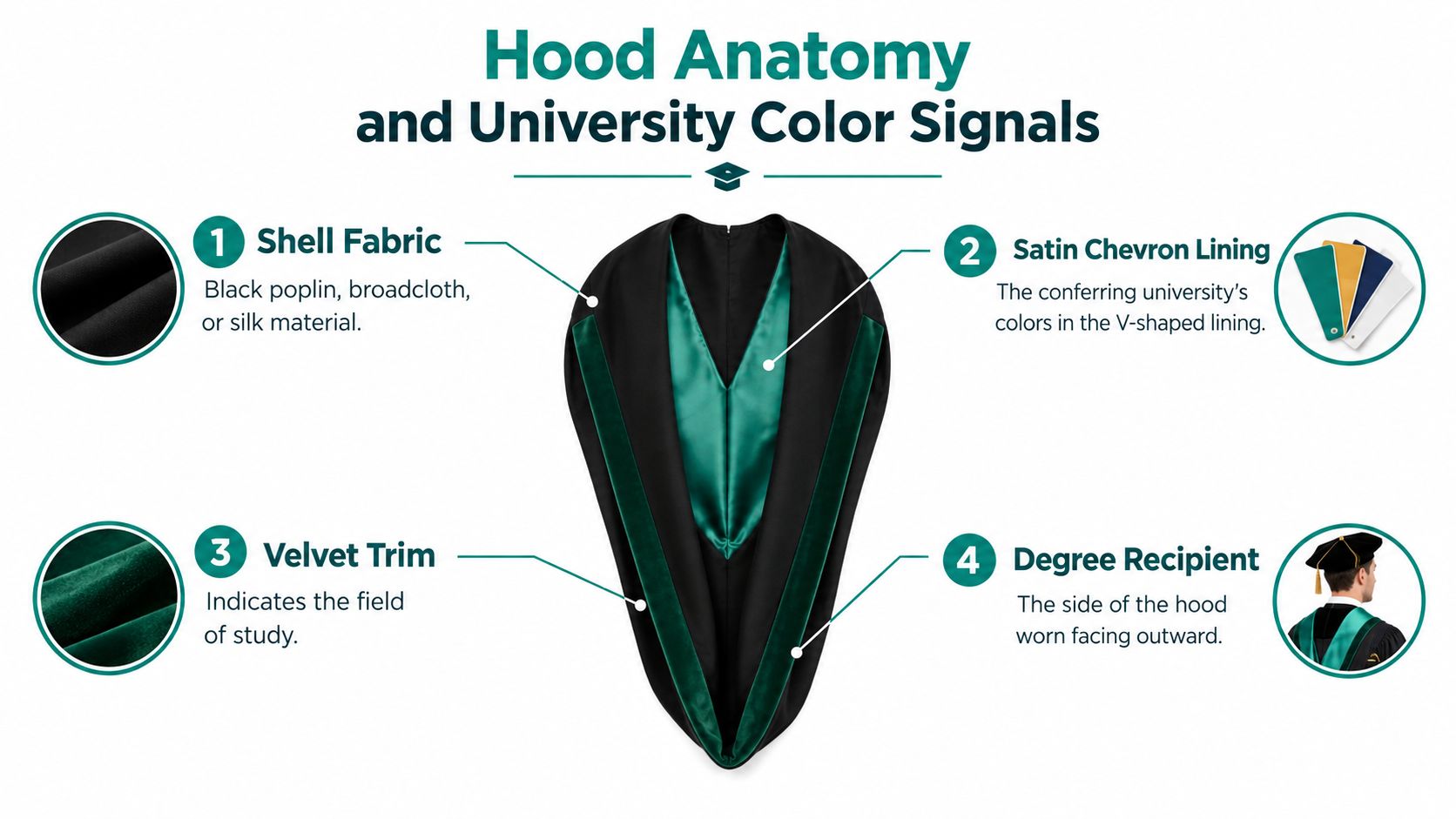
Four parts you need to verify
Start with the shell. It is usually black. The satin lining carries the conferring university's colors, the velvet trim identifies the academic discipline, and the hood length has to match doctoral standards. Each part does a different job, so checking only one color is how buyers end up with the wrong hood.
Some schools use a single lining color. Others use a split lining with two colors, and that pairing is often the clearest signal on stage. The discipline trim is separate. Education may call for light blue, science for golden yellow, and other fields have their own established code colors.
If the university uses a custom lining, verify that first. If the discipline uses a standard velvet color, verify that too. The field signal can be right while the school signal is wrong, and you need both to match.
For a reference point, review a deluxe doctoral hood against the school's published spec before you order.
Don't confuse school color with field color
That mistake causes most hood returns. A candidate sees a blue lining and assumes it is correct because the university uses blue in its branding. That is sloppy. The hood lining has to match the awarding institution, while the velvet trim has to match the discipline under the code.
The hood is where doctoral regalia by university becomes most specific, so be strict here. If the lining colors are hard to judge on screen, request a swatch before you buy. If the vendor cannot show the exact shell, lining, and trim combination, keep looking.
Tam and Mortarboard Choices for Doctorates
Doctoral headwear is where universities show how traditional or practical they want the ceremony to feel. The tam is the code-default choice, but not every institution uses the same number of points, and not every campus accepts the same headwear. A generic bundle that drops in a mortarboard because it's cheaper is a bad assumption.
| Style | Points | Typical Universities | Notes |
|---|---|---|---|
| Velvet tam | 4 | Streamlined doctoral programs and some private colleges | Less common than six- or eight-point styles |
| Velvet tam | 6 | Large public systems and many doctoral programs | Common doctoral standard |
| Velvet tam | 8 | Research-intensive universities | Often preferred where tradition is emphasized |
| Mortarboard | 4 corners | Selected institutions and some professional doctorates | Must be confirmed with the commencement office |
Pick the headwear the university expects
If your school wants a tam, match the style to the robe velvet and keep the finish consistent. If the school allows a mortarboard, confirm it in writing before you buy, because “allowed” and “preferred” are not the same thing. The safest move is to follow the commencement office, not the generic product bundle.
The tam choice should also fit the tone of the institution. Some campuses lean toward a more traditional doctoral look, while others are more modern. Either way, the headwear has to belong to the rest of the set.
Match the cap to the school, not to the cheapest package in the catalog.
That's the clean rule. For doctoral regalia by university, headwear is never just a finishing touch. It's part of the specification.
Major University Specifications Side by Side
The fastest way to see how much variation exists is to compare actual university requirements. The silhouette stays recognizable, but the combinations of gown color, hood lining, and tam style change in ways that matter when you order. If you're comparing schools, this is the part to read twice.
| University | Gown Style | Hood Lining Colors | Preferred Tam | Notes |
|---|---|---|---|---|
| Harvard | Black gown with black velvet facings and three sleeve bars | Crimson satin lining | Eight-point black velvet tam | Classic doctoral presentation |
| MIT | Black gown with black velvet | Cardinal red lining | Eight-point tam | Strong institutional color signal |
| Stanford | Cardinal red gown with matching velvet facings | Dark cardinal lining | Eight-point black velvet tam | One of the few schools that color-blocks the gown |
| Yale | Black gown | Royal blue lining | Eight-point tam | Clean contrast, strong school identity |
| University of Michigan | Black gown with black velvet | Maize and azure split lining | Six- or eight-point tam | Split lining makes the university identity obvious |
| UCLA | Black gown | Gold and powder blue lining | Six-point black velvet tam | Distinctive school colors with a traditional cut |
| University of Chicago | Black gown | Maroon lining | Eight-point tam | Straightforward, traditional doctoral look |
What stands out across these schools
Harvard and MIT keep the gown conventional and let the hood carry the identity. Stanford goes further and uses a cardinal red gown, which is one of the clearest examples of a university pushing identity into the robe itself. Michigan and UCLA show how split linings and two-color combinations can make the hood unmistakable even when the gown stays black.
Those are not minor variations. They change what you should order. A doctoral candidate at one of these universities should not rely on a broad “PhD regalia” listing without checking the exact combination. For doctoral regalia by university, the combination matters more than any single piece.
How to use the comparison
If your school appears similar to one of these examples, don't assume similarity is enough. Use the university page, then cross-check gown style, hood lining, and tam choice against the listed specs. Small differences are still differences, and commencement photos make them obvious.
Ordering Logistics and Lead Times
The wrong set usually fails at checkout, not at commencement. For doctoral regalia by university, ordering is a procurement job. You are matching school specs, size, hood colors, and delivery timing before the ceremony clock runs out.
Plan backward from commencement
Start with the ceremony date and work backward. Custom doctoral sets need production time, and embroidered details take longer than stock items. If your university has a crowded spring schedule, do not wait for the last campus email. Order from the deadline, not from your memory.
Cohort and department orders make sense when several candidates need the same school-specific setup. One coordinator can collect measurements, verify hood linings, and keep the order consistent. That avoids the common error where one person gets the wrong degree color or the wrong tam size.
What to request before you pay
Ask for a swatch if the color matters and the screen view looks uncertain. Deep cardinal, split blue linings, and other fabric-specific shades often look different online than they do in hand. Confirm the return policy before you buy, especially if your school allows either purchase or rental. Johns Hopkins says doctoral regalia can be purchased or rented, and rental returns are required, which shows why procurement rules matter as much as appearance (Johns Hopkins graduation FAQs).
If you are comparing vendors, Grad Store is a practical place to check school-specific sets and custom doctoral options through its university finder and collections pages.
| Weeks Before Commencement | Action Required | Notes |
|---|---|---|
| 8 to 12 | Place custom or group order | Safer window for special colors and imports |
| 6 to 8 | Confirm swatches and proofs | Needed if lining or facing color is unclear |
| 4 to 6 | Order stocked doctoral set | Typical window for standard items |
| 2 to 4 | Recheck shipping and return terms | Fix problems before deadline pressure hits |
| Final week | Steam, inspect, and label | Keep tags until the fit is confirmed |
Verifying Your Set Matches Your University
Do not trust a product title. Trust the university spec, then prove the vendor matches it. That's the only reliable way to buy doctoral regalia by university without getting stuck with an almost-right set that fails under campus lighting.
Check the official page first
Start with the commencement office or graduate school page, not with a search result. You're looking for the exact gown length guidance, hood shell fabric, satin lining colors, velvet trim width, and acceptable headwear. If the university publishes a PDF or a regalia chart, treat that as the authority.
Then compare the vendor listing line by line. The gown facing color should match. The hood lining should match. The trim should match. If the product page uses loose language like “dark blue” while the university uses a specific school designation, stop and ask for a proof.
Use proof, not assumptions
If the order is expensive or custom, ask for a digital proof or a fabric swatch before final approval. Once the set arrives, photograph it against the university reference material before you remove tags. That gives you a clean record if something is wrong and needs to be exchanged.
Joint-degree candidates should also confirm which hood is worn on the outside during procession. If your institution uses two hoods, the primary degree usually needs to be the visible one, and that detail should be verified before ceremony day. Don't leave that to guesswork.
If the school page and the vendor page disagree, the school page wins.
That's the rule. Every time.
Quick Reference for Any U.S. University
A wrong doctoral set usually starts with a bad lookup. Pull the university spec first, then buy to that spec. That keeps you from ordering the right gown in the wrong trim, or the right hood with the wrong lining.
Follow this four-step process
- Find the university's official regalia page. Use the school's wording for hood lining color, velvet trim color, and approved headwear style.
- Identify the degree level. A PhD, EdD, DBA, or JD can change velvet color and other code-based details.
- Cross-check the disciplinary color. The Intercollegiate Code assigns field colors, but the school may refine or override that standard.
- Verify any campus-specific deviation. Custom gown panels, rental rules, and vendor lock-in need confirmation before you order.
A campus search tool helps because it starts with the school, not a generic gown category. That is how you avoid the most common buying mistakes. Use the Grad Store university finder to anchor the search to the institution first.
What to ask if the page is vague
Ask the graduate school or bookstore for the official hood lining swatch, the approved tam style, and whether the set is purchase-only or rental-friendly. If the answer is buried in a FAQ, get the exact line in writing. If the vendor cannot say which piece is institution-fixed and which piece is degree-fixed, the order is still a guess.
If the page stays unclear, ask for a sample image or a written spec summary before you commit. That is the cleanest way to keep the set aligned with school identity, degree identity, and headwear approval.
Doctoral Regalia Checklist Before You Order
Before you click buy, run the order through a hard checklist. If a vendor can't clear every point, the set isn't ready. That's the difference between looking polished and looking like you ordered from the wrong catalog.
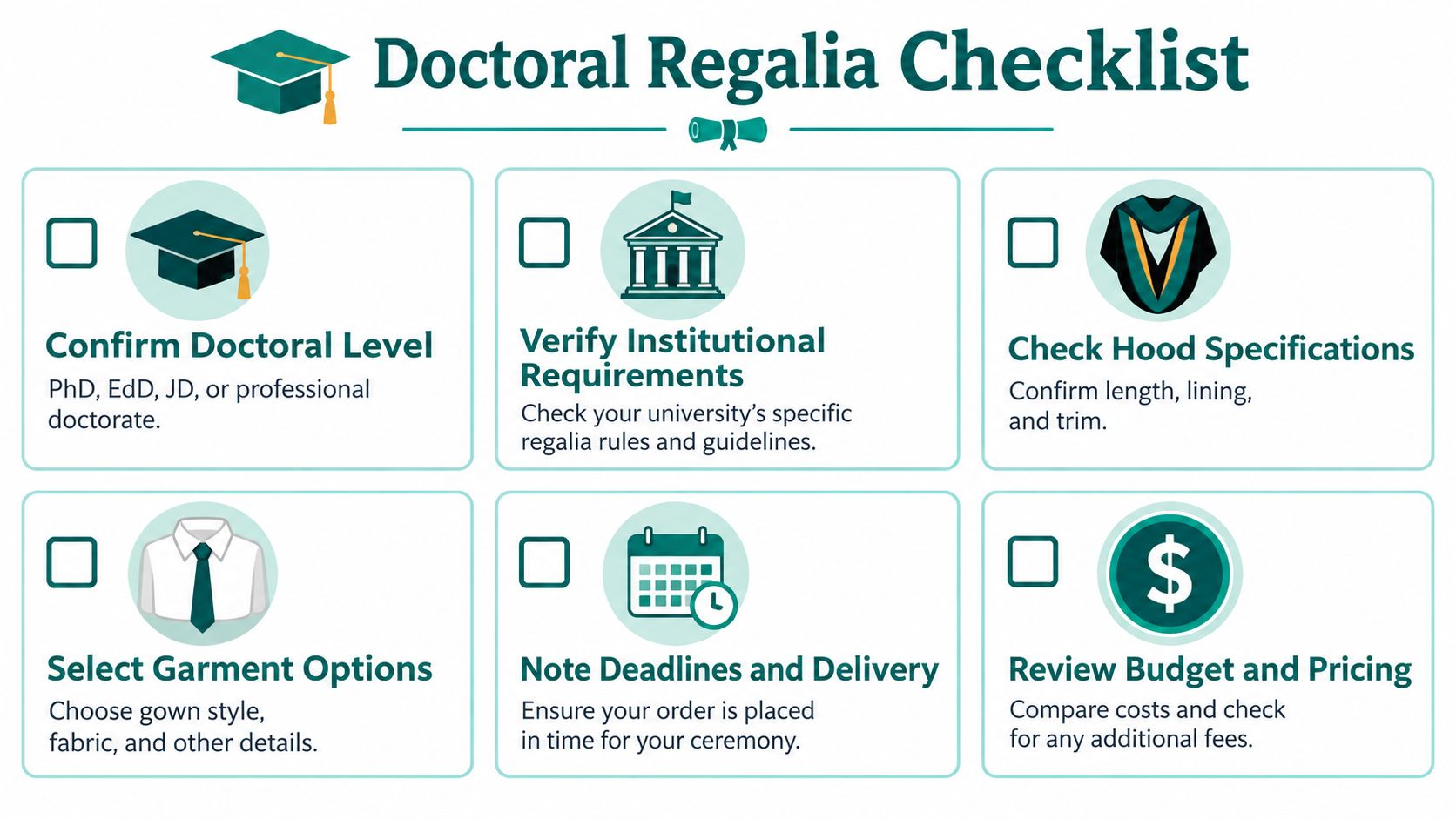
The checklist is straightforward. Confirm the doctoral level first, then verify the university requirement, then lock in the hood spec, and only after that choose the gown and headwear. If one of those steps is fuzzy, pause. Fuzzy regalia turns into returns.
Order with the ceremony, not the cart, in mind
Use the university's timing and your delivery window together. If you're ordering custom or imported fabric, give yourself more room than you think you need. If you're buying stock, still leave enough time to inspect the set and steam it before the ceremony.
Keep these four decisions fixed:
- Correct gown size
- Correct hood lining
- Correct velvet trim
- Correct headwear style
That's the sequence that prevents the most common mistakes. It works for PhD, EdD, JD, and professional doctorates alike.
Your best move is to verify your university's exact spec, then order against that spec, not against a generic doctoral listing. If you want a school-specific set, a fabric swatch, or help matching the pieces to the campus requirement, visit Grad Store and compare the doctoral options against your university's official guidance before you buy. """