

You're probably getting dressed in a dorm room, hotel room, or campus hallway with a gown bag on one chair and somebody asking for photos on the other. The cap feels slightly off, the hood looks inside out, and the last thing you want is to step onto the stage realizing your regalia doesn't sit the way the marshal expects. That's the moment when how to wear graduation regalia stops being a style question and becomes a ceremony question.
The good news is that the rules are simpler than they look once you treat the outfit as a sequence. The gown comes first, the hood has to show its velvet and lining correctly, and the cap has to sit flat long enough to survive walking, sitting, and photos. The harder part, for most graduates, is not the basic sequence. It's keeping the hood secure and knowing which parts change by degree level and university.
Academic dress also carries a real visual code. The hood's velvet trim, color, and lining identify degree field and institution, a system formalized by the 1895 Intercollegiate Code of Academic Costume that still shapes regalia in the United States today (Burgon Society article on the 1895 code). If you get the small placement details right, the photos look cleaner, the walk feels less fussy, and you stay within ceremony rules instead of fighting them.
Table of Contents
- Introduction to Wearing Graduation Regalia the Right Way
- What Each Piece of Regalia Means and When You Need It
- How to Put On Your Cap Gown Hood Stole and Cords
- Degree Level and University Variations You Should Check
- Ceremony Etiquette Movement and Photo Ready Tips
- Troubleshooting Common Regalia Problems and Quick Fixes
Introduction to Wearing Graduation Regalia the Right Way
The easiest way to spot a regalia mistake is to watch someone halfway to the stage with a hood twisting at the neck or a cap riding too high. Those problems rarely start onstage, they start in the dressing room, when people rush the order and skip the checks that matter. A gown that hangs correctly, a hood that stays in place, and a cap that sits level all help the whole look hold together under movement and bright lights.
Academic dress isn't just decoration. It's a standardized visual language, and the hood does most of the talking, through trim color, lining, and placement that signal degree level and field of study (Burgon Society article on academic costume). The modern U.S. system grew out of that code, which is why regalia can look slightly different from campus to campus but still follow the same broad grammar.
Practical rule: If the gown looks right but the hood is slipping or the cap is tilted, the outfit still reads as unfinished in photos.
A calm ceremony morning starts with the basics, then moves to the details that most guides skip. The next sections cover what each piece means, how to put it on in the right order, what changes by degree level, and how to fix the failures that happen, especially with hood security and cap alignment.
What Each Piece of Regalia Means and When You Need It
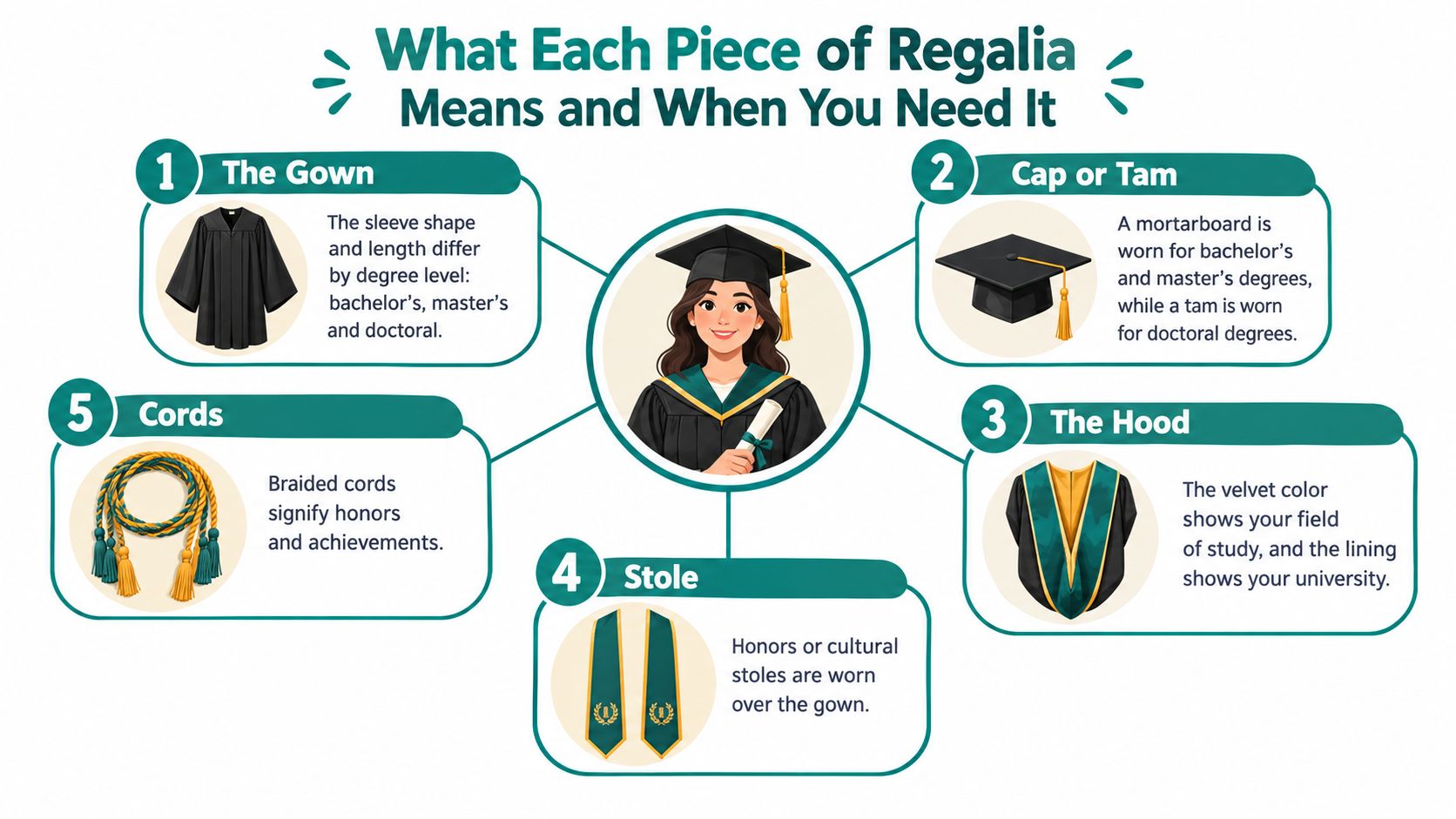
The core pieces of regalia each do a different job. The gown is the base layer, the cap or tam frames the face, the hood identifies degree and discipline, and optional pieces like the stole and cords add honors, affiliations, or cultural meaning. If a piece isn't assigned by your school or your degree level, don't assume it belongs on ceremony day.
The historical color system still helps explain why hoods don't all look the same. The 1895 code assigned the original subject colors, including white for arts and letters, scarlet for theology, purple for law, dark blue for philosophy, gold yellow for science, brown for fine arts, pink for music, and green for medicine (Burgon Society article on the 1895 code). That system is why a hood's trim can signal the discipline at a glance.
The pieces in plain terms
- The gown: The main garment, and the one most likely to wrinkle or hang crooked if you rush.
- The cap or tam: The headwear that has to sit level, not perched back on the head.
- The hood: The piece that carries the color code and usually causes the most confusion.
- The stole: Often used for honors, affiliation, or cultural display, depending on your institution.
- The cords: Braided honor indicators that should hang evenly and not disappear under the hood.
If you're checking size, fabric, or color before ordering, a practical reference point is the size, color, and fabric guide, especially if your school uses a narrow set of approved options. That matters because regalia only works when the pieces are aligned with the institution's own standards.
How to Put On Your Cap Gown Hood Stole and Cords
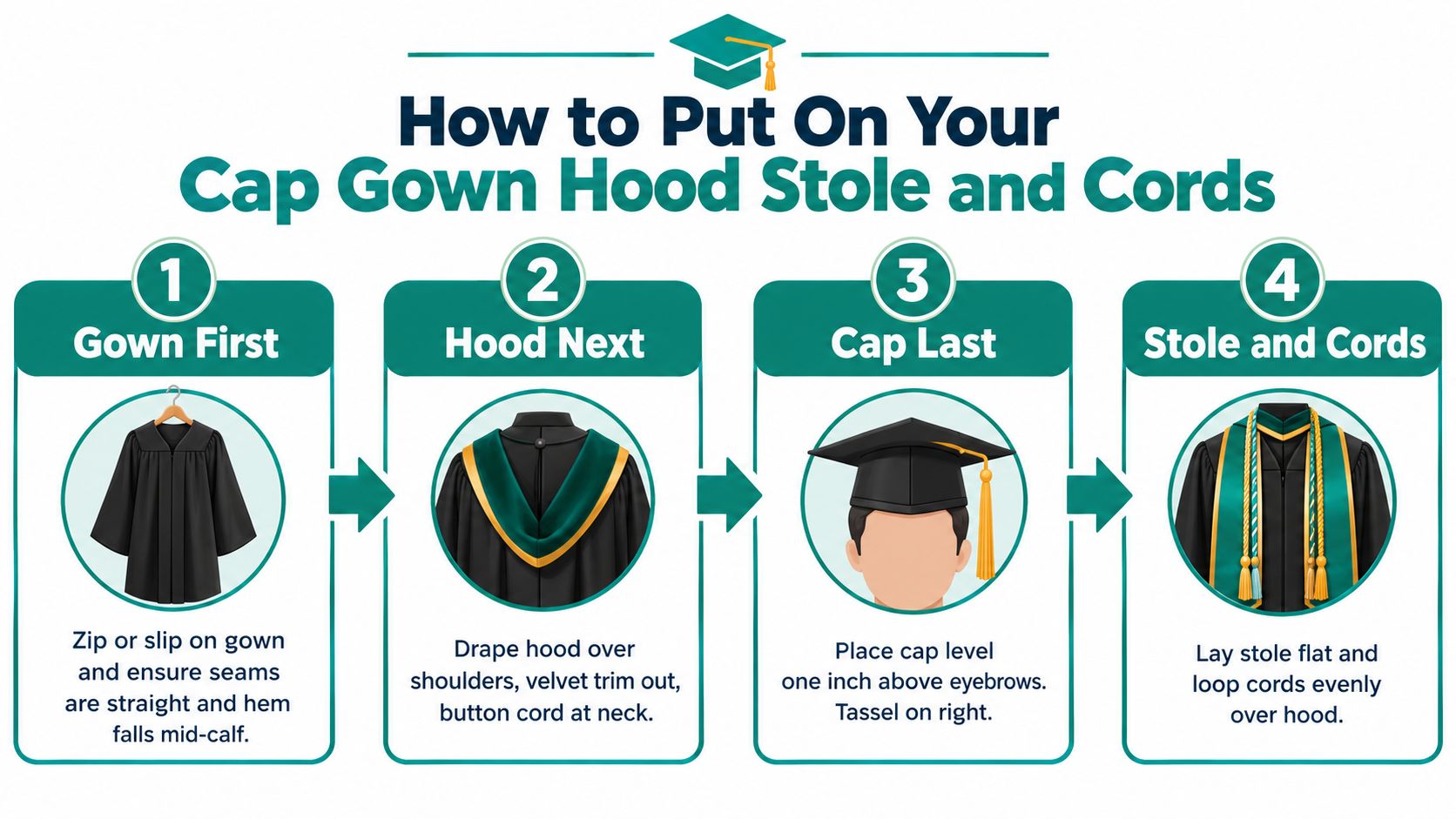
The order matters because each layer changes how the next one sits. Start with the gown, because it creates the base line for everything else. Pull it on so the seams hang straight and the front closes cleanly, then check that sleeves and hem fall naturally instead of bunching at the shoulders or knees.
The hood comes next for anyone who wears one. Drape it so the neckband or loop secures at the gown opening or button, then let it fall down the back with the velvet trim visible and the lining turned outward enough to show the school colors. One university guide says the hood should sit with the velvet visible directly under the chin and the lower tip turned inside-out, while another says to attach the front loop to a button and fold the hood so the inner lining and school colors show (Delaware Bible University regalia guidance). Use the method your school specifies, because the finish can vary by garment construction.
Practical rule: If the hood looks flat from the front but disappears at the shoulders, it's not set correctly.
The cap or mortarboard goes on last. It should sit level and flat, with the point forward and the tassel on the right side before conferral (University of the Commonwealth Caribbean regalia guide). Don't perch it back like a casual hat. If it needs stability, use pins or bobby pins that fit your hair type and don't distort the board.
Where stoles and cords fit
Stoles and cords should stay visible, but not sloppy. Lay the stole flat over the gown, then place cords so they hang evenly and don't slip into the hood's neckline. If you wear both a hood and a stole, keep the hood in place first, then layer the stole so the colors remain readable.
A useful detail here is comfort. Hood security that's too tight at the neck tends to shift, twist, or pinch during a long ceremony. Guidance from university regalia tips reflects that tension, with some instructions recommending a cord or safety pin to keep the hood from slipping and others advising no pins at all, depending on the garment and institutional rules (Valdosta State University regalia tips).
Degree Level and University Variations You Should Check

The biggest mistake graduates make is assuming regalia is universal. It isn't. Degree level changes the shape of the gown, the type of headwear, and sometimes whether the mortarboard is optional or required, so the safe move is to verify your own school's rules before ceremony day.
Bachelor's, master's, and doctoral differences
Bachelor's regalia is usually the simplest setup, with a gown, cap, tassel, and sometimes a stole or cords if the school allows them. Master's regalia adds the hood, and doctoral regalia changes both the robe and the headwear, with some institutions using a tam instead of a mortarboard. Official guidance from one university says the mortarboard is optional for bachelor's graduates and compulsory for master's graduates, while doctoral attire follows different robe and hood specifications (Murdoch University graduation regalia guidance).
That variation is the reason a borrowed hood or a one-size-fits-all set can fail on arrival. A hood with the wrong lining, the wrong trim, or the wrong length won't read correctly under ceremony lighting, even if it looks close in a closet. If your campus publishes doctoral or institution-specific details, the doctoral regalia by university guide is the kind of reference page that helps compare approved styles without guessing.
What to confirm with your school
- Headwear rules: Mortarboard, tam, or optional cap requirements.
- Hood design: Color placement, lining, and whether your institution uses a specific conferral style.
- Allowed accessories: Stoles, cords, cultural items, or honors pieces.
- School colors: Make sure any lining or accent matches the institution's specification.
Personalization is growing, but ceremony rules still win. A 2026 industry trend source notes that 31% of online sales included at least one customization element, which points to stronger demand for discipline colors and institution-specific detailing, but that doesn't replace your campus requirements. The smart approach is to personalize only inside the rules, not instead of them.
Ceremony Etiquette Movement and Photo Ready Tips
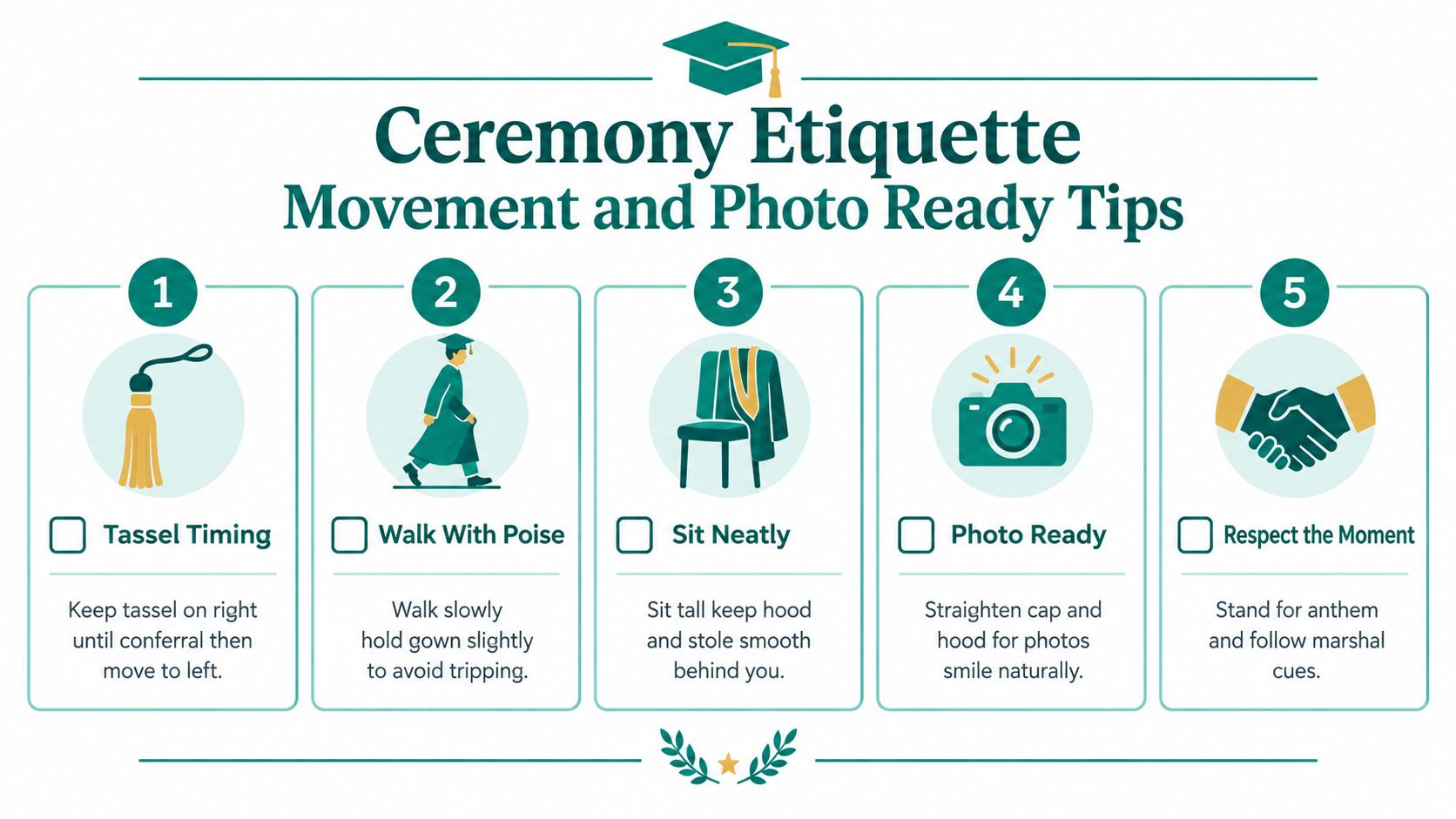
The walk matters as much as the dress. A cap that looks perfect in the mirror can shift the moment you turn, sit, or accept your diploma, so the cleanest approach is to keep the whole outfit quiet while you move. That means slow steps, level shoulders, and no tugging at the hood unless something has clearly shifted.
The clearest ceremonial marker is the tassel move from right to left at conferral (Delaware Bible University regalia guidance). Before that moment, leave it on the right. Afterward, let it stay on the left so the photos and the ceremony match the official sequence.
Photo rule: A level cap and visible hood lining matter more than perfect posture, because those are the details the camera catches first.
For photos, aim for a cap that reads diamond-shaped from above, with the point centered forward and the board parallel to the floor (University of the Commonwealth Caribbean regalia guide). If the cap tips, the whole look reads off-balance. A few discreet pins can keep it steady without changing the silhouette.
When you sit, keep the hood smooth behind you and avoid shrugging your shoulders forward. That keeps the neck opening from twisting and stops cords from disappearing under the gown. When you stand again, check that the stole still lies flat and the hood hasn't crept toward one shoulder.
Troubleshooting Common Regalia Problems and Quick Fixes
Most regalia problems show up in the last five minutes before the procession. The hood slides, the cap tilts, or the gown wrinkles in the car and suddenly everyone is searching for a mirror. The fix is usually small, but it has to be deliberate.
Hood slippage and conflicting fastening advice
This is the failure point most guides underplay. Some institutions advise securing the hood with a cord or safety pin so it doesn't slip, while others say not to use pins at all, which means the garment's construction and your school's rules both matter (Valdosta State University regalia tips). If your hood feels loose, check the loop, button, or neckband first, then decide whether a discreet fastener is allowed. Leave enough room at the neck so it doesn't feel tight during a long ceremony.
A twisted lining is usually a setup issue, not a fabric defect. Turn the hood fully so the interior colors face outward before you fasten anything, because once the hood is pinned, it's harder to correct without starting over. If the lining still folds under, flatten it with your hands from the collar down.
Cap, gown, and replacement fixes
A tilted cap usually means the board is sitting too far back or the front point isn't centered. Reset it level, with the front point near the forehead and the board parallel to the floor, then secure it with pins if needed (University of the Commonwealth Caribbean regalia guide). If the gown wrinkles, hanging it in steam or using a garment steamer is safer than trying to force the fabric flat.
If something arrived wrong, look to school-specific replacement options instead of improvising with the wrong color or shape. A practical FAQ page like the one at Grad Store's FAQ is useful when you need quick answers about fit, replacement pieces, or order issues without starting from scratch. The confidence check is simple, if the hood stays put, the cap sits level, and the colors are visible, you're ready to walk.
Grad Store carries bachelor's, master's, and doctoral regalia, along with school-specific hoods, tams, stoles, and accessories that match institution requirements. If you need to compare options before ceremony day or replace a missing piece fast, visit Grad Store and check the available regalia by degree level and university.