

You're standing in the graduation section with your family, cap and gown already purchased, when someone notices that the master's graduates nearby are wearing academic hoods. Then comes the uncomfortable question: Does a bachelor's graduate need one too?
The answer is not universal. In many U.S. ceremonies, bachelor's candidates wear a gown, mortarboard, and tassel without a hood. Other schools require a bachelor graduation hood, offer one as an optional addition, or use a different tradition altogether. The ceremony instructions from your institution matter more than a generic product page or a relative's memory of graduation day.
Table of Contents
- The Hood Question Most Graduates Do Not Think to Ask
- What a Bachelor Graduation Hood Actually Looks Like
- How Hood Colors Encode Your Degree and Your School
- Why Bachelor Hoods Look Different Across Countries
- Special Cases That Change What You Wear
- When a Bachelor Does Not Need a Hood at All
- Wearing the Hood Without a Last-Minute Mishap
- What to Confirm Before You Order or Pack the Hood
The Hood Question Most Graduates Do Not Think to Ask
A family can spend weeks arranging announcements, photographs, travel, and dinner reservations without ever checking the hood requirement. That's understandable. Schools often describe caps and gowns together, while the difference between undergraduate and graduate regalia appears in a separate commencement guide, bookstore notice, or departmental email.
The confusion becomes obvious when graduates line up. A doctoral candidate may wear a tam and a richly trimmed gown. Master's candidates may wear academic hoods. Bachelor's candidates may be dressed in gowns and mortarboards only. All three groups can appear in the same ceremony, yet their regalia rules differ.
Practical rule: Never assume that a bachelor's degree automatically requires a hood. Confirm the ceremony instructions before you buy or borrow one.
Academic regalia has deep roots in medieval Europe, but the U.S. system gained an important standardizing framework in 1895, when the Intercollegiate Code of Academic Costume established styles for bachelor's, master's, and doctoral gowns and hoods. The code still influences commencement clothing, but it doesn't force every institution to use every item for every degree level. The history of academic regalia from the University of Alabama at Birmingham explains how the hood changed from a practical garment into a symbolic part of academic dress.
Who sets the rule
Your commencement office, registrar, bookstore, or academic department may publish the applicable instructions. The rule can vary by ceremony, so a university that uses bachelor's hoods for a special college ceremony may omit them from its general commencement.
Before ordering, look for direct wording such as:
- Required: The hood must be worn with the bachelor's gown.
- Optional: Candidates may purchase or wear a hood, but it isn't part of the required set.
- Omitted: Bachelor's candidates wear the cap, gown, and tassel only.
- Credential-specific: A student receiving more than one credential follows a separate instruction.
If the wording is unclear, email the graduation office and ask for a written answer. A short confirmation can prevent an expensive mismatch and remove the uncertainty before the family arrives at the venue.
What a Bachelor Graduation Hood Actually Looks Like
A bachelor graduation hood is a draped academic garment, not a cape and not a scarf. It rests around the neck, spreads across the shoulders, and falls down the back in a curved, cowl-like shape. The front usually includes a small loop or fastening point so the hood can connect to the gown.
In the U.S. academic-dress tradition, a bachelor's hood is commonly specified as a 3-foot hood with a black shell and 2-inch velvet or velveteen trim. Those specifications are part of the visual language of degree level. Master's and doctoral hoods use wider trim, so the bachelor's version looks narrower and generally shorter. This academic regalia guide describes how length, trim, lining, and velvet communicate different information.
Identify the parts before you put it on
The shell is the outer fabric, commonly black in U.S.-style regalia. The lining is the colored interior that shows across the back, often arranged in a chevron or similar pattern associated with the institution. The velvet trim is the colored border that identifies the field of study.
The hood should hang evenly from both shoulders. Its extra fabric belongs down the back, while the front point and loop sit near the neckline. If the velvet edge faces inward, the most important academic color may disappear from the audience's view.
Try the hood with the gown before commencement. Check that the shell matches the gown, the lining faces outward at the back, and the fastening point can reach the gown without pulling the fabric to one side. A family member standing behind you can spot a twist much faster than you can.
The hood's design isn't decorative guesswork. Its geometry helps communicate the degree level, while its colors communicate the institution and academic field.
For a visual demonstration of academic dress in use, watch this commencement regalia guide:
How Hood Colors Encode Your Degree and Your School
You arrive at commencement and notice three graduates wearing different hood colors. Before you compare them, check whether your school requires a bachelor's hood at all. If it does, the garment usually carries three kinds of information: cut and length show degree level, the velvet trim indicates the academic field, and the lining identifies the awarding institution.
The system works like a visual label for a crowded ceremony. Viewers can read the hood's overall shape first, then its trim and lining. A white velvet edge may indicate a Bachelor of Arts, while golden yellow may indicate a Bachelor of Science, as described in Purdue University Northwest's history of academic regalia. These meanings are common rather than universal, so your school's instructions still control.
Three signals, one garment
Degree level comes from the hood's construction. A bachelor's hood is generally shorter, with narrower trim than the hoods used for master's or doctoral degrees. The shape gives the audience a broad clue about the credential before color adds more detail.
Field of study appears in the velvet border. White commonly represents arts and letters, while golden yellow commonly represents science. Other fields use other colors, and a school may assign a different color to an interdisciplinary or professional program.
Awarding institution appears in the lining, often through official colors and a specified pattern. That lining identifies the college or university granting the degree. It does not indicate your nationality, hometown, or personal background.
| Hood element | What it signals | Example |
|---|---|---|
| Shell and overall cut | Degree level | A shorter, narrower bachelor's design |
| Velvet trim | Field of study | White for Bachelor of Arts or gold for Bachelor of Science |
| Lining and chevron | Awarding institution | School colors arranged according to institutional specifications |
A general online chart can point you in the right direction, but it may misclassify an interdisciplinary program, combined major, or professional degree. Confirm the color before ordering.
The school's official color chart outranks a generic chart. If the two disagree, ask the graduation office which specification applies.
A guide to PhD regalia colors can help explain the wider color system, but doctoral conventions do not determine the bachelor's hood your ceremony requires.
Why Bachelor Hoods Look Different Across Countries
Academic dress doesn't travel perfectly across borders. A bachelor's hood that looks correct at a U.S. commencement may look unfamiliar, or even incorrect, at a ceremony using British or Commonwealth conventions.
The U.S. framework associated with the Intercollegiate Code generally describes a black shell, institutional lining, and discipline-colored velvet trim. A bachelor's hood in this tradition has a recognizable draped form and a narrow border. Other systems use different proportions, materials, and expectations about whether bachelor's graduates wear hoods at all.
The same word can describe different garments
In the United Kingdom and related academic traditions, a bachelor's hood may be shorter and more scarf-like, sitting closer to the neck than the familiar U.S. shape. Some Commonwealth systems also use white fur or fur-like edging, a detail that doesn't match the standard American description of black shell fabric with discipline-colored velvet.
Canadian universities often draw on British precedent, but individual institutions set their own regalia rules. Australian universities also vary. La Trobe University, for example, specifies a bachelor outfit that includes a Burgon-style hood with a 10-centimetre-wide silk facing in the discipline color, illustrating why a U.S. product description can't be treated as an international standard. The academic dress overview on Wikipedia provides broader context for these national and institutional differences.
| Country or system | Hood length | Trim style | Bachelor use |
|---|---|---|---|
| United States | Typically a shorter bachelor's hood within the U.S. code tradition | Narrow, discipline-colored velvet or velveteen trim | Varies by institution and ceremony |
| United Kingdom | Often shorter and closer to the neck | May use local materials, edging, and institutional design | Common in institutions that specify it |
| Canada | Often influenced by British academic dress | University-specific variations | Check the institution's ceremony rules |
| Australia | Varies by university | May follow British, American, or local conventions | Check the awarding institution |
| Continental Europe | Varies widely | May use different dress elements or no hood | Some institutions omit the bachelor hood |
International students attending a U.S. ceremony should follow the host university's instructions unless the ceremony explicitly asks them to wear regalia from their home institution. Graduates attending abroad should send a photograph or product specification to the host registrar before packing. The important question isn't whether the hood is attractive. It's whether its shape, colors, and degree-level signals belong to that ceremony's academic tradition.
Special Cases That Change What You Wear
The standard answer becomes less reliable when a graduate has more than one major, credential, or ceremony role. Schools may use a single hood for each graduate even when the academic record contains several fields. Others may provide a departmental instruction that overrides the general commencement guide.
Double majors and interdisciplinary programs
A student with two majors may expect two velvet colors. In practice, the institution often assigns one hood based on the primary degree, the college, or the field recorded for commencement. A double major usually doesn't mean wearing two hoods, and adding a second one without permission can create a problem during the processional.
Ask the registrar:
- Which degree or field controls the hood color?
- Does the school assign one hood to each graduate?
- Should a second field appear on a stole, cord, or another approved accessory?
The same caution applies to interdisciplinary and pre-professional programs. Don't select a shade because it seems intuitively related to the subject. Use the school's own designation.
Second bachelor's degrees
A graduate earning a second bachelor's degree may already hold a master's or doctoral degree. That previous credential doesn't automatically change the regalia required for the current ceremony. The event may be organized by the new bachelor's credential, or the university may have a broader rule for participants who already hold a higher degree.
A student attending as a faculty member, graduate, or guest can also face different instructions from someone receiving a bachelor's degree. The ceremony role determines the dress code.
Accessories are not substitutes for hoods
Honor cords, departmental stoles, medals, and society insignia are separate from the hood. Latin honors or membership in an honor society may add approved accessories, but they don't decide whether a bachelor's hood is required. A stole can display a department or cultural organization, while the hood follows the institution's academic-regalia rules.
Keep the categories separate: The hood identifies degree-level, field, and institution signals. Cords and stoles recognize honors, affiliations, or approved groups.
If your registrar's answer conflicts with a bookstore listing, send both references to the graduation office and ask which one governs the ceremony. That written clarification is more useful than trying to interpret a photograph from a previous graduating class.
When a Bachelor Does Not Need a Hood at All
You arrive at commencement wearing a cap and gown, then notice that only graduate students have fabric draped over their shoulders. That arrangement is common at U.S. ceremonies. Many bachelor's candidates wear the gown, mortarboard, and tassel only, with the tassel moving from the right side to the left when the degree is conferred.
A hood may appear in catalogs and graduation photographs, so its absence can seem like an omission. The tradition exists, but your institution's ceremony instructions determine whether you wear one. Treat the hood as a dress-code requirement to verify, not as a standard item to assume.
Follow this decision path
- Read the ceremony program: Look for a regalia diagram or a direct statement about bachelor's attire.
- Check the official vendor listing: See whether the undergraduate package includes a hood or lists one separately.
- Ask the bookstore: Staff can often clarify whether a hood is supplied, rented, optional, or excluded.
- Contact the registrar: Use the registrar or commencement office when the vendor information and ceremony program disagree.
- Review orientation materials: Wording such as “bachelor's gown only” settles the question.
A school may offer a hood as an optional add-on. Before buying it, find out how it will be used during the event. If graduates will not wear it in the procession or onstage, it may serve mainly for portraits, family photographs, or a keepsake. If the institution includes hoods in official photographs, order the approved version rather than relying on a generic one.
Smaller colleges, religious institutions, and professional schools may set their own undergraduate dress codes. A simpler outfit does not reduce the formality of the degree. It reflects the institution's chosen way to distinguish bachelor's ceremonies from graduate ceremonies. When instructions remain unclear, ask the commencement office for a written answer before ordering.
Wearing the Hood Without a Last-Minute Mishap
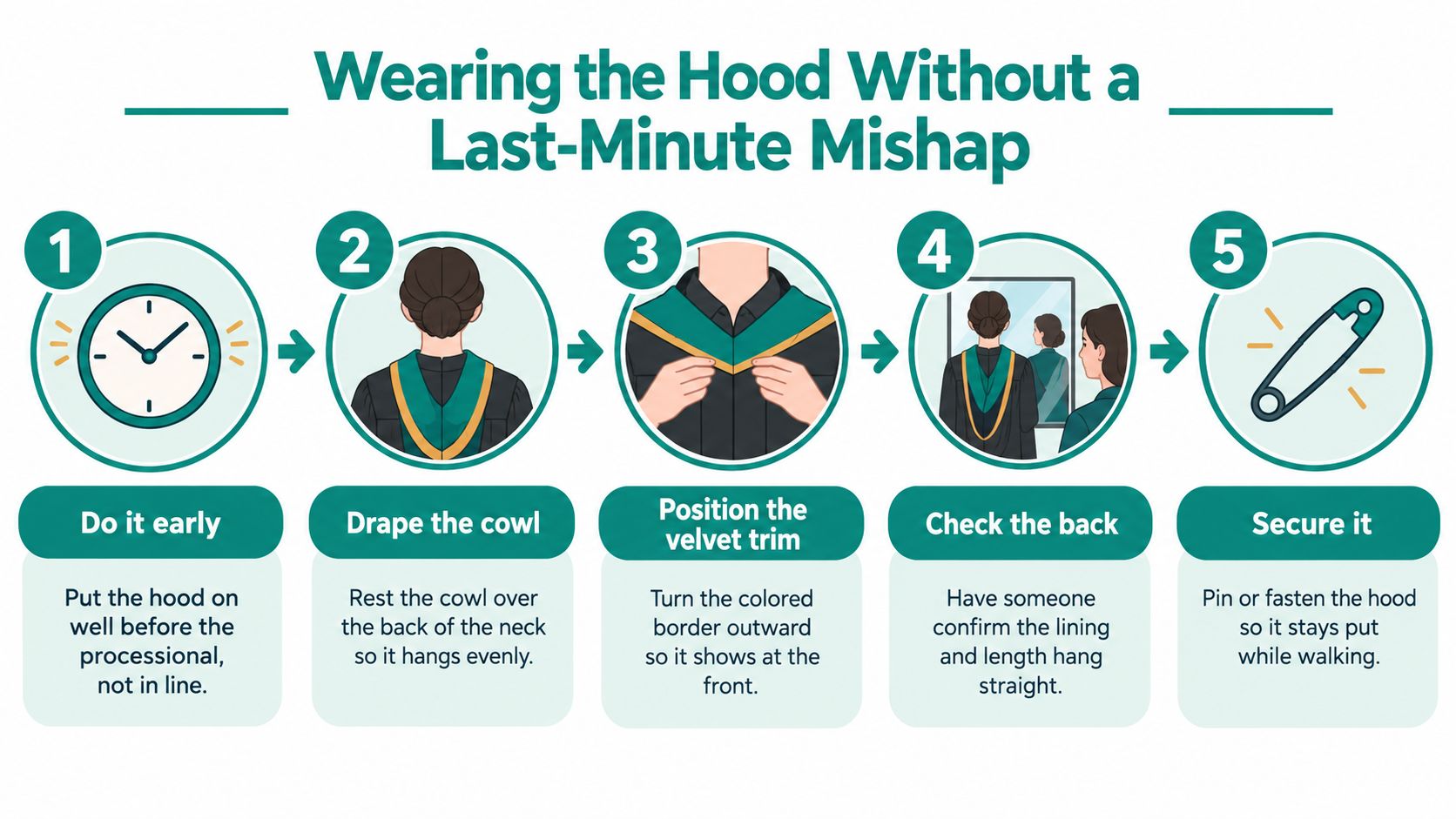
Put the hood on before you join the processional line. Trying to orient the fabric while walking, sitting, or waiting for your name creates the exact twists that show up in family photographs.
Start with the gown fully on and zipped. Find the hood's front point and fastening loop, then identify the longer section that belongs down your back. Drape the cowl over the back of your neck so both shoulders carry the fabric evenly.
Turn the colored velvet border outward. Arrange the lining so the school colors are visible across the back rather than trapped underneath the gown or hidden behind a stole. Fasten the loop to the gown if the design allows it, and ask someone to inspect the back.
Avoid the two common positioning errors
The first is letting the hood slip behind a stole. The stole may cover the lining and pull the hood off-center, so check both items from the side and rear. The second is twisting the hood so the velvet edge faces inward. That hides the field color and makes the garment appear incorrectly worn.
Keep the hood on while seated unless staff instructs you to remove it. Graduates sometimes tug it off after sitting down, then struggle to restore the lining before the diploma handoff. A small mirror check before the procession prevents that disruption.
For a fuller overview of placement and fastening, use this guide to wearing graduation regalia.
At home, hang the hood over a chair back the night before, transport it flat, and do one practice fitting. On photo day, smooth the shell before group pictures and check the hood again before walking across the stage. Keep it on during the diploma handoff if the ceremony calls for it. Tossing the hood with the cap can tangle the velvet trim and crease the lining, so celebrate with the cap alone unless staff says otherwise.
What to Confirm Before You Order or Pack the Hood
A family really needs to settle three decisions before ordering. First, does the ceremony require a bachelor's hood? Second, which exact design matches the degree and institution? Third, how will you obtain it in time and keep it in good condition?
Start with the school, not the product catalog. Confirm whether the undergraduate ceremony uses a hood, whether the item is included in the official set, and whether the institution has a custom shape or color arrangement.
Questions for the graduation office
Ask for written confirmation of:
- Ceremony requirement: Is the hood required, optional, or omitted?
- Degree classification: Which field determines the velvet trim for a double major or interdisciplinary program?
- Institutional lining: What colors and pattern should appear inside the hood?
- Construction: Does the school specify a particular shell, cut, trim width, or fastening method?
- Accessories: Are stoles, cords, or medals permitted alongside the hood?
Then compare the answer with the supplier's listing. The cap and gown graduation guide can help you think through the full regalia set, but your university's written requirements should control the final selection.
Check the practical details
Confirm the fabric, lining, velvet width, size, delivery timing, and campus pickup arrangements. If the program uses a color outside a generic chart, request a swatch or ask the registrar to approve the shade before purchase. Rental, purchase, and borrowing from a previous graduate are all possible approaches, but a borrowed hood may have the wrong lining or field color.
The safest final step: Email the graduation office, describe your degree and ceremony, and ask, “Please confirm whether I need a bachelor's hood and which exact colors and style apply.”
That message gives your family a reliable record and gives the supplier information that a peer's recollection may not include.
Grad Store offers bachelor's regalia sets, institution-specific colors, hoods, caps, gowns, tassels, and stoles, along with sizing support, swatches, group-order coordination, and expedited shipping options. Visit Grad Store after confirming your university's written requirements so you can choose a hood that matches the ceremony rather than guessing.