

Under the U.S. Intercollegiate Code, the Doctor of Philosophy is marked by dark-blue velvet on the hood, no matter what field the graduate studied. The institution appears in the hood's satin lining, and the rest of the outfit works as a layered color system that most first-time doctors only learn to read on commencement day.
A student can spend months getting the gown pressed, the tam fitted, and the hood ordered, then still stand backstage wondering why a PhD in biology looks so close to a PhD in literature. That confusion is normal. phd regalia colors are not a single color choice, they're a coded set of signals that separate degree level, academic field, and granting institution.
Table of Contents
- The Moment a New PhD Tries to Read Their Own Regalia
- The Three Color Layers Every Doctoral Outfit Carries
- Why the PhD Hood Is Dark Blue No Matter the Field
- How PhD Regalia Differs From EdD, DNP, and DBA
- Discipline Color Codes and What the Hood Lining Reveals
- Where Universities Bend the National Code
- Common Misconceptions and a Final Verification Checklist
The Moment a New PhD Tries to Read Their Own Regalia
The most common scene I see at commencement is simple. A doctoral candidate reaches for the hood, pauses at the dark-blue velvet edge, and asks why their friend in education has light blue while they're holding the same black gown and a completely different lining. The answer is that regalia is a uniform with layers, not decoration.
The gown, the hood, the lining, and the tassel each tell a different part of the story. The gown says “doctor,” the hood velvet says something about the degree or field, and the lining points back to the university that granted it. If you've ever tried to decode the whole set from a single photograph, you've probably seen why online charts leave people half-informed. A practical wear guide like how to wear graduation regalia helps because it shows how the pieces sit together on the body, not just what they look like in isolation.
Why the outfit feels confusing at first
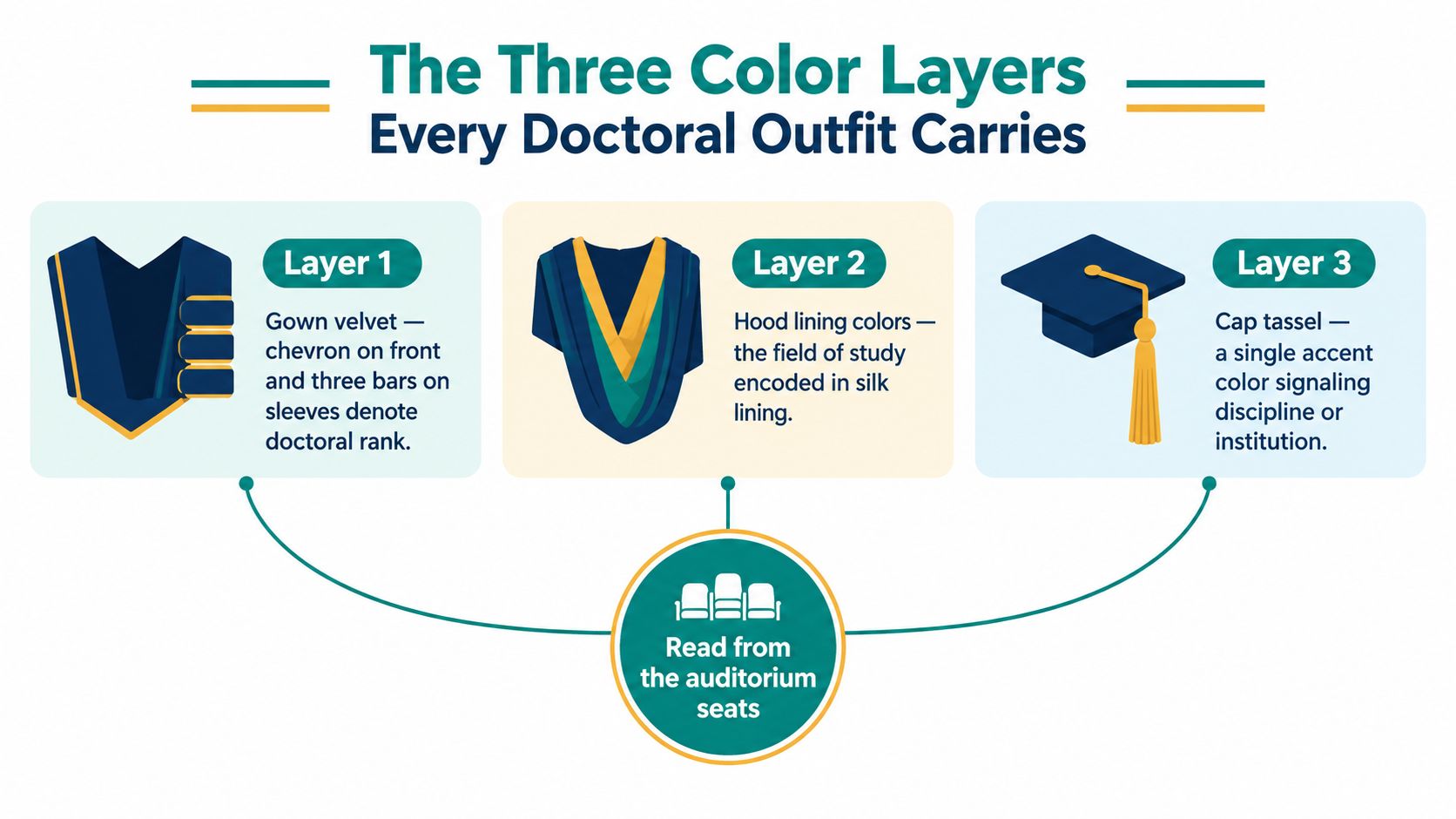
The confusion comes from the fact that doctoral dress is built in layers. From the auditorium seats, the gown reads first, then the hood velvet catches the eye, and only after that does the lining become visible at the throat and back. That means a single glance can never tell the full story.
Practical rule: if you're trying to identify a doctorate from across the room, start with the gown shape, then check the hood velvet, then look for the lining colors.
That order matters because the outfit isn't trying to be artistic. It's trying to be legible. The first thing to learn is that each layer serves a different audience, and each layer answers a different question about the graduate wearing it.
The Three Color Layers Every Doctoral Outfit Carries
What you see from the seats
Start with the part that stands out first. The gown velvet sits on the front facing and shows the doctoral rank through its black velvet and three velvet sleeve bars (Virginia Tech Graduate School). It is the clearest sign that the wearer has reached the doctoral level, but it does not tell you which field the degree belongs to.
The next layer is the hood velvet, the colored band along the outer edge of the hood. That band carries the degree or discipline signal, and for the PhD it is dark blue. In a crowded ceremony, that color is often the quickest clue that you are looking at a Doctor of Philosophy rather than another doctoral degree.
The third layer is the hood lining. This satin interior shows near the throat and opens across the back, and it identifies the institution that granted the degree (USC Aiken Commencement Regalia History). Two PhDs can wear the same dark-blue hood velvet and still look different because their linings point to different universities.
The tassel and piping sit lower in the visual hierarchy. They can add detail, but they do not carry the same weight as the gown, hood velvet, and lining. If the outfit seems hard to read from the aisle, that is normal. The important parts are layered, and each one answers a different question.
How the layers work together
The gown answers one question: doctoral level. The hood velvet answers another: degree or field code. The lining answers a third: awarding institution. Once you separate those jobs, the outfit stops looking like a confusing collection of colors and starts reading like a system.
That system is why a single photograph can mislead. A hood may look simple from a distance, yet the unfolded lining and the sleeve details tell a fuller story once the graduate is standing in place.
Why the PhD Hood Is Dark Blue No Matter the Field
A first-time doctoral graduate often expects the hood color to match the dissertation topic. PhD regalia does not work that way. The dark-blue hood follows the Intercollegiate Code, where dark blue is the color assigned to the Doctor of Philosophy, the degree title itself. That is why a PhD in biology, literature, or mechanical engineering still wears the same velvet color. The code identifies the doctorate, not the subject under study.
Degree level, not subject matter
The hood works like a label for the degree family. Dark blue signals PhD status, while the field of research appears elsewhere in the regalia system, usually through the lining or school-specific details. For a commencement reader, that distinction matters. A hood can tell you someone earned a research doctorate before you know the subject of the dissertation.
This is the point that causes the most confusion. Many readers expect the hood velvet to mirror the major, but the national code keeps the PhD color constant across disciplines. That consistency is deliberate. It lets the audience read the ceremony quickly, even when the stage includes candidates from different fields.
A quick comparison helps:
| Degree | Hood Velvet Color | Field Signal? |
|---|---|---|
| Doctor of Philosophy | Dark blue | No, it marks the degree type |
| Doctor of Education | Light blue | Yes, it marks a different doctoral field |
| Doctor of Nursing Practice | Apricot | Yes, it marks a different professional doctorate |
A hood with dark-blue velvet and a different lining usually points to a research doctorate rather than a professional doctorate. At mixed commencements, that color is the fastest visual cue in the room, which is why the hood velvet gets so much attention from the audience and so little interpretation from the wearer.
How PhD Regalia Differs From EdD, DNP, and DBA
The easiest way to spot a PhD in a crowded procession is to compare it with the professional doctorates around it. EdD hoods often use light blue, DNP hoods use apricot, and DBA hoods use drab, a brownish tone. Those colors tell you the doctorate is in a different category, even when the gown silhouette looks similar.
The hood edge stays in the same place
The placement of the velvet trim is usually consistent. It sits on the hood edge, so the eye learns to look in the same place even when the color changes. That consistency is what makes the system readable during a long ceremony. The difference is in the hue, not the structure.
The Juris Doctor and MD sit beside this system but don't belong to it in the same way. They're first professional degrees, so they don't follow the PhD velvet convention even though their gowns can look similar from a distance. That's one reason commencement programs often list multiple hood colors side by side. Mixed ceremonies are visual shorthand for several different degree families sharing the same stage.
Common doctorate mix-ups
| Degree | Velvet Color | Typical Field | Common Confusions |
|---|---|---|---|
| PhD | Dark blue | Research fields across disciplines | Often mistaken for philosophy majors only |
| EdD | Light blue | Education | Confused with PhD because both are doctoral |
| DNP | Apricot | Nursing practice | Mistaken for a research doctorate |
| DBA | Drab | Business administration | Often assumed to be the same as a PhD in business |
A hood swap almost never happens midway through a ceremony, because the regalia is assigned before the procession starts. Once the line begins moving, the colors are part of the stage picture, and the staff needs the whole set to stay consistent.
Discipline Color Codes and What the Hood Lining Reveals
The code gets more precise once you separate discipline velvet from hood lining. Discipline velvet names the academic area, while lining colors identify the granting institution. That's why the same PhD candidate can look different at two universities even if the degree title doesn't change.
Two systems, two jobs
Under the Intercollegiate Code, several disciplines have their own standard colors. Dark blue is for philosophy, golden yellow for science, copper for economics, sage green for physical education, russet for forestry, and drab for business. Those colors appear in the velvet trim and, in some gown designs, in the front-facing details as well.
The hood lining works differently. It's the satin or silk interior that folds open and shows the school's official colors. Penn, Virginia Tech, and Stanford each use their own institutional color pairings in that lining, which is why two doctoral hoods can share a field color and still look distinct (Penn Commencement Regalia Information). That's also why a generic color chart can be misleading if it ignores the institution.
Practical rule: use the trim to read the field, and use the lining to read the university.
Common discipline color codes under the Intercollegiate Code
| Discipline | Trim Color | Field Examples | Where It Appears |
|---|---|---|---|
| Philosophy | Dark blue | PhD fields that follow the doctoral standard | Hood velvet |
| Science | Golden yellow | Biology, chemistry, physics | Hood velvet |
| Economics | Copper | Economics and related fields | Hood velvet |
| Physical education | Sage green | Kinesiology, movement studies | Hood velvet |
| Forestry | Russet | Forestry and natural resource study | Hood velvet |
| Business | Drab | Business administration, accountancy | Hood velvet |
The important detail is that a PhD in biology and a PhD in public policy can still use the same dark-blue velvet because the PhD designation sits above the specific subject. The lining then tells you where that doctorate came from, which is why the hood is really a two-part identity badge.
Where Universities Bend the National Code
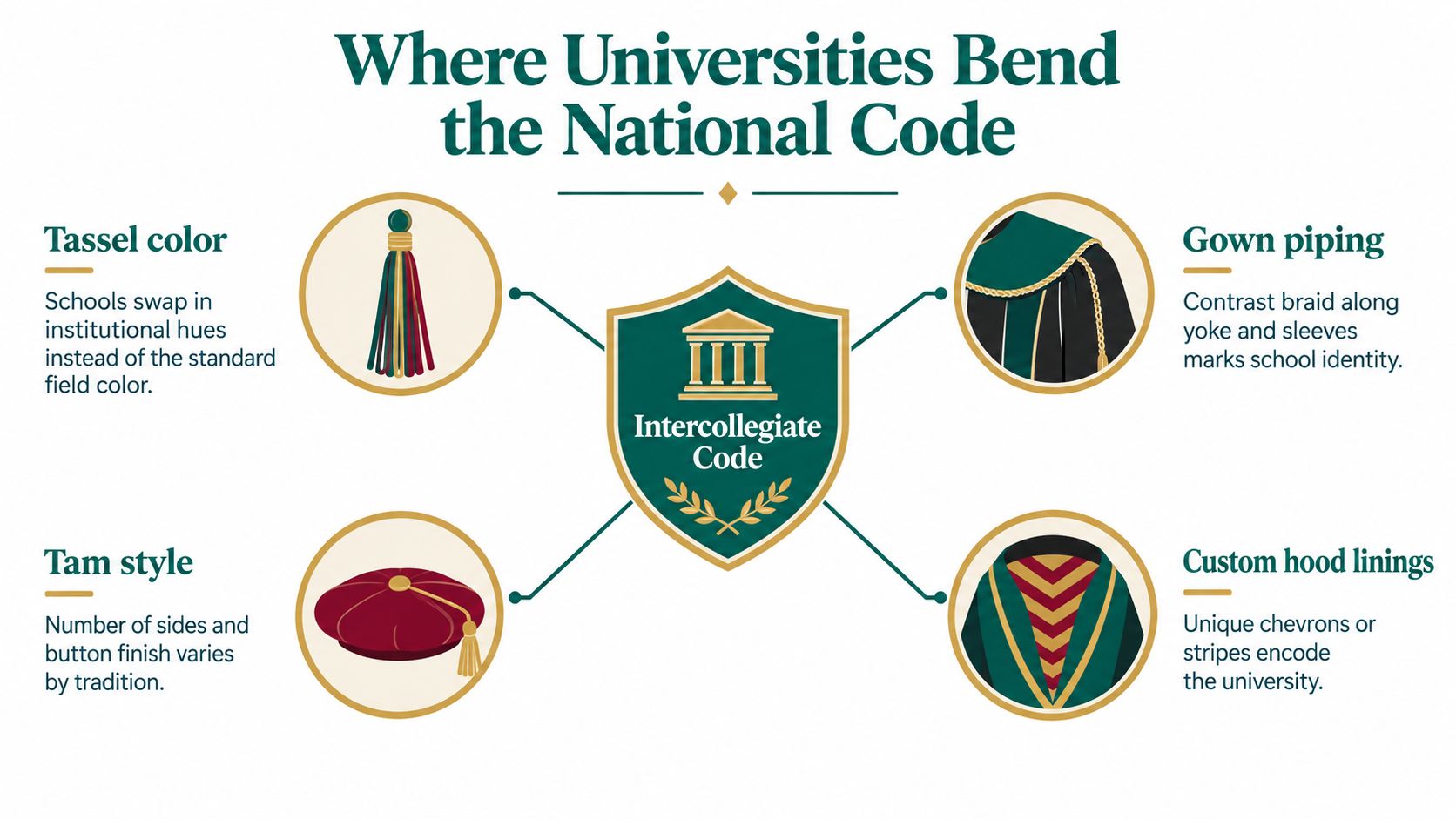
Universities adapt the national code in a few predictable places, and they usually do it without changing the core PhD rule. Tassels, piping, tam style, and custom hood linings are the common pressure valves. They let a school emphasize identity while keeping the degree readable.
What schools customize most often
Tassels are the most flexible piece. Some institutions use a gold tassel, some use an institutional color, and some reserve special tassels for honors or internal distinctions. Tam style can also vary, with different numbers of sides or different button finishes depending on the school's tradition. Gown piping, when used, adds a thin contrast line that signals institutional identity without overwhelming the overall design.
The hood lining is the most subtle place for customization. A university can keep the dark-blue PhD velvet and still make the lining unmistakably theirs through a unique interior color combination. That's why the regalia can be technically standard and still feel specific to one campus.
If you're ordering for a university, the safest source is the school's own color sheet, not a generic chart. A school-specific guide may also help you match the hood shape, lining, and trim in one pass, and a resource like doctoral regalia by university shows how institution-level details change the final set.
Customization points to check
- Tassel color: institutional hue or standard doctoral accent
- Gown piping: thin contrast line that can echo school colors
- Tam style: side count and finish vary by tradition
- Hood lining: school colors tucked inside the hood
The result is a layered system, not a contradiction. The national code gives you the structure, and the university fills in the details that make the outfit feel like a specific academic home.
Common Misconceptions and a Final Verification Checklist
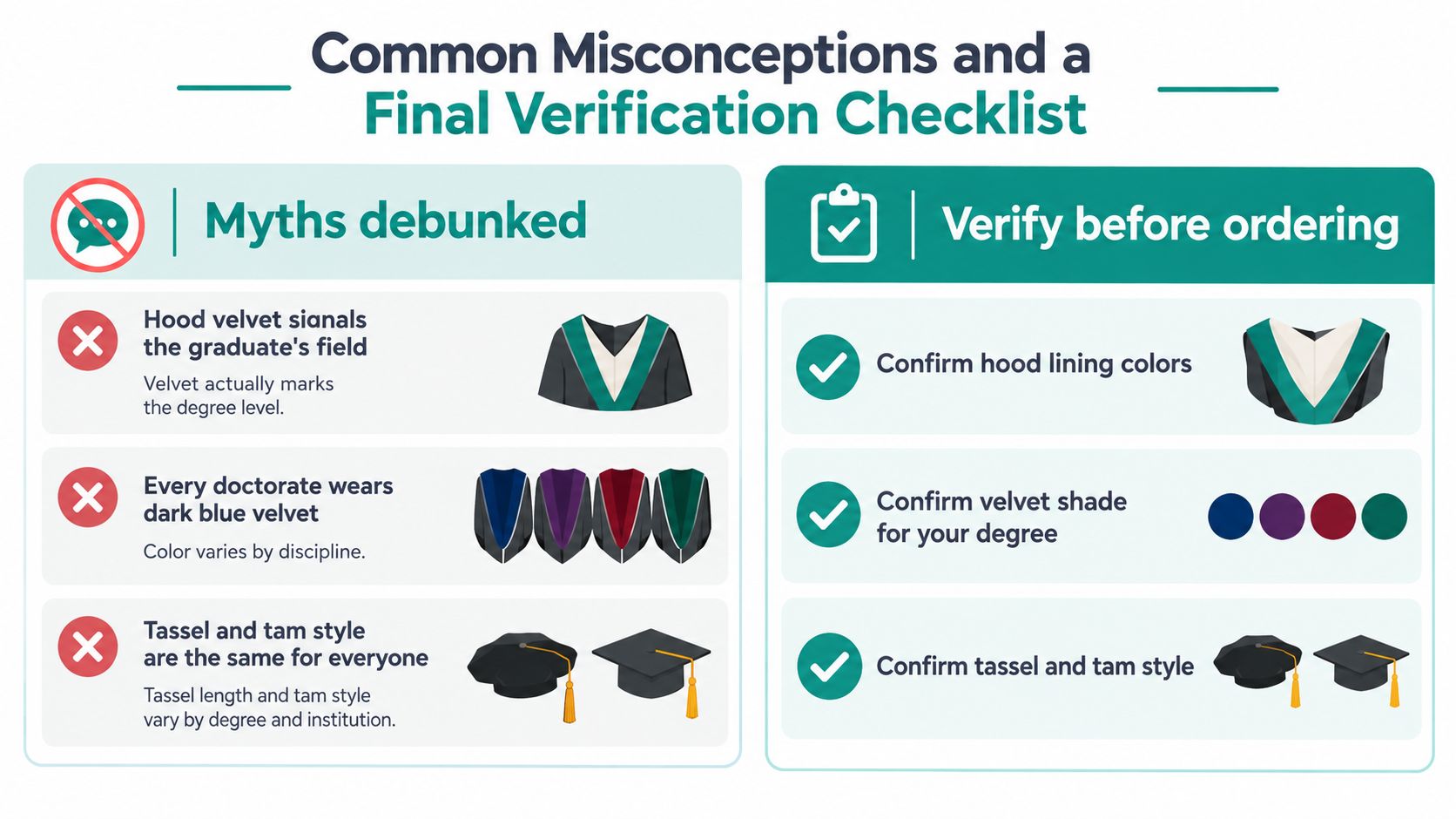
The biggest myth is that hood velvet always tells you the graduate's field. It doesn't. For PhDs, the velvet marks the degree type, while the lining and other institutional details do the rest of the work. Another common mistake is assuming every doctorate wears the same dark blue, which isn't true once you move into education, nursing, business, or public health.
What people usually get wrong
A third mistake is using random photos to identify the correct set. Online images can be helpful for orientation, but they're unreliable if you're trying to order regalia for a specific school. Institutional custom matters, and one campus can differ from another even when the degree title is identical.
That's why I always push graduates to verify each layer before they order. If the hood looks off, the tassel doesn't match, or the lining feels wrong, the problem is usually a mismatch between the school's specification and a generic vendor chart. When that happens, campus stores and registrar offices usually know the official setup better than a search result does.
A practical sizing and material reference such as size, color, and fabric guide can help you check the physical details before you buy, especially if you're comparing a standard PhD set against a school-specific version.
Final verification checklist
- Confirm the degree type: make sure the order is listed as PhD, EdD, DNP, or another exact degree.
- Confirm the hood velvet: check the doctoral color against the degree, not the major.
- Confirm the hood lining: match the lining to the university's official colors.
- Confirm the gown velvet: look for the doctoral gown's black velvet facing and sleeve bars if it's a PhD set.
- Confirm tassel and tam style: verify the accent color and headwear shape before checkout.
- Cross-reference the school guide: use the registrar, bookstore, or commencement office if anything looks inconsistent.
If any layer looks wrong, call the campus bookstore before ordering. Vendors update inventory, and a five-minute check can save a lot of ceremony-day stress.
If you need doctoral regalia that matches a university's official colors and degree specifications, Grad Store offers school-specific sets, hoods, tams, and accessories for commencement orders. Visit Grad Store to compare options and verify the details before you place your order.