

You've got the email open, the ceremony date on your calendar, and one nagging question left, which Yale gown, hood, and cap are correct for your degree? That's where Yale regalia gets tricky. Yale doesn't treat academic dress as generic commencement clothing, it uses a precise system that tells people your degree level, your field, and your connection to the university.
Table of Contents
- Why Yale Regalia Comes with Extra Rules
- The Three Degree Tiers at a Glance
- Decoding the Yale Color Code
- Bachelor's vs Master's vs Doctoral Regalia
- Sizing, Tams, and Validating Fabric Before You Order
- Ordering Timelines and Stock vs Custom Choices
- Group Orders and Bulk Pricing for Yale Cohorts
- Commencement Day Questions Answered
Why Yale Regalia Comes with Extra Rules
Maya, a PhD candidate, thought she'd done everything right. She ordered a doctoral gown online, opened the box, and immediately noticed something off, the sleeves didn't carry the Yale-approved velvet layout she expected. That kind of mistake matters at Yale, because the university's regalia system is built to be read, not just worn.
Yale follows the broader Intercollegiate Code tradition that helped standardize American academic dress in the late 19th century, but it also adds its own institutional rules and color map. The result is a system that distinguishes not just bachelor's, master's, and doctoral wear, but also the specific school or discipline behind the degree, with Yale blue used as an institutional thread throughout as described in Yale's commencement regalia guidance and in Yale's regalia regulations from the university's governance rules.
If one detail is off, the regalia stops reading as Yale-specific and starts looking generic.
That's why the Yale Bookstore works from a printed specification sheet each spring. Rehearsal staff can flag a mismatch quickly, especially when sleeve velvet, hood color, or gown color doesn't match the degree being conferred. For a graduate, that can mean being pulled aside on the morning of commencement, which is exactly the kind of stress nobody wants while lining up for photos and procession.
The point of all these rules is simple. Yale regalia has to communicate three things at once, the degree earned, the field studied, and the institution granting it. When those signals line up, the gown, hood, and cap work together cleanly. When they don't, the mismatch shows immediately.
The Three Degree Tiers at a Glance
Yale's system starts with a basic question, what degree level are you wearing? Once you know that, the rest of the outfit becomes much easier to decode. The three tiers are bachelor's, master's, and doctoral, and each one has a different visual weight.
A bachelor's gown is the simplest. It's untrimmed black, with open pointed sleeves and no velvet facing. The hood is the main place where the field color appears, so bachelor's wearers usually focus on getting that hood right rather than looking for dramatic gown details.
A master's set adds more structure. Yale allows an untrimmed black or blue gown with oblong sleeves, and the hood gets a wider border than the bachelor's version. This is the tier where many people start confusing “plain” with “incorrect,” but at Yale, plain can still be completely official if the degree level calls for it.
Doctoral regalia is the most detailed. Yale specifies black or blue gowns with velvet facing, bell sleeves, and three velvet bars on each sleeve. The hood border is also broader at this level, which makes the doctoral outfit the easiest to spot from a distance.
Practical rule: If you can identify the sleeve shape, you can usually identify the degree tier before you even check the hood.
| Feature | Bachelor's | Master's | Doctoral |
|---|---|---|---|
| Gown color | Black | Black or Yale blue | Black or Yale blue |
| Sleeve style | Open pointed sleeves | Oblong sleeves | Bell sleeves |
| Velvet facing | None | None | Yes |
| Velvet bars on sleeves | None | None | Three |
| Hood border width | Two inches | Three inches | Five inches |
| Visual impression | Clean and simple | Fuller than bachelor's | Most formal and layered |
For sizing, this tier breakdown matters because the visual structure changes with the level. A bachelor's wearer should expect a lighter, less layered silhouette. A doctoral graduate should expect a heavier-looking front panel and more sleeve structure, which makes fit and shoulder room especially important when ordering.
Decoding the Yale Color Code
A Yale hood does two jobs at once. It shows the university's identity, and it shows the field of study. That is why the color system can feel intricate at first, especially if you are ordering for a cohort and trying to match everyone correctly.
The first layer is Yale itself. The hood lining is officially black lined with Yale blue, and Yale regulates that blue closely under the university's regalia rules. If a blue gown or hood is used, it has to be approved by the Secretary of the University under the university's regalia rules. A shade that seems close on a screen can still look off in person, which is why online color names are not enough.
The second layer is the discipline color. That is the stripe or border that tells viewers what field the degree belongs to. The lining identifies Yale, while the border and velvet identify the subject area. If those two parts are mixed up, the set may look polished but still miss Yale's official pattern.
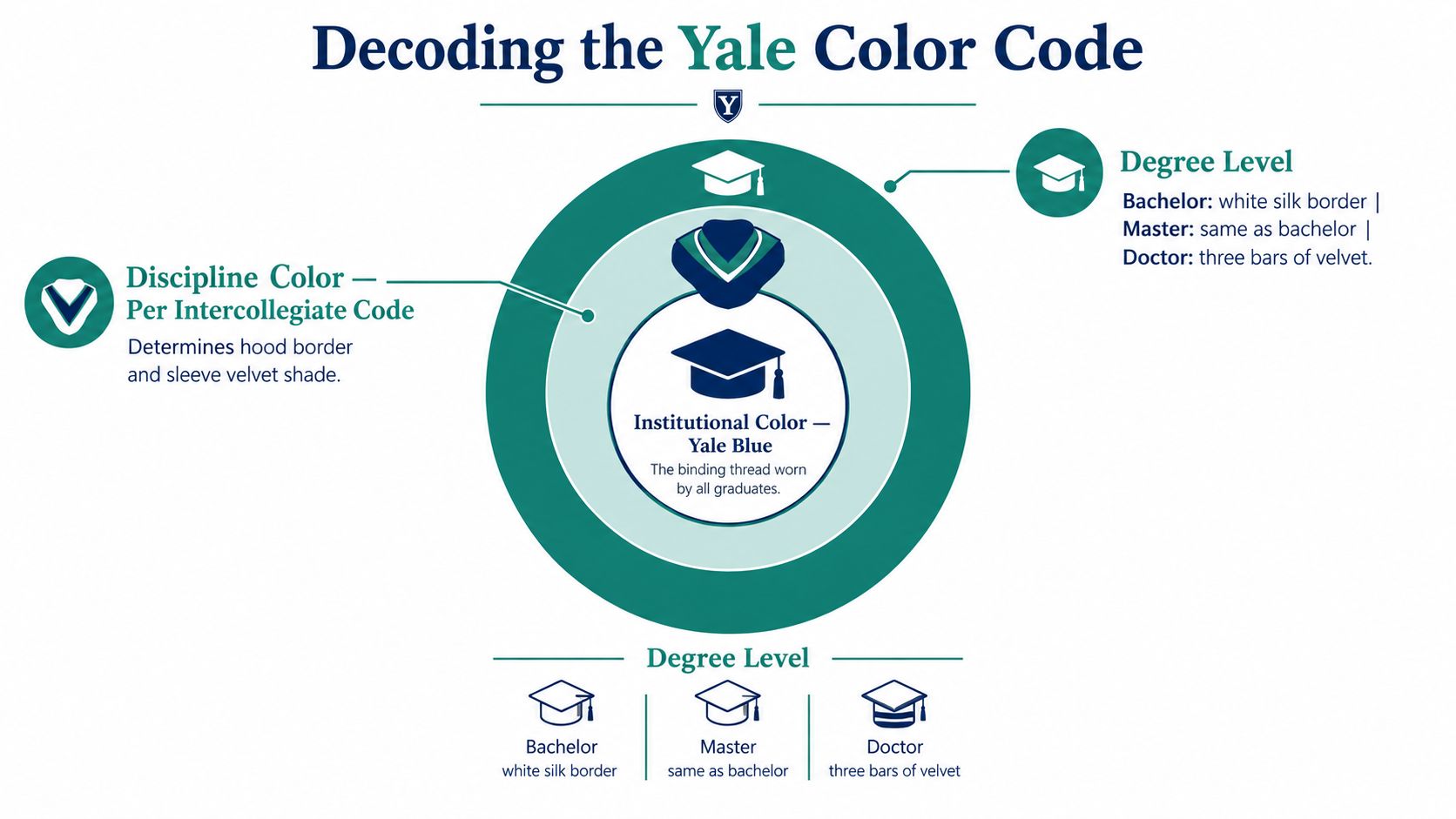
The field colors matter because they are not interchangeable. Yale's current regulations name white for liberal arts, gold-yellow for science, dark blue for philosophy, orange for engineering, green for medicine, and purple for law in the university's official specifications. Yale's commencement regalia page also maps white to Liberal Arts, gold-yellow to Science, scarlet to Divinity, purple to Law, green to Medicine, and orange to Engineering in its hood mapping. For ordering, the safest approach is to match the exact degree title, not a general school label.
Buying check: Confirm the exact degree title before you order, then match the hood color to that title rather than guessing from the department name.
The Yale blue layer can override broad assumptions, especially for interdisciplinary or philosophy degrees where the color logic is less obvious. If a program uses a special color rule, that rule should take priority over a generic match. Yale-specific ordering guides matter because they keep the institutional blue, the discipline color, and the degree level aligned.
Bachelor's vs Master's vs Doctoral Regalia
The easiest way to avoid a mistake is to compare the three tiers side by side. Once you see the differences at a glance, the right choice usually becomes obvious. Yale's rules are exact, but they're not complicated once the visual markers are separated.
The bachelor's set is the cleanest version. The gown is black and untrimmed, the sleeves are pointed, and the hood uses Yale's narrowest border. This is the look immediately recognizable as standard undergraduate academic dress.
The master's set feels a little fuller. Yale permits a black or blue gown with oblong sleeves, and the hood border widens from the bachelor's version. That added width is part of what makes master's regalia look more formal without jumping all the way into doctoral structure.
Doctoral regalia is in a class of its own. The gown has velvet facing, the sleeves are bell-shaped with three velvet bars, and the hood uses Yale's widest border. For readers comparing doctoral styles across institutions, the doctoral regalia overview by university can be a useful way to see how Yale's version fits into the broader pattern.
| Component | Bachelor's | Master's | Doctoral |
|---|---|---|---|
| Gown body | Black | Black or Yale blue | Black or Yale blue |
| Gown trim | None | None | Velvet facing |
| Sleeve shape | Pointed | Oblong | Bell |
| Sleeve velvet bars | None | None | Three |
| Hood border | Two inches | Three inches | Five |
| Overall look | Minimal | Mid-level formality | Most formal |
A quick self-check helps here. If your degree is undergraduate, you should not be looking for velvet bars or velvet facing. If your degree is a master's, you should expect a more structured hood but still not the doctoral sleeve treatment. If your degree is doctoral, the velvet details are part of the required visual language, not optional decoration.
Sizing, Tams, and Validating Fabric Before You Order
Yale regalia should be sized the way formal clothing is worn, over real clothing, not on paper. That means you should measure yourself in lightweight clothes and think about the extra layer you'll wear underneath on commencement day. A gown that fits perfectly over a T-shirt can feel tight over a shirt, dress, or suit jacket.
The headwear decision matters too. Bachelor's and master's candidates usually wear the traditional mortarboard, while doctoral candidates choose a tam in the style their provider offers. The choice isn't about fashion first, it's about matching the degree level Yale expects.
The most practical way to validate fabric is to ask for a swatch before you commit. Yale blue has to read as the correct deep tone, not just a nearby navy, and fabric sheen can change the whole look under outdoor light. A swatch lets you check color, weight, and finish before the order is final.
Compare the swatch in natural daylight, not just on a phone screen. Phones flatten color, and Yale blue can look noticeably different once the material is draped.
A simple ordering routine helps:
- Measure early. Use height and chest as your baseline, then account for what you'll wear underneath.
- Choose the headwear by degree level. Mortarboard for bachelor's and master's, tam for doctoral.
- Request the fabric swatch. Hold it beside the color reference the vendor provides.
- Check the finish. A good Yale match should look deliberate, not overly shiny or dull.
- Confirm the hood color. The hood is where many mistakes show first, especially for disciplines with close-looking shades.
For a practical size-and-material checklist, the size, color, and fabric guide is worth reviewing before you place an order. That kind of pre-check is especially useful if you're deciding between keeping regalia for future use or wearing it once and passing it along later.
Ordering Timelines and Stock vs Custom Choices
A graduate who waits until the last minute usually discovers the same problem, the gown is available, but the hood, fabric, or size needs extra time. Yale-approved vendors open ordering well before commencement, and that lead time matters because stock and custom regalia move on different schedules. Order as soon as your degree details are confirmed.
Stock sets are the faster path. They suit graduates whose size and Yale's required color and style details fall within the standard range, which is why they work for many bachelor's and master's orders, and for doctoral orders that do not require special adjustments. Custom orders take longer because they are built for cases where the fit or specification falls outside the standard chart, or where a group wants matching details for photographs or school presentation.
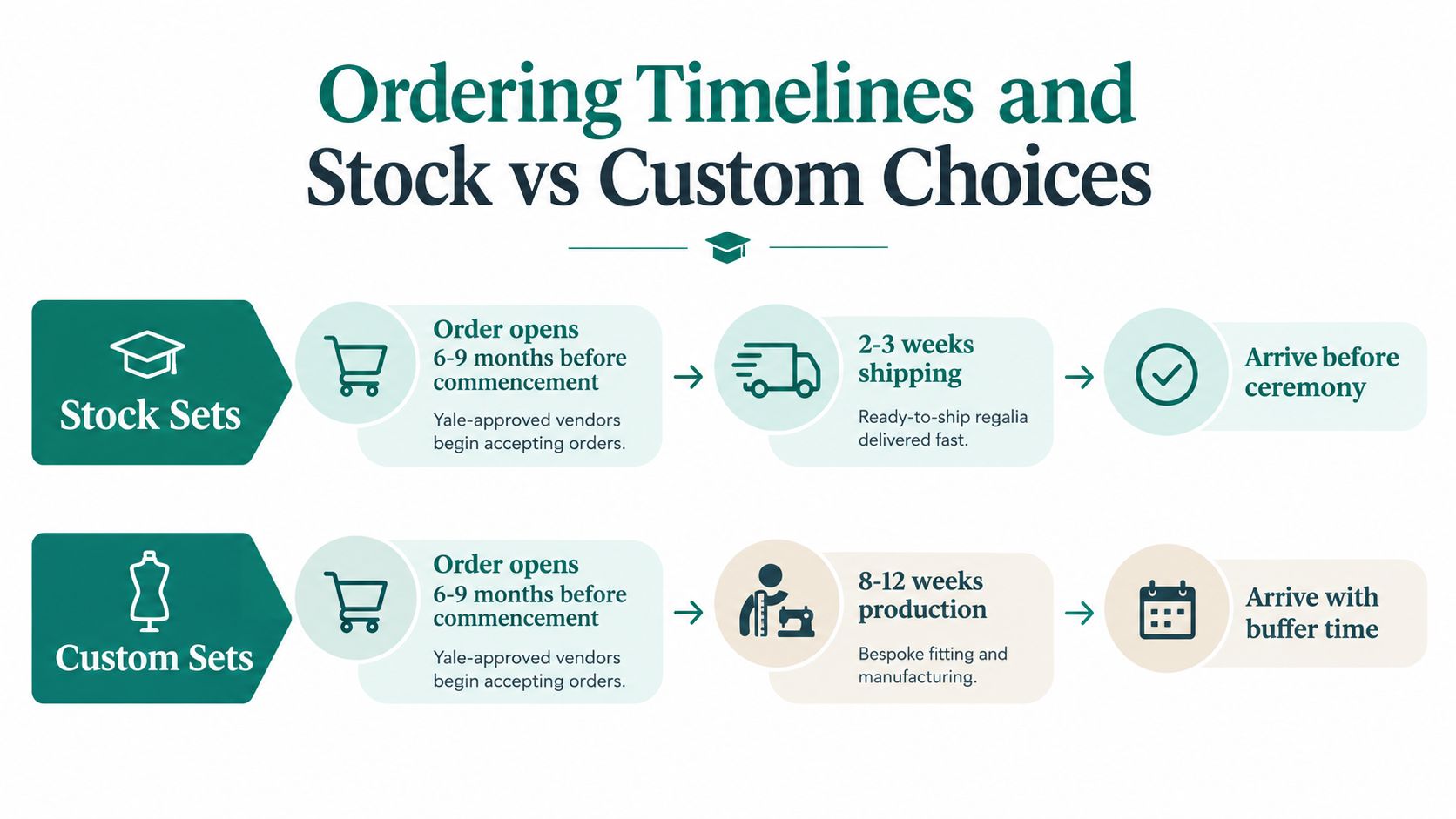
Early planning keeps both spring and winter ceremonies calmer. The calendar changes, but the buying logic does not. Leave room for a sizing correction, because a small delay can turn into a missed deadline if the order is already tight.
Ordering rule: If the regalia must arrive by a fixed date, do not treat a custom option as a casual upgrade. Use it only when the standard set cannot meet Yale's specification.
The rental versus purchase decision follows the same practical logic. Yale's Graduate School notes that portal-ordered caps and gowns are made of GreenWeaver material and are intended for only one or two uses, while Yale's commencement FAQs also explain that some regalia can be rented and that gowns bought through the Yale Hub are kept rather than returned in Yale's commencement FAQs. For buyers, that means the right choice depends on whether the set is for one ceremony, repeated use, or long-term wear for faculty or doctoral purposes.
Group Orders and Bulk Pricing for Yale Cohorts
Departments and cohorts save time when one person manages the whole order. A single point of contact keeps degree levels, colors, and shipping details from getting scrambled, which is especially important when a school includes bachelor's, master's, and doctoral graduates in the same procession. Group ordering also helps everyone receive a set that matches the same Yale standard.
The cleanest workflow starts with a roster. An administrator collects names, degree levels, and size details, then confirms who needs a hood, who needs a gown only, and who needs the full set. Once that information is organized, the order can be checked as a group instead of one graduate at a time.
Because Yale regalia is so specific, group orders are about more than convenience. They also reduce the chance that one person shows up in the wrong shade of hood or an off-spec sleeve cut. That matters when a school wants the stage photos, procession, and hooding moment to look cohesive.
| Order Size | Eligible Items | Typical Savings |
|---|---|---|
| Small cohort order | Caps, gowns, hoods | Modest per-unit reduction |
| Medium cohort order | Full sets and selected accessories | Better pricing consistency |
| Large department order | Full cohort regalia with matching pieces | Strongest coordination benefit |
For departments, the practical steps are straightforward. Confirm the degree list first, then collect sizes, then lock the ship-to address, then set the delivery window with enough room for distribution. If matching tams are needed for doctoral groups or faculty, that detail should be added before the final invoice goes out.
The reason bulk orders work so well is simple. They keep the Yale specification intact while reducing the admin burden on the people who have to coordinate it.
Commencement Day Questions Answered
The last two weeks before commencement are when small issues feel huge. A gown arrives, the hood seems off, or a graduate realizes the fit isn't quite right once everything is tried on together. The good news is that most of these problems are fixable if you catch them early.
If something is wrong, use the provider's support line immediately and document what's off, fit, color, or damage. Yale's regalia guidance expects the proper visual standard to be met, so don't wait until the morning of the ceremony to ask for help. If you ordered through a rental workflow, confirm pickup details early so you're not searching for the right office while family is already seated.
For last-minute how-to questions, the how-to-wear-graduation-regalia guide is a useful reference for placement and wear. It's especially helpful if you haven't worn academic dress before and want a quick visual check before the procession.
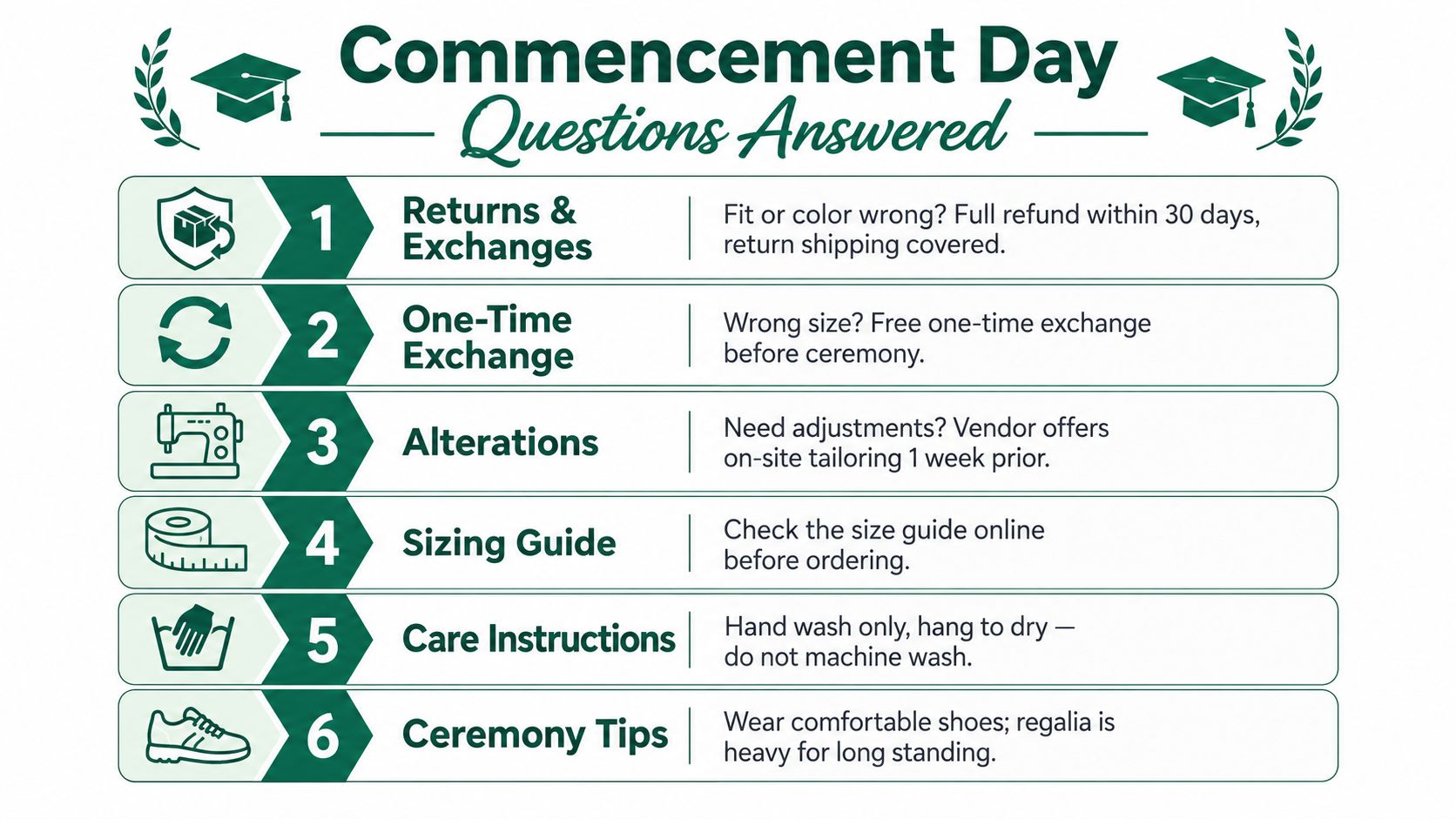
A few day-of details make the whole experience smoother:
- Wear comfortable shoes. You'll be standing and walking more than you think.
- Keep the hood positioned correctly. It should sit cleanly until the hooding moment, then settle back into place.
- Leave the tam level. A crooked fit draws attention fast in photos.
- Store the gown carefully. Hang it so the fabric stays smooth between events.
Most problems don't need a dramatic fix, they need a quick one. If you contact support early, many issues can be handled within a day or two, which is usually enough to keep your schedule intact.
If you want Yale-compliant caps, gowns, hoods, and tams without having to decode every sleeve and hood rule yourself, Grad Store carries institution-specific regalia and support for sizing, color checks, and group coordination. Visit Grad Store to review Yale-focused options, compare sets, and place an order that fits your ceremony timeline.