

You're probably at the point where the ceremony feels real, the email inbox has gone quiet, and the only thing left is the outfit. That's when NYU regalia stops being a vague graduation detail and becomes a real procurement problem, one with the wrong size, the wrong hood, or the wrong level of formality waiting to trip you up at the worst possible time.
NYU's own tradition makes the choice feel weighty for a reason. The university says its first graduation exercises were held in 1833, when three students received degrees, and that by 1920 all divisions were included in the same ceremony. NYU's 2026 program also describes the coming 193rd All-University Commencement on May 14, 2026, which shows how thoroughly this ritual is embedded in the institution's identity. The result is simple enough to say and easy to mess up in practice, your regalia has to match both the ceremony rule and the actual item you order. NYU's commencement history is the place to start if you want the institutional context behind the dress code.
Table of Contents
- Starting Your NYU Regalia Journey
- Decoding the Official Academic Attire
- Securing Your Regalia Set
- Navigating Logistics and Deadlines
- Optimizing Group and Department Orders
- Addressing Common Scenarios and Questions
Starting Your NYU Regalia Journey
The order should begin with the ceremony, not the vendor's size chart. A graduate can follow NYU's dress expectations and still receive an unusable set by selecting the wrong degree level, hood, or event option. NYU regalia becomes a procurement task as soon as ceremony details, academic status, and delivery timing have to line up.
NYU's long ceremony history helps explain why attire carries formal weight. It is part of the institution's ceremony structure, and the university connects appropriate dress with entry and participation. You are ordering clothing that must satisfy a specific event requirement, not just assembling an outfit for photographs. NYU's regalia history page provides the institutional context, while NYU academic attire guidance defines the practical requirement.
Start with the event, not the shopping cart
First, identify the ceremony or ceremonies you will attend. A student going only to the All-University Commencement may need a different order from a student attending a school ceremony, hooding, or more than one formal event. A Gallatin dual-degree student, for example, should confirm which hood applies at each ceremony before placing an order. The required attire can vary with degree level and participation context, so record those details before selecting a package.
Practical rule: buy for the ceremony you are actually entering, not a later event you may attend.
Check degree status, ceremony attendance, and any honors or special regalia before submitting payment. Then verify that the vendor's package lists the correct hood, gown, headwear, and size. If a school changes your ceremony assignment or degree details late, contact the supplier before production or shipment rather than assuming the original order can be adjusted. That early check reduces exchanges, rush fees, and an incomplete set on ceremony day.

Decoding the Official Academic Attire
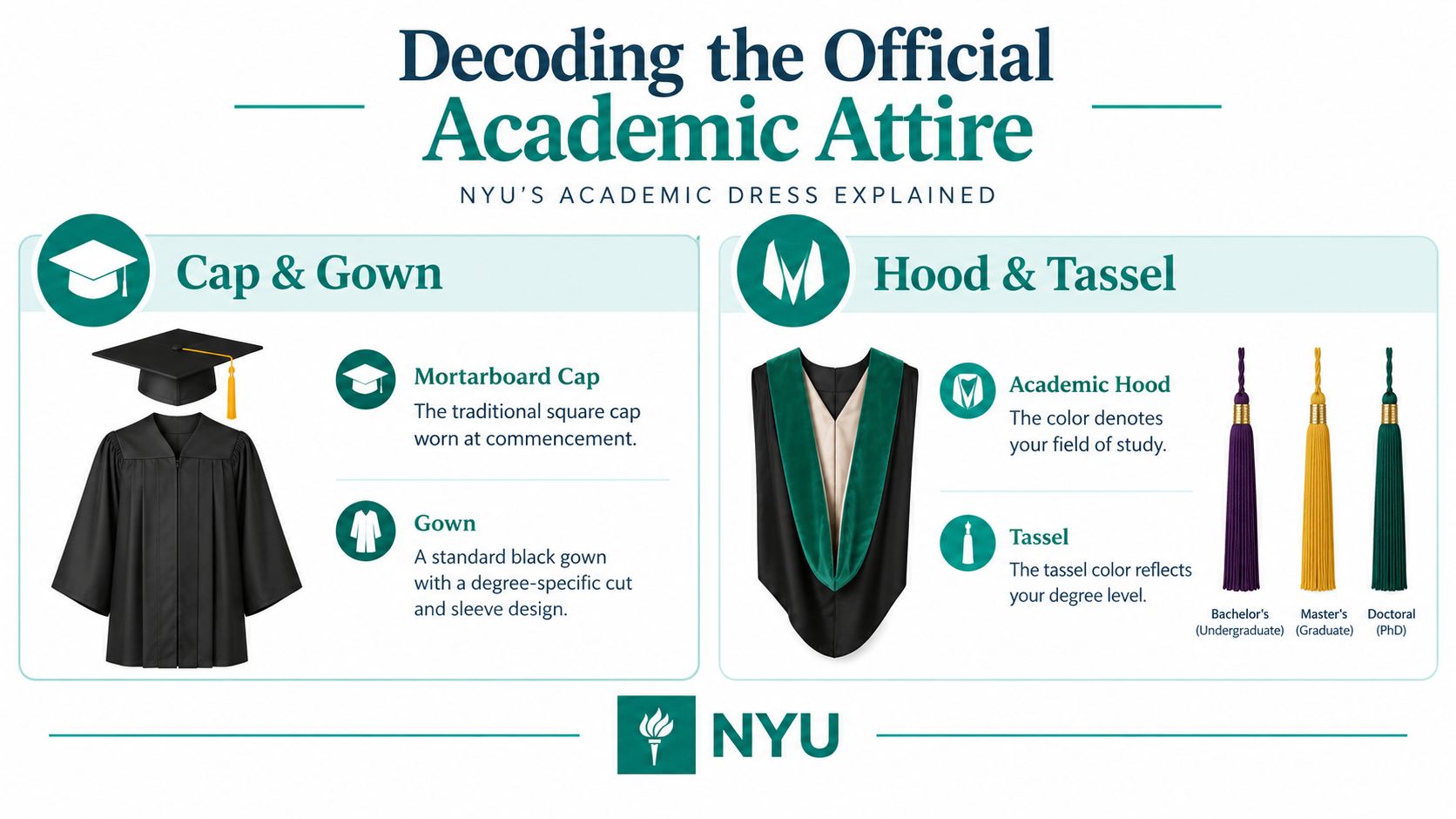
A regalia order can look correct in a product photo and still be wrong for an NYU ceremony. Degree level determines the cap, tassel, and gown details, so procurement should begin with the official attire requirements rather than a generic black graduation package. Bachelor's and master's recipients wear a square mortarboard with an NYU violet tassel. Doctoral graduates wear a black velvet octagonal tam with a gold tassel, along with a doctoral gown featuring broad velvet front panels and three velvet bars on the full open sleeves. NYU's accessible commencement program sets out these distinctions clearly.
The difference affects the supply chain. A bachelor's or master's set contains fewer specialized pieces, while a doctoral order requires the hood, tam, and gown to match the degree and fit together properly. Vendors may list several black gowns that appear similar, but a standard gown cannot substitute for doctoral construction. Confirm the complete set before production begins, especially if the order is being placed for another graduate.
Read the degree level from the headwear
Use the headwear as a fast receiving check. Before accepting or distributing an order, confirm:
- Mortarboard and violet tassel for bachelor's and master's graduates.
- Octagonal tam and gold tassel for doctoral graduates.
- Velvet panels and sleeve bars only on doctoral gowns.
This checklist catches packing errors that a quick review of the gown alone can miss. It also helps departments sort shared or group orders without relying on names that may be abbreviated or listed differently by the supplier. NYU's academic attire page is useful here because it connects each item to the relevant degree level.
Headwear can also expose a late-stage change. If a graduate moves from a master's ceremony to a doctoral ceremony, or a dual-degree student receives different instructions for separate events, the original cap and tassel may no longer be suitable. Ask the ceremony coordinator to confirm the required set, then contact the vendor before a replacement is cut or shipped.
Use the gown construction as a second check
The doctoral gown is a distinct garment, not just a more decorated version of the bachelor's or master's gown. Velvet panels and sleeve bars affect the gown's appearance and how it folds, hangs, and moves during the ceremony. Check those features alongside the hood and headwear, rather than inspecting each item in isolation.
For broader context on how doctoral colors relate to academic level and discipline, this doctoral regalia color guide provides a useful reference. Grad Store's product descriptions should still be checked against NYU's requirements, since a color guide does not confirm the exact ceremony package.
Securing Your Regalia Set
The cleanest purchase path starts with verification, not speed. If you know the degree level, you can match the required set, then confirm fabric, size, and accessories before checking out. That sounds basic, but in practice it's where most mistakes get caught or missed.
A good ordering workflow is simple. First, match the item to NYU's requirements. Second, check the size guide before you buy. Third, compare the material and color against a sample if the seller offers one. Fourth, make sure the return or exchange path is clear in case the fit is off. Grad Store's published support materials include a size, color, and fabric guide at its guide page, which is the kind of resource that helps prevent a bad order from becoming a ceremony-day problem.
Fit matters more than most students expect
A gown that technically fits but hangs awkwardly is still a problem. You'll be standing, walking, and sitting through a long program, so the shoulders, sleeves, and length all need to work together. The same is true for the hood and tam, especially in doctoral orders where the set has more parts to balance.
A regalia order should feel boring after it arrives. If you're still wondering whether it's the right shape, shade, or size, it's not done yet.
That's why fit verification belongs before purchase. A size guide tells you how the garment is supposed to sit, but a real-world check protects you from the common gap between chart and body. If you're responsible for a cohort, the best move is to standardize the measuring process before anyone clicks buy.
Material checks prevent avoidable disappointment
Color and fabric are not abstract details. They affect how polished the gown looks under stadium lights and how closely it tracks NYU's official look. A swatch is useful because it lets you verify texture and shade instead of trusting a screen image, which can vary a lot by device.
If your supplier offers samples, use them. If they don't, be extra careful with product photos and written specifications. One clear decision now is worth more than trying to fix a wrong shade or loose fit on the morning of commencement.
Navigating Logistics and Deadlines
Procurement gets harder when the calendar starts shrinking. Graduation planning pushes shipping, returns, and exchanges into a narrow window, which means the actual job isn't just ordering regalia, it's controlling the number of things that can go wrong after the order leaves the cart.
The best logistics plan assumes something might change. A student may update their program, switch ceremonies, or realize too late that a required piece is missing. That's why tracking, shipping method selection, and exchange rules matter as much as the garment itself. Fast fulfillment and overnight options can be the difference between a usable set and a missed deadline, especially when a student is buying late or replacing an incorrect item. Grad Store also supports this kind of timing pressure through its shipping and support structure, including fast delivery, tracking, and customer support.
Make the deadline part of the purchase decision
A regalia order should be placed with the ceremony date in mind, not just the product description. If you're buying close to the event, the clock becomes part of the product specification. The question shifts from “Do I like this set?” to “Can this set arrive, be checked, and still leave time for a return if needed?”
That timing pressure changes how you shop. A student with plenty of time can ask for a sample, compare options, and wait for a preferred size. A late buyer needs to focus on stock, speed, and certainty. In that case, fewer choices are often better because every extra option adds delay.
Keep the return path visible before you buy
Returns and exchanges are not an afterthought in commencement season. They're part of the risk management plan. If the gown is wrong, the hood doesn't match, or the headwear arrives damaged, the only useful return policy is the one you already understand.
The operational mistake is assuming the first delivery is automatically final. It isn't. Open the shipment immediately, confirm the degree level, and inspect every component against the order as soon as it arrives. That's the kind of check that saves a student from discovering the problem on the morning of the ceremony.
Optimizing Group and Department Orders
Individual orders are manageable when you're shopping for one graduate. They're inefficient when you're handling a department, a lab, or a full cohort. In a group setting, the best question isn't which single item is easiest to buy, it's which ordering path gives you the fewest errors across the whole set.
Bulk coordination helps because it creates one point of truth. Instead of students ordering from memory, a coordinator can confirm the required degree level, collect sizes, and line everyone up against the same standard. That reduces duplicate work and makes it easier to spot outliers before they become missing items on the ceremony floor.
Compare the two ordering models
Individual purchasing gives each graduate flexibility. They can order at their own pace, handle their own payment, and manage their own shipping address. That works well when the group is small and the ceremony requirements are stable.
Group ordering is better when consistency matters more than autonomy. Coordinators can consolidate the process, check the list once, and reduce the chance that one person orders the wrong headwear or forgets a required piece. Grad Store's group order coordination and bulk-discount tools are built for that kind of workflow, and they fit especially well when a department wants all sets to arrive together.
| Ordering path | Best for | Main trade-off |
|---|---|---|
| Individual order | One graduate, one timeline | More room for personal errors |
| Group order | Departments and cohorts | Less flexibility for each student |
The practical choice depends on who is absorbing the risk. If everyone orders separately, every student owns their own mistake. If the department coordinates, one person carries the responsibility for accuracy, but the process is easier to supervise.
Addressing Common Scenarios and Questions
Regalia problems usually appear after an order is placed. A program changes, a dual-degree candidate learns that the ceremonies recognize different credentials, or a student discovers that one set does not cover separate school and university ceremonies. Resolve the event and degree details before choosing replacement pieces. NYU's academic attire page remains the clearest reference for those boundaries.
Start with the ceremony, not the product photograph. Confirm which credential is being recognized, which event the student will attend, and whether the order needs a hood, tam, or other degree-specific item. This prevents a common procurement error: buying a visually complete set that does not match the ceremony requirement.
Treat dual degrees as separate planning problems
A dual-degree student may have different attire requirements for different ceremonies. Confirm the recognized degree with each school, then record the required pieces separately. Do not assume that the higher credential determines every event or that one hood works across both ceremonies.
If the dual-degree status changes after ordering, contact support immediately. Ask whether the hood or tam can be swapped before shipment, confirm the exchange window, and check the overnight-shipping cutoff against the May 14, 2026 ceremony date. Late changes are manageable when the supplier receives the correction before the package leaves the warehouse. After shipment, the same correction may require a return, replacement, and separate delivery.
Keep the order record current. Save the student's degree status, size, ceremony, and requested revision in one place so the coordinator and supplier are working from the same information.
Gold tassels and honors belong in the decision tree
Honors details should be confirmed alongside the main regalia pieces. NYU's guidance distinguishes standard headwear from honor-related items, including the gold tassel. Treat that tassel as an order requirement when applicable, not as a decorative afterthought, and verify it before final approval.
Students who are unsure about dressing order can use this regalia-wearing guide. Put the ceremony rule first, then confirm how each piece is worn, and finish with a visual check before leaving for the venue. That sequence catches missing or misplaced items before they become a parking-lot repair.
If you need help choosing the right NYU regalia set, Grad Store carries institution-specific caps, gowns, hoods, tams, and accessories, with size guidance, group-order support, and shipping options. Visit Grad Store to compare options and place an order that matches the confirmed ceremony requirements.