

Five days before commencement, you open the delivery box and find a black gown, a stiff cap, a velvet-trimmed hood, and a tassel with no obvious place to attach it. The pieces look simple until you try to match them to your degree, your university, and the instructions buried in your commencement email.
A master's cap and gown is far more than a generic black outfit. It's a coded academic uniform. The gown identifies the degree level through its sleeve construction, the hood identifies the field through its trim, and the lining may identify the institution. This guide walks through each piece as a commencement coordinator would, so you can check the details your school requires before you arrive for lineup and photographs.
Table of Contents
- A Graduate's First Look at Master's Regalia
- The Five Core Pieces of a Master's Cap and Gown
- How Hood Colors Decode Your Discipline
- Why the Sleeve Shape Matters More Than the Color
- Getting the Right Fit Before You Order
- Why School-Specific Sets Beat Generic Black Gowns
- Buy, Rent, or Borrow After the Ceremony
- Ordering Checklist for a Stress-Free Commencement
A Graduate's First Look at Master's Regalia
Start by separating the pieces on a clean surface. You should be able to name the gown, cap, hood, tassel, and any optional stole or cord before you try them on. That vocabulary matters because commencement instructions often refer to each item separately, especially when the university issues the gown but asks students to order a hood through an approved supplier.
The gown is the robe itself. The cap is usually a mortarboard, although some universities specify another style for particular ceremonies. The hood is the colored fabric that rests around the neck and falls down the back. The tassel attaches to the cap, while stoles and cords are additional recognition pieces rather than substitutes for required regalia.
Coordinator's rule: Don't judge the set by its overall color. Check the degree level, sleeve shape, hood trim, hood lining, and school instructions independently.
Two questions usually come first. Does the school provide or require its own regalia? And what color should the hood be? The answer to the first question may determine where you order, whether you keep the set, and which return rules apply. The answer to the second depends on both your field of study and the institution conferring the degree.
U.S. commencement traditions also assume that graduates understand these distinctions during the procession, stage crossing, and any hooding ceremony. A hood worn upside down, a tassel placed incorrectly, or a bachelor's gown substituted for a master's gown can be noticeable in group photographs even when the fabric looks similar.
The historical shape of today's U.S. master's gown comes from Oxford-style academic dress. The intercollegiate academic costume code adopted in 1895 established common design conventions across U.S. institutions, and the American Council on Education's 1960 update changed the master's sleeve opening from the elbow to the wrist and allowed the gown to be worn closed. That history explains why the modern master's gown has its distinctive long, closed sleeves. The University of South Carolina's history of regalia provides the background behind this standardization.
The Five Core Pieces of a Master's Cap and Gown
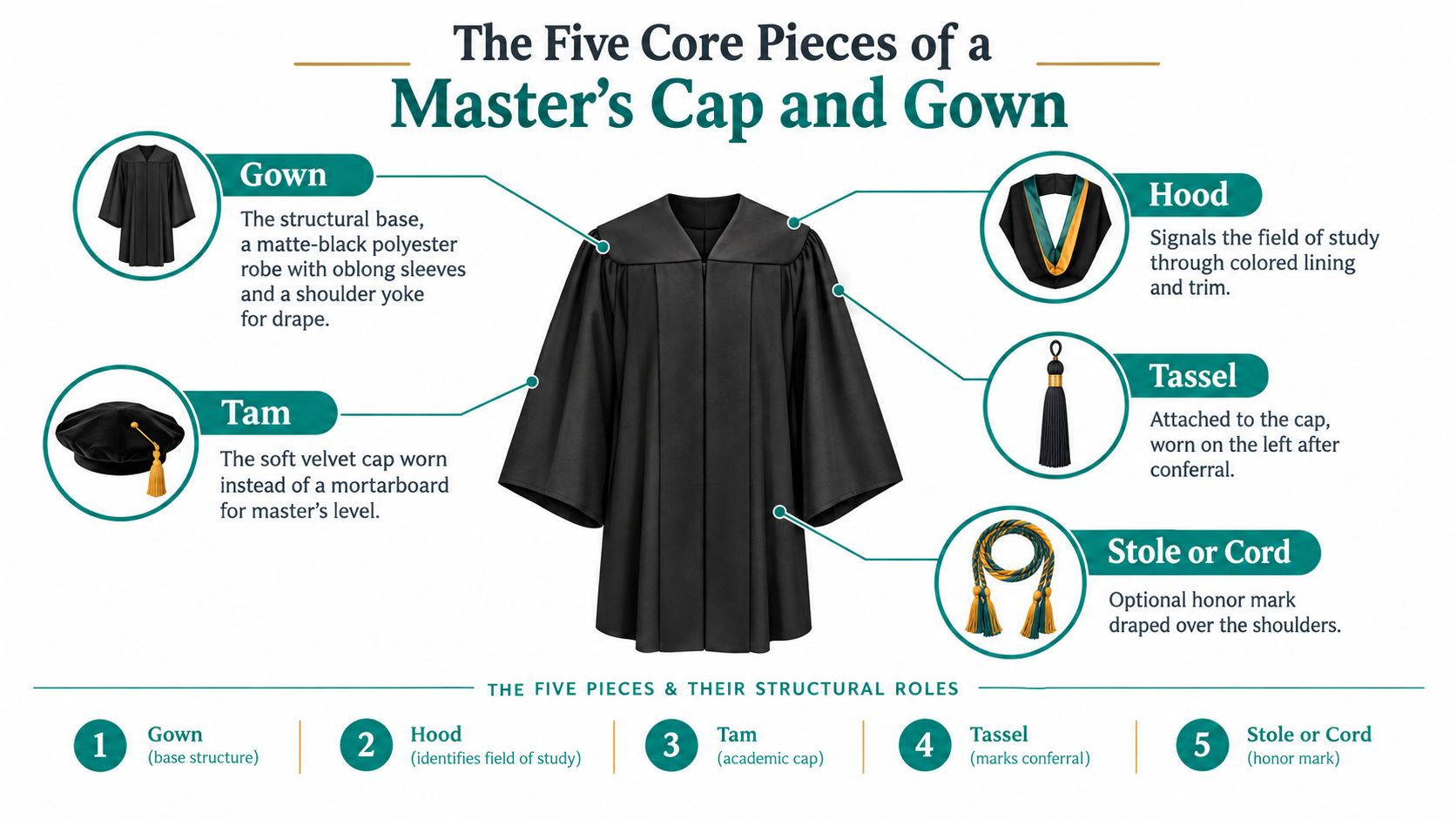
Treat the ensemble as five separate components rather than one package.
The gown
The master's gown is generally black or dark and has full-length oblong sleeves open at the wrist. It forms the structural base of the outfit and should hang over your clothing without pulling across the shoulders or bunching at your hands. The gown's yoke rests over the shoulders, helping the fabric drape smoothly over a shirt, dress, or other ceremony clothing.
The cap
The cap is commonly a mortarboard with a flat top and a central button. Some institutions permit or specify a soft academic cap, so follow your university's instructions rather than assuming that every graduate wears the same style. The cap should sit level, remain secure while you walk, and avoid pressing tightly against your hairstyle.
The hood
The academic hood is the most visibly coded part of the set. Its velvet trim communicates the field of study, while the satin lining represents the institution in schools that follow this system. It should lie flat around the neck and drape down the back without twisting.
The tassel
The tassel hangs from the cap's button. Placement rules vary, but many institutions direct master's candidates to wear it on the left. Follow the ceremony office's instructions for any movement at degree conferral, because traditions differ between undergraduate and graduate ceremonies.
The stole or cord
A stole or cord is usually optional and may represent honors, membership, cultural identity, military service, or another university-approved recognition. It sits over the gown and should not cover the hood trim or interfere with the neckline.
The gown and hood are the pieces most likely to matter for formal regalia checks. A cap can be adjusted, and approved cords may be added later, but an incorrect sleeve construction or hood specification can make the entire set non-compliant.
How Hood Colors Decode Your Discipline
Hood colors work as a visual language. The velvet edging identifies the academic discipline, while the lining often identifies the institution conferring the degree. That means the hood is not merely a decorative splash of color. It gives faculty, marshals, alumni, and guests information about the graduate's program.
Examples from the academic regalia tradition include white for arts and humanities, drab for business, light blue for education, orange for engineering, green for medicine, pink for music, and golden yellow for science. Universities may add or adapt colors for their own degree structures, so a color chart from another institution is useful for orientation but not final ordering.
Virginia Tech's guidance illustrates the scale of the system. Its master's tassels are black, while hood edging varies by discipline, and its academic guidance explains how field-specific colors are assigned. The university also notes that its graduate school works across 183 graduate degree majors, showing why a registrar's hood chart matters more than a generic marketplace listing. Virginia Tech's hood-color guidance is a useful example of how schools organize these choices.
Trim and lining answer different questions
Suppose two graduates both earned an MBA. Their hoods may use the same business trim, yet the linings can look different if their universities use different official colors. Conversely, graduates from one university may share a lining while wearing different trim colors for education, engineering, science, or another field.
That distinction is easy to miss because retailers often describe a hood using one dominant color. Ask for both parts of the specification:
- Discipline trim: The velvet binding that identifies the field.
- Institutional lining: The satin interior that identifies the university.
- Degree-level construction: The size and shape of the hood designed for a master's gown.
For combined degrees, interdisciplinary programs, and unusual specializations, the registrar remains the final authority. Don't infer your color from a classmate in another program. If you're comparing a school-specific example, the University of Pennsylvania regalia guide can help you see why institutional details matter, but your own commencement office should decide your exact combination.
Why the Sleeve Shape Matters More Than the Color
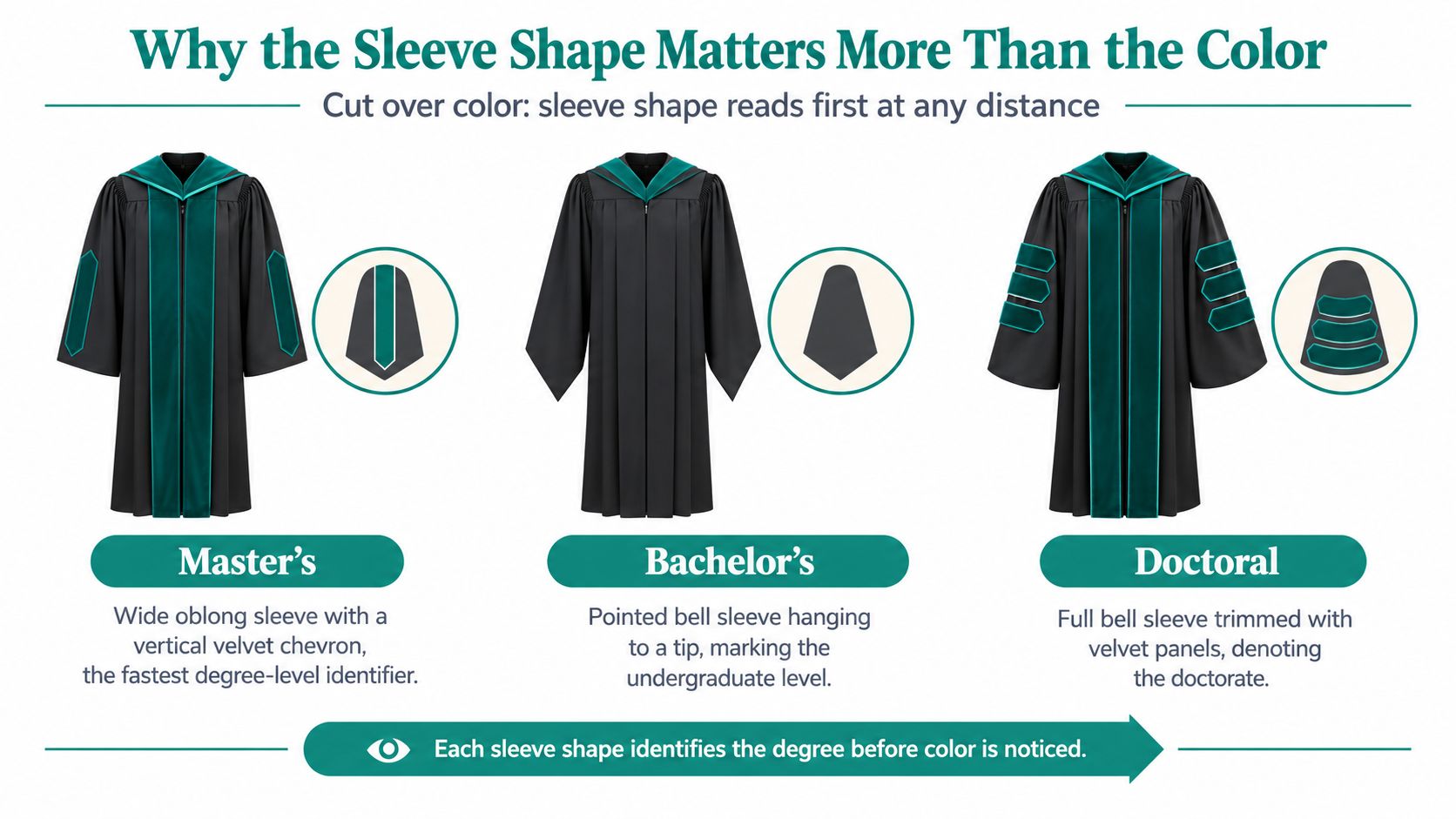
At a crowded commencement, sleeve construction often identifies the degree level faster than color does. Black gowns can look nearly identical from a distance, while the silhouette changes clearly when graduates walk, sit, or raise their arms for photographs.
A master's gown has an oblong sleeve. The sleeve is commonly square-cut at the back and arced at the front, with the opening at the wrist. This shape creates the long, closed profile associated with master's regalia and distinguishes it from the pointed sleeve used for bachelor's gowns.
A bachelor's gown typically has a pointed sleeve that hangs toward a tip. Doctoral regalia uses fuller bell sleeves and often includes velvet panels or other substantial trim. These silhouettes can overlap visually when a gown is folded in a shipping box, which is why you should inspect the sleeves before the ceremony rather than relying on the product title.
A quick silhouette check
Lay the gown flat and look at the sleeve from the side. You're checking for the following:
- Master's: An oblong, wrist-opening sleeve with the intended academic profile.
- Bachelor's: A pointed sleeve associated with undergraduate regalia.
- Doctoral: A fuller bell sleeve, often paired with velvet panels and doctoral accessories.
Color can vary by school, program, and institutional tradition. Sleeve construction provides a more dependable degree-level clue. A graduate who receives a black bachelor's gown by mistake may not notice until the sleeve hangs sharply to a point in stage photographs.
The official attire guidance from Purdue University Northwest describes the master's gown as a dark gown with full-length oblong sleeves open at the wrist, and it explains how the hood drapes over the back for ceremonial wear. Purdue Northwest's academic attire guide also makes clear why incorrect length or sleeve construction affects both comfort and appearance.
Getting the Right Fit Before You Order
Sizing begins with height, but height alone isn't enough. Regalia charts commonly use total height as the primary variable, then adjust the selection with chest, shoulder, and sleeve information. Use the supplier's chart rather than choosing the same size you wear in a jacket or dress.
Take four measurements
- Total height: Measure from the floor to the top of your head while standing naturally. This helps determine gown length and keeps the hem from sitting too high or dragging.
- Chest circumference: Measure around the fullest part of the chest, keeping the tape level. This indicates whether the gown will close comfortably over your ceremony clothing.
- Shoulder width: Measure across the natural shoulder line. A gown that's too broad can let the yoke slip beyond your shoulders.
- Sleeve length: Measure from the shoulder area toward the wrist. The master's sleeve should finish at the wrist rather than covering the hands.
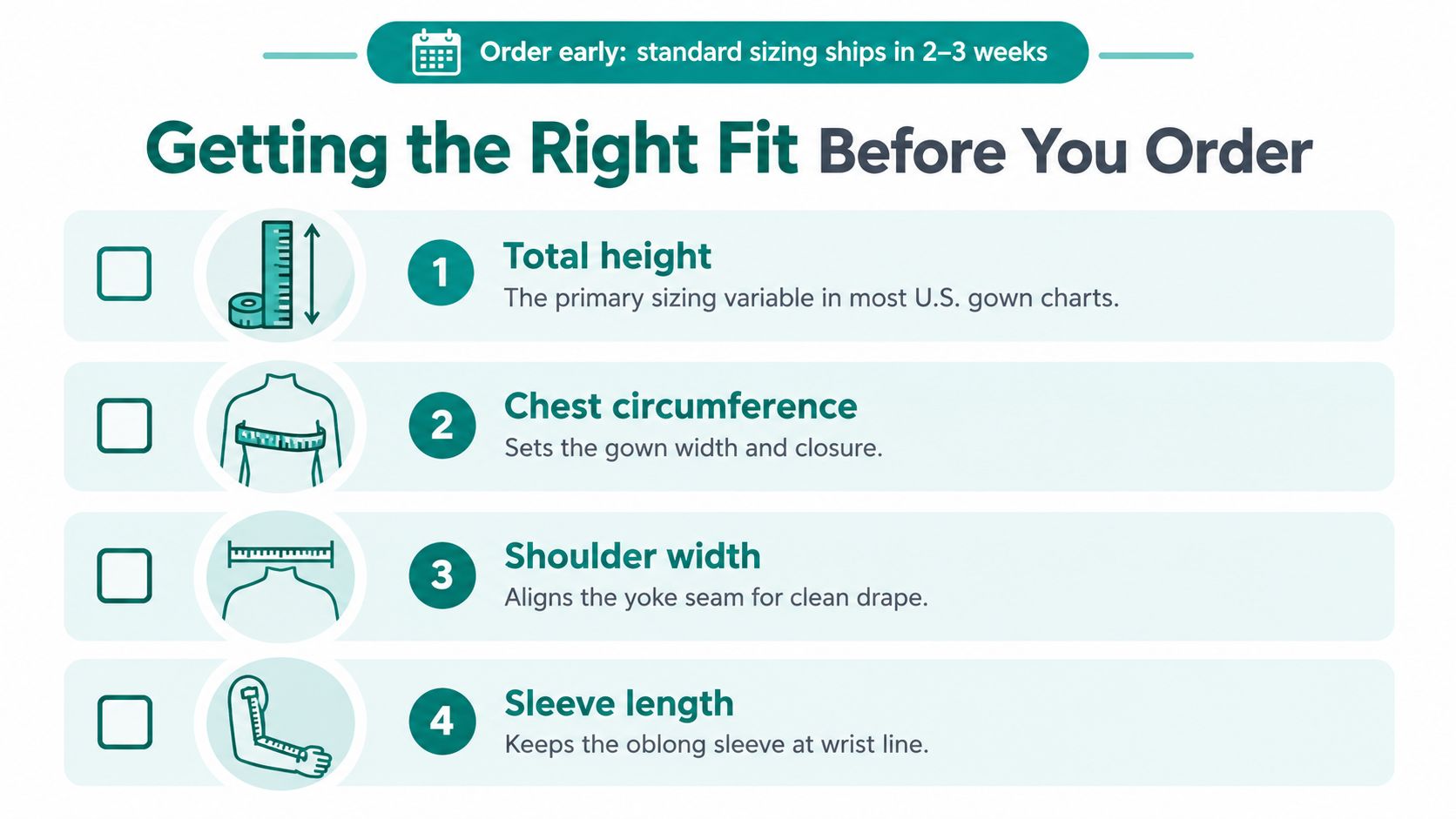
Check the cut, not just the label
Women's cuts may use a more contoured bodice, while unisex or men's cuts often provide a straighter drape. The right choice depends on the supplier's measurements and your proportions, not on assumptions about how the label should fit.
When the package arrives, try everything on over the clothing you expect to wear. Walk, sit, lift your arms, and check whether the sleeves bunch at your hands or expose too much wrist. Inspect the shoulder seams too. If they fall beyond your natural shoulders, the gown may be too wide even if the length looks correct.
Your cap should sit level rather than tilting forward. A gown that fits well can still look unbalanced if the cap size, hairstyle, or head placement causes the mortarboard to slope. Steam or hang the gown according to the supplier's care directions, and avoid crushing the hood beneath heavy items.
Fabric weight also affects comfort. Standard polyester and rental-grade fabrics can feel different in a warm venue, so ask the supplier about material and breathability before ordering. For a practical overview of ordering details and cap-and-gown components, consult Grad Store's cap and gown guide.
Why School-Specific Sets Beat Generic Black Gowns
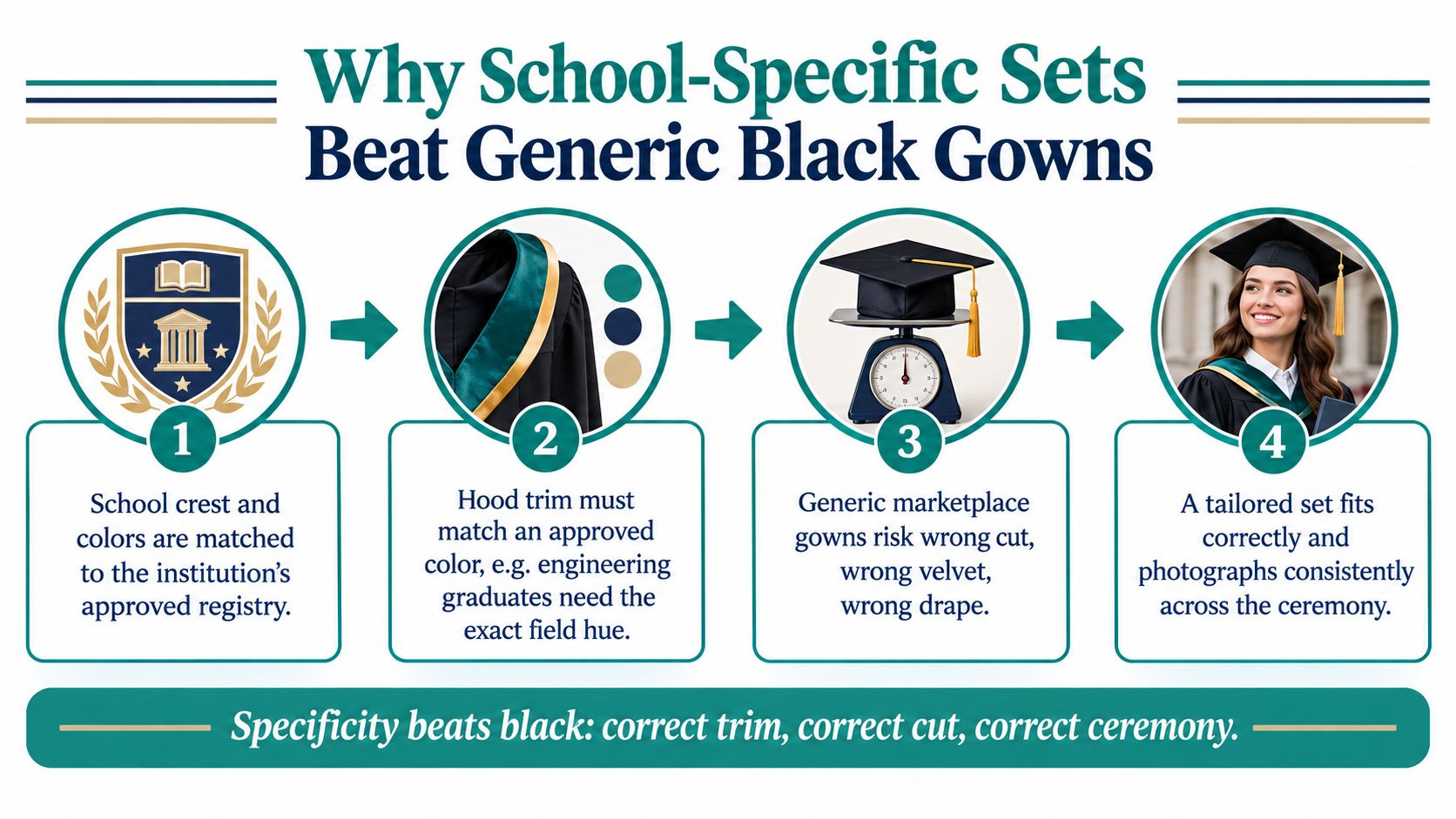
A generic black gown may satisfy the broadest visual expectation, yet still fail your university's actual specification. The risk usually appears in the details: a hood trim that doesn't match the approved discipline color, a lining in the wrong institutional shade, a sleeve cut that belongs to another degree level, or a tassel that conflicts with the ceremony office's instructions.
An engineering graduate, for example, may need the engineering color listed by the university rather than a retailer's approximation. An MBA candidate may need business trim with the institution's prescribed lining. An education graduate may receive a tassel color determined by the school's own protocol rather than by a general discipline chart.
What approved ordering can clarify
An approved supplier or campus bookstore can help connect your order to the university's requirements. That connection matters when the school uses a roster, degree chart, or program-specific ordering form.
- School identity: The crest, lining, and color combination can match the institution's published specifications.
- Degree accuracy: The hood trim can correspond to the exact field rather than a broad category.
- Ceremony consistency: Graduates in the same cohort appear in coordinated silhouettes and colors.
- Recognition pieces: Approved stoles, cords, and medallions can be added without covering required regalia.
- Fit support: A supplier may offer a school-specific chart instead of a generic size range.
Some universities also provide or subsidize regalia, which changes the cost comparison. Check the commencement office before paying for a replacement set. You may need to return the gown and hood after the ceremony, while keeping certain accessories.
Practical rule: Match the institution first, the degree field second, and the size third. A perfect fit can't correct the wrong hood specification.
If you need to compare an institution-specific package, Grad Store's Stanford master's cap, gown, and hood package shows the kind of school-level detail that generic listings often omit. The important question isn't whether the garment is black. It's whether every visible component agrees with your university's instructions.
Buy, Rent, or Borrow After the Ceremony
Owning regalia makes sense for some graduates, but it shouldn't be the automatic choice. A master's gown may become a keepsake, yet many graduates have no later event that requires the same hood, lining, and sleeve construction. Your likely future use should guide the decision.
| Factor | Buy | Rent | Borrow |
|---|---|---|---|
| Best fit | Keepsakes, alumni events, future academic ceremonies, or family photographs | A single commencement with minimal long-term commitment | A matching degree, field, and institution are already available |
| Main advantage | You control the set and can keep it | You avoid storing a rarely used garment | You may avoid a purchase entirely |
| Main risk | The set may sit unused after commencement | Size, color, and availability may be limited | The hood or sleeve construction may not match your requirements |
| After ceremony | Store, donate, resell, or reuse it | Follow the return deadline and condition rules | Return it promptly and carefully |
| Sustainability question | Reuse matters if you'll wear it again | Shared inventory can reduce duplicate purchases | Existing garments get another use |
Borrowing only works when the details align. A friend's master's gown may fit, but the hood could identify a different discipline or university. Check the trim, lining, sleeve profile, and school rules before treating a borrowed set as ready.
Rental and reuse programs deserve more attention. Chapman's sustainability survey found that a considerable share of students had purchased regalia they still owned without plans to use it again, which contributed to a reuse program. Chapman's past sustainability survey results illustrates why post-ceremony planning belongs in the purchase decision.
Ask whether your university collects and redistributes gowns, accepts donations, or operates a campus lending network. A reuse program can combine the low commitment of borrowing with a better chance of receiving the correct school-specific pieces.
Ordering Checklist for a Stress-Free Commencement
The safest order follows three decisions: institution match, hood match, and timeline. Make them in that order, because a correctly measured gown is still wrong if it carries the wrong hood, and an accurate set is not useful if it arrives after the ceremony.
Confirm the institution's rules
Find the official commencement page, bookstore instructions, or registrar notice. Verify whether the school requires an approved vendor, supplies the gown, specifies a particular cap, permits stoles and cords, and expects the set to be returned.
Match the hood to the degree
Use the university's ordering chart for your exact program. Confirm the discipline trim, institutional lining, hood size, and degree-level gown. Don't rely on a classmate's color or a general internet chart when your university publishes its own combination.
Protect the timeline
Place the order early enough to allow shipping, inspection, and an exchange if the fit is wrong. The internal plan may recommend ordering eight to ten weeks before the ceremony, but your school's deadline and the supplier's stated fulfillment time control the decision. If you're ordering close to commencement, ask about stock status and expedited options before submitting payment.
When the package arrives, open it immediately. Measure the sleeve and hem against your body, check the shoulder line, attach the tassel, place the hood correctly, and photograph the full set for your records. If anything looks wrong, contact the vendor and commencement office while there's still time to correct it.
A prepared graduate doesn't necessarily have the most expensive regalia. They have the right institution, the right hood, the right sleeve construction, and enough time to fix a mistake.
Grad Store offers institution-specific master's regalia, including caps, gowns, hoods, tassels, stoles, accessories, sizing support, swatches, and group-order coordination. Review your school's requirements, compare the matching set, and visit Grad Store to choose regalia that fits both your degree and your commencement instructions.