

Master's sets start around $109 and custom doctoral regalia can reach about $915, with the main online order window closing on March 20 for Penn's 2026 cycle (Penn Commencement FAQ). If you're staring at regalia options and wondering whether to buy, rent, or scramble for a late solution, that's the decision point.
Most grads don't get stuck on the idea of regalia. They get stuck on the details. Which set matches your degree. Whether a doctoral gown should be standard or custom. What to do if you missed Grad Fair. How to avoid paying for the wrong hood, wrong cap, or wrong sizing when the ceremony is close and exchanges are harder.
Penn adds one more layer: the clothing is ceremonial, but the ordering is logistical. You need the right configuration, the right timing, and a backup plan if anything goes sideways. That's where people usually panic.
I'm going to walk you through UPenn regalia the way I'd explain it to a nervous student at a commencement help table: first the essentials, then the visual details, then the money and deadline choices that matter most.
Table of Contents
- Understanding the Penn Commencement Requirement
- Reading Penn Regalia Colors and Hoods Correctly
- Choosing Between Standard and Custom Regalia
- Sizing, Fit, and Fabric Choices
- Where to Buy Penn Regalia and How It Compares
- Real Scenarios That Show How Penn Orders Go Wrong
- Next Steps and What to Do Before You Order
Understanding the Penn Commencement Requirement
Two weeks before Commencement is when the avoidable mistakes show up. A student realizes regalia is required, checks out quickly, and only then notices the bigger question: standard doctoral set or custom doctoral regalia? Another missed the main order window and now needs a late-order plan instead of a shopping plan.
At Penn, regalia is required to take part in Commencement, and Penn directs graduates to the Penn Bookstore for purchase or rental options. If you missed Grad Fair, Penn says to contact the Bookstore directly. That is your first practical fallback, not your last-minute backup (Penn Commencement FAQ).

The part students overlook is that "required" answers only one question. It does not tell you which version you need, how early you need it, or what to do if money or timing gets tight. Those are the hidden decision points that create stress.
Start with the choice you face.
For many bachelor's and master's graduates, the task is simple: get the correct set in the correct size before the ordering window closes. Doctoral graduates have a second decision layered on top. They may need to choose between standard doctoral regalia and custom doctoral regalia, and that choice affects cost, lead time, and what options remain if they order late.
A good way to frame it is this: a standard set is the ceremony solution. A custom doctoral set is the long-term academic wardrobe solution. If you expect to use regalia again for future commencements, faculty ceremonies, or academic events, custom can make sense. If you need approved attire for one Penn ceremony, standard is often the cleaner choice.
The three routes Penn graduates usually sort through
- Buy a standard set if you want the usual ceremony configuration and the fastest decision path.
- Rent if your program allows it and keeping the regalia does not matter to you.
- Order custom doctoral regalia if you are a doctoral graduate who wants a personalized set for repeated future use.
Confusion starts when students compare unlike items. A master's package and a custom doctoral package are not competing versions of the same thing. They serve different degree levels and different needs.
The calendar matters more than students expect
Penn's regalia process runs on a real deadline calendar, not a vague spring timeline. There is a main online order cutoff, then an in-store pickup period, and after that the process becomes less flexible. Once the main ordering window closes, your choices may narrow on size, availability, and turnaround time.
That is why late ordering feels so stressful. You are no longer making a calm product choice. You are working through an availability problem under a fixed ceremony date.
Use this rule: order regalia before you lock in graduation photos, family travel, or celebration plans. If regalia is required for participation, it belongs on the same planning tier as your ticketing and schedule.
Where students misread the requirement
The requirement is simple. The setup is not.
A bachelor's graduate usually needs to confirm the basic set and pickup details. A master's graduate needs to make sure the hood matches the degree. A doctoral graduate should pause before checkout and ask one extra question: Do I need standard regalia for this ceremony, or do I want custom regalia for future academic use?
That pause saves money for some students and saves time for others.
If you are late or short on budget, act early anyway
Late orders and budget gaps do not always block participation, but they do reduce your room to choose. Contacting the Bookstore promptly gives you the best chance of finding an available path. Waiting usually turns a manageable issue into a harder one, especially for doctoral orders, where customization can add time and limit what can be changed close to Commencement.
Penn also places regalia in a longer academic tradition. The university explains that Penn adopted its own “Pennsylvania” System of Academic Costume in the nineteenth century before shifting to the Intercollegiate System used more broadly today (Penn's history of academic regalia).
That history explains the formality. The practical takeaway is simpler: Penn requires regalia, the deadline calendar shapes your options, and doctoral graduates need to separate the question of what is permitted from the question of what is worth ordering.
Reading Penn Regalia Colors and Hoods Correctly
Most confusion around UPenn regalia starts with the hood. Students often focus on the gown first because it's the largest item, but the hood is where Penn-specific identity shows up most clearly.
Penn says its graduates wear a hood lined in red with a blue chevron, and Penn's tradition materials also note that doctoral gowns have velvet in a field color, doctorates may wear a gold tassel, the mortarboard is standard, and a soft square-topped cap is permissible. Penn also notes that the tassel moves from right to left at conferral (Penn Today on commencement traditions).
The details that actually matter
When you look at a product page, check for the parts that affect accuracy:
- Penn hood lining: It should reflect Penn's red lining with a blue chevron.
- Doctoral gown trim: Doctoral gowns use velvet in the field color tied to the degree.
- Cap choice: Most students will see a mortarboard. Some doctoral participants may use the permitted soft square-topped cap.
- Tassel logic: Doctoral graduates may use a gold tassel. During conferral, the tassel shift goes from right to left.
Students often assume school branding appears only on the hood. At Penn, that's partly true, but the degree field and ceremonial role also affect what you're wearing.
Penn Regalia Configuration by Degree Level
| Degree Level | Gown Style | Hood Lining and Chevron | Cap and Tassel Notes |
|---|---|---|---|
| Bachelor's | Standard academic gown | Penn hood details may not be the main decision point for many undergraduate sets | Mortarboard is the standard reference point in Penn tradition materials |
| Master's | Fuller gown than bachelor's, with hood as a key identifier | Hood lined in red with a blue chevron for Penn graduates | Mortarboard is standard; tassel movement at conferral goes right to left |
| Doctoral | Doctoral gown with velvet in the field color | Penn hood lined in red with a blue chevron | Doctorates may wear a gold tassel; mortarboard is standard, and a soft square-topped cap is permissible |
That table won't answer every school-specific question, but it gives you a fast filter. If the hood colors are off, or a doctoral product ignores field-color velvet, stop before ordering.
Where doctoral buyers get tripped up
Doctoral regalia isn't one single thing. You may see differences in hood finish, cap style, and whether the gown is sold as a basic university-specific set or a more custom package. If you want to compare those categories visually, a useful starting point is this overview of doctoral regalia by university.
If you can't identify your hood lining, gown trim, and cap type from a product description in under a minute, that listing is too vague for a rushed commencement order.
The practical takeaway is simple. Don't buy by thumbnail image alone. Read the construction details. Penn's colors and ceremonial rules are specific enough that a close look can save you from an expensive mismatch.
Choosing Between Standard and Custom Regalia
A Penn doctoral student usually hits the same decision point after confirming hood colors and gown style. Do you order the standard doctoral set and stay on the university track, or do you pay more for a custom version and accept more decisions?
Start with the part many grads miss. Standard and custom doctoral regalia are not two names for the same product with different price tags. They solve different problems.
Standard regalia is the ceremony option. It is built to meet the visual requirements for commencement without asking you to choose every finishing detail. Custom regalia is closer to a long-term academic garment. It makes more sense if you expect to wear it again for faculty ceremonies, hoodings, or future university events.
That distinction matters because the ordering calendar is different in practice, even when students treat both options as a last-minute purchase. A standard doctoral set can work on a tighter timeline if the seller already has Penn-specific pieces ready. A custom order usually needs extra lead time for manufacturing, confirmation, and shipping. If you wait too long, the choice may be made for you by the calendar rather than your preference.
When standard regalia is the better call
Standard regalia is usually the safer choice for Penn doctoral graduates who want to get through commencement without adding avoidable risk. It fits well if you:
- plan to wear the regalia once or only rarely after graduation
- want the correct Penn look without extra customization decisions
- are ordering on a compressed timeline
- need to keep costs contained
- would rather avoid mistakes tied to trim, fabric, or optional details
I often describe standard regalia as the checked-bag version of commencement planning. It may not feel glamorous, but it gets the job done if your main goal is arriving with the right item in hand.
When custom regalia makes sense
Custom regalia earns its cost when it prevents a specific problem.
That problem might be repeated future use. It might be an unusual fit issue that standard sizing handles poorly. It might be a strong preference for higher-grade fabric or construction because you expect to wear the gown for years.
Custom can also appeal to graduates who care about details that standard listings may gloss over, such as sleeve finish, gown weight, or how the velvet sits. The catch is simple. More options create more opportunities to order the wrong thing. If you are not ready to confirm each detail before checkout, custom can become an expensive guess.
The hidden decision points Penn grads overlook
Three questions usually sort this out faster than a long product comparison.
1. Are you buying for one day or for a decade?
If this is a one-ceremony purchase, standard often wins. If you expect regular academic use, custom starts to make more sense.
2. Are you early enough to absorb a delay?
Custom orders have less margin for error. If your graduation date is getting close, ask about production time, not just shipping time. Those are different clocks.
3. What happens if your budget tightens?
Many grads compare standard and custom based on preference, then realize too late that they still need to cover announcements, travel, photos, and professional clothing underneath the gown. If custom strains the budget, standard is not a compromise in correctness. It is often the more practical Penn decision.
Standard vs Custom Regalia at Penn
| Factor | Standard Regalia | Custom Regalia |
|---|---|---|
| Primary use | Commencement and occasional academic wear | Repeated academic use, faculty events, long-term ownership |
| Budget impact | Lower upfront cost in most cases | Higher cost and more careful planning |
| Lead time | Better if stock is already available | Often needs more production time |
| Decision load | Fewer choices to confirm | More choices on fabric, finish, and construction |
| Late-order risk | Lower, if the correct Penn version is in stock | Higher, especially near deadline periods |
| Error risk | Lower for straightforward orders | Higher if details are vague or unchecked |
What to do if you are late or short on funds
Panic causes bad orders.
If you are ordering late, ask one question first: “Do you have the Penn doctoral set in stock in my size?” That answer matters more than a polished product page. A seller can offer fast shipping and still miss your ceremony if the gown is not available.
If your budget is tight, protect the required pieces first. Get the correct gown, hood, and cap before paying extra for upgrades that do not change whether your regalia is acceptable for Penn commencement. A custom doctoral package can be worthwhile. It is not automatically the responsible choice.
Decision shortcut: Choose custom only if it solves a real use, fit, or longevity problem. Choose standard if your goal is correct Penn regalia, predictable timing, and fewer chances to make an expensive mistake.
One last correction, because this trips people up every year. “Custom” does not mean “more official.” At Penn, the official question is whether your regalia is correct for your degree and ceremony. Once you frame the decision that way, the right option usually becomes much clearer.
Sizing, Fit, and Fabric Choices
A gown can be technically correct and still feel awful for a long ceremony. That's why fit matters more than students expect, especially with doctoral regalia, where the garment has more structure and visual weight.
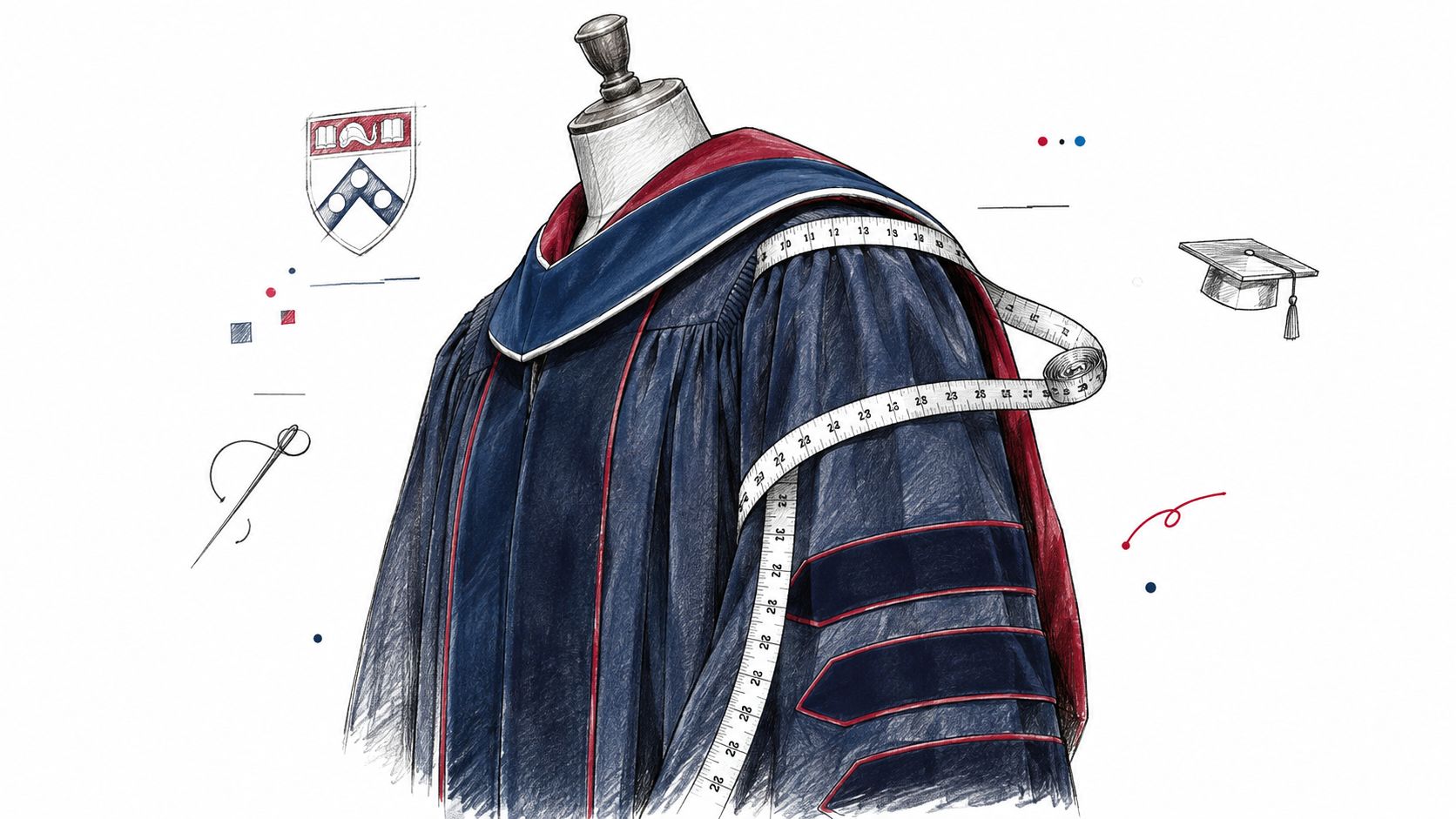
The first thing to understand is that academic sizing isn't like shopping for everyday clothes. You're not trying to get a fitted silhouette. You're trying to get the right drape, proper length, and enough room for what you'll wear underneath.
Where fit problems usually appear
Most UPenn regalia issues show up in three places:
- Length: A gown that runs too short looks wrong immediately in photos and on stage.
- Shoulders and upper torso: This matters more for layered doctoral gowns.
- Sleeve and arm movement: You'll notice this during lining up, handshakes, and seated stretches of the ceremony.
Doctoral buyers should slow down here. Velvet panels and heavier trim make mistakes more noticeable, and they're harder to shrug off once you're wearing the gown.
Penn Bookstore versus third-party retailers
Penn's official route is the Bookstore, and that's the right starting point if you want the university's direct process. Third-party retailers can be useful when you need different fulfillment options, more visible product comparisons, swatch access, or help with grouped ordering.
One example is the size, color, and fabric guide from Grad Store, which shows the kind of detail buyers should look for when they're comparing fabrics, trims, and measurements. The important part isn't the retailer name. It's whether the seller gives you enough information to verify fit before you commit.
A measuring routine that prevents headaches
Use a simple check before ordering:
- Measure in the shoes you expect to wear, or at least account for them.
- Decide what will be under the gown. A light dress shirt and a suit jacket affect drape differently.
- Check the return or exchange terms before checkout.
- Ask about swatches or fabric descriptions if the finish matters to you.
This short walkthrough helps if you need to visualize how academic gowns sit and move during wear:
A regalia order goes smoother when you treat measurement as ceremony prep, not as online shopping trivia.
Fabric also matters more than most students think. Some buyers care mainly about price. Others care about how the gown photographs, whether the shell fabric looks matte or shiny, and whether the hood lining feels substantial instead of flimsy. If you're deciding between two sellers, ask who gives you the clearest sizing method, the simplest exchange path, and enough fabric information to avoid guesswork.
Where to Buy Penn Regalia and How It Compares
Most buyers are choosing between the Penn Bookstore, another academic regalia retailer, or a group-order process run through a department or coordinator. Each route solves a different problem.
Penn's own guidance is clear on the official side: regalia can be bought or rented through the Bookstore, and students who miss Grad Fair should contact the Bookstore directly. That makes the Bookstore the default channel when you want the university's stated path and a clear answer on basic compliance.
Which route fits which buyer
The Bookstore is usually the cleanest choice for graduates who want the approved campus process and don't need many comparison features. It's also where many students should start if they've missed an event and need to know what's still available through Penn's normal workflow.
A third-party retailer can make sense when you need more product visibility than Penn's public pages provide. That's especially true for doctoral buyers who want to compare standard and custom Penn-specific listings side by side, such as this University of Pennsylvania doctoral regalia collection. Retailers may also offer swatch access, faster shipping paths, or group-order tools that are easier to use when a department is coordinating multiple graduates.
Then there's the department route. This one is often overlooked. If your program has several doctoral or master's graduates ordering around the same time, a coordinator can reduce confusion by collecting degree details, confirming who needs standard versus custom, and checking fit questions before everyone orders separately.
Build a timing and budget framework
Students often ask, “Where should I buy?” The better question is, “What failure am I trying to avoid?”
Use this framework:
- If your main concern is compliance: start with the Bookstore and verify pickup or rental details.
- If your main concern is a doctoral configuration: compare listings carefully and make sure Penn hood and gown details are visible.
- If your main concern is time: choose the seller that can clearly explain availability, shipping, and replacement options.
- If your main concern is department logistics: use a group process so one person isn't decoding every hood and cap alone.
Buying regalia late doesn't always create one big problem. It creates several small ones at once: fewer choices, less time to exchange, and more pressure to accept a near miss.
This is why UPenn regalia decisions shouldn't start with price alone. Cost matters, but timing, configuration accuracy, and recovery options matter just as much once the ceremony gets close.
Real Scenarios That Show How Penn Orders Go Wrong
The mistakes are usually ordinary. Nobody wakes up planning to order the wrong hood or miss the deadline. People get busy, assume a detail, or think they can fix it later.

The doctoral candidate who waited too long
A doctoral student decides to “look into regalia after the defense.” By the time they start comparing options, they realize doctoral sets involve more choices than expected. Now every decision feels rushed: standard or custom, mortarboard or permitted soft square-topped cap, basic fit or more refined fit.
What fixes it? Narrow the goal. Under deadline pressure, the smartest move is often to choose the correct standard configuration unless you already know you need custom. The safeguard would have been setting the regalia decision before other graduation tasks crowded it out.
The master's student who guessed at the hood details
A master's student assumes the gown matters more than the hood and orders based on a generic product image. The package arrives, and they suddenly notice the hood details don't line up with what Penn expects.
This kind of mistake happens because students treat regalia like costume instead of university-specific academic dress. The recovery path is to verify the Penn hood details before trying to patch the problem with random accessories. The safeguard would have been checking the exact Penn color and hood description first, then ordering.
The department coordinator juggling a cohort
A staff member tries to help a group of graduates by sending one quick email: “Please order your regalia this week.” It sounds efficient, but the group includes master's students, doctoral candidates, and people with different timing needs. Questions start coming in immediately. Which cap. Which hood. Whether anyone can rent. Whether custom is necessary.
The problem here isn't bad intent. It's lack of triage.
A better recovery plan is to split the cohort into buying categories:
- Straightforward standard orders
- Doctoral orders needing closer review
- Anyone dealing with late timing or budget questions
Small regalia errors become expensive when they happen late. Early in the season, they're annoying. Close to ceremony day, they can block participation or force a compromise.
These scenarios all point to the same lesson. Most ordering problems aren't caused by Penn being unusually complicated. They happen because buyers don't identify their own risk early enough. If you know whether your issue is timing, money, fit, or doctoral complexity, the solution usually becomes much clearer.
Next Steps and What to Do Before You Order
If you only do five things before placing a UPenn regalia order, make them the right five.
The pre-order checklist
- Confirm your degree level: bachelor's, master's, and doctoral regalia aren't interchangeable decisions.
- Verify Penn-specific visual details: especially the hood and any doctoral distinctions.
- Measure carefully: don't guess because your everyday clothing size feels “close enough.”
- Choose your ordering path: Bookstore, rental if available, or another seller with the features you need.
- Work backward from Penn's main order window: if you're near the deadline, prioritize availability and error recovery over browsing.
That last point matters most. Students often chase small savings and lose the bigger battle. A slightly cheaper option isn't a bargain if the hood arrives wrong, the fit can't be corrected in time, or the seller can't help you once the ceremony gets close.
What I'd recommend to most Penn graduates
Prioritize accuracy first, timing second, and budget third. That order surprises people, but it's the one that causes the fewest disasters.
If you're a master's student with a straightforward need, keep the process simple. If you're a doctoral student, pause long enough to decide whether standard meets your needs before drifting into custom territory because it sounds more distinguished. If you're late, stop comparison shopping and move into confirmation mode: what's available, what matches Penn's requirements, and what can still be corrected if necessary.
When to ask for help
Ask a human being for help when:
- you're unsure about a doctoral cap or hood choice
- your size sits awkwardly between standard categories
- you missed the main ordering event
- a department is trying to coordinate several different degree types
A good support question is short and specific. State your degree, your ceremony role, the regalia type you think you need, and the deadline you're facing. That gets you a usable answer faster than sending a vague “What should I order?” message.
Order with enough time to solve one mistake. That's the safest rule in commencement planning. Most Penn regalia stress comes from needing a perfect first try when there's no cushion left.
If you need another place to compare Penn-specific doctoral options, sizing guidance, fabric details, or group-order support, Grad Store offers university-aligned academic regalia and practical ordering resources. It's a useful option when you want to check standard versus custom paths, review measurement help, and avoid last-minute guessing before ceremony week.