

What if the most important detail about bachelors graduation robes isn't the robe itself, but the university rule you haven't found yet? Two gowns can look nearly identical online while differing in approved color, accessories, closure, sizing, or pickup process. That gap between a formal specification and a real purchase is where many graduates become anxious.
The safest approach is simple: treat commencement attire as an official requirement first and a shopping decision second. Your university's registrar, commencement office, bookstore, or graduate services team should determine the baseline. Once you know that baseline, you can make informed choices about fit, fabric, timing, customization, and reuse without guessing.
Table of Contents
- Understanding Your University's Requirements
- The Anatomy of a Bachelor's Gown
- Beyond the Gown, Caps, Tassels, and Accessories
- Mastering Fit and Fabric Choices
- Smart Ordering Timelines and Strategies
- Customizing and Upgrading Your Regalia
- Embracing Sustainability in Academic Dress
Understanding Your University's Requirements
A graduating student arrives at the final commencement meeting with a phone full of product screenshots. One gown is black, another is navy, and a third includes a hood that the student's classmates say isn't required. The events coordinator asks whether the student has ordered regalia. Suddenly, a routine purchase feels like a high-stakes exam.
That confusion is understandable because academic dress follows broad traditions while universities apply their own local rules. Bachelor's candidates in the United States typically wear a black gown and mortarboard, but some institutions add or omit a hood according to local practice. The Congressional Research Service overview of academic regalia describes how U.S. academic dress developed from medieval European traditions and how the modern code became widely used across postsecondary institutions.
Find the rule before the retailer
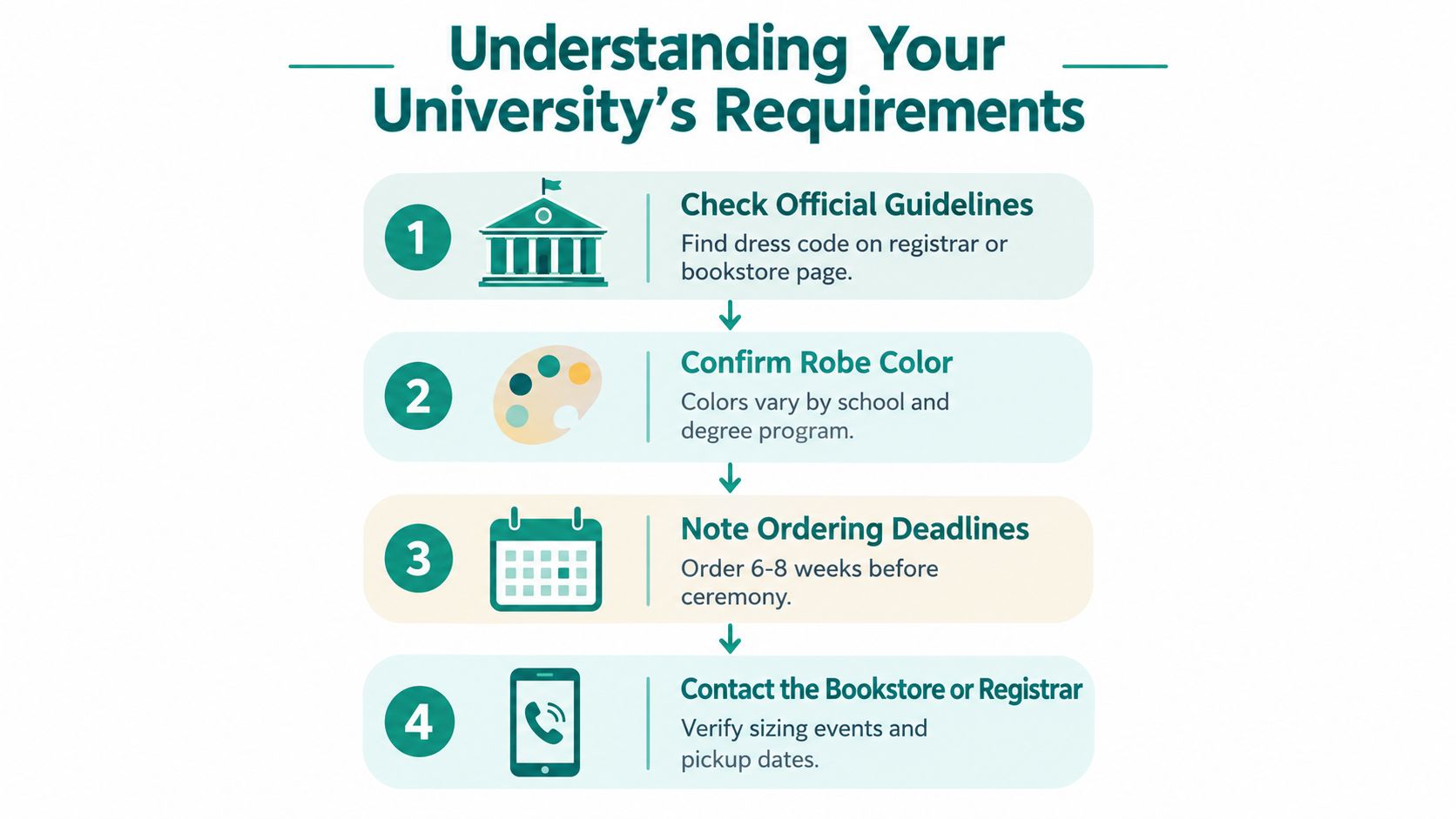
Start with your school's official commencement page. Search for terms such as “academic regalia,” “cap and gown,” “graduation attire,” or “commencement bookstore.” The official page should tell you whether your order must come through a designated bookstore, whether the university requires a specific vendor, and which items are included in a standard bachelor's package.
Read the page carefully rather than relying on a product photograph. Separate the information into three groups:
- Required items: Usually the gown, mortarboard, and tassel, but your institution may define the set differently.
- Approved additions: Stoles, honor cords, medals, or other accessories may require authorization from a department or student organization.
- Local instructions: These can include pickup dates, ceremony-specific colors, photographs, and rules about decorating the cap.
Create a document-backed checklist before you buy. Record the ceremony date, gown color, degree level, required accessories, sizing method, ordering deadline, pickup or delivery process, and a contact for unresolved questions.
Practical rule: If a retailer's product page conflicts with your university's commencement instructions, follow the university instructions and ask the registrar or bookstore to resolve the difference.
The history helps explain why details matter. A student movement in 1885 encouraged U.S. colleges to allow caps and robes at commencement, and the 1895 intercollegiate code introduced a standardized color and design system, as outlined by the University of Toledo's account of academic dress traditions. That tradition gives bachelor's regalia its recognizable appearance, but local implementation still controls what you should order.
The Anatomy of a Bachelor's Gown
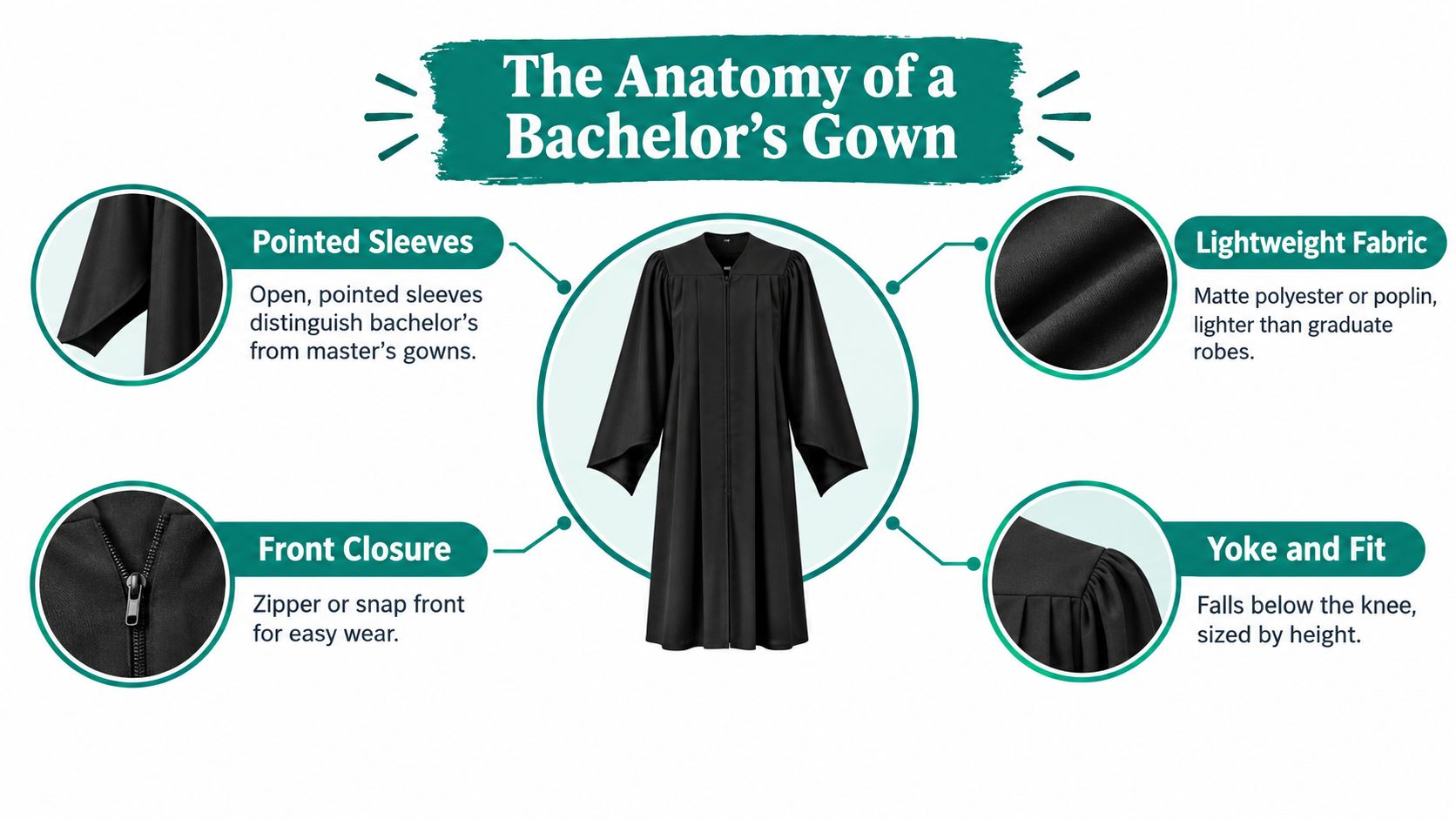
A bachelor's gown isn't just a loose black robe. Its cut identifies the degree level and affects how the garment fits, moves, and appears in official photographs. The Intercollegiate Code tradition specifies a black gown with pointed sleeves and a closed front, features that distinguish bachelor's attire from other academic garments. Carnegie Mellon University's regalia guidance also discusses the traditional bachelor's gown and the associated mortarboard and tassel placement.
Read the product description carefully
When reviewing a gown listing, look for the degree-level specification rather than assuming that every black garment is interchangeable. A practical inspection follows four steps.
- Confirm the sleeve shape. Bachelor's sleeves are pointed. Don't mistake the extra hanging fabric on an Oxford-style sleeve for the opening where your arm belongs.
- Check the front closure. The gown should close at the front, commonly with a zipper or another fastening system. A closed front creates the formal silhouette your university expects.
- Inspect the length guidance. Use the seller's height chart and the university's instructions together. A gown that drags on the floor can create a safety problem, while a very short gown may look visibly out of proportion.
- Verify the degree category. A master's gown or doctoral garment may use different sleeve construction, trim, or accessories. Don't choose by color alone.
The term “regalia” can also create confusion. It may refer broadly to ceremonial clothing, while academic regalia usually means the formal set associated with a degree. For a bachelor's candidate, that commonly centers on the gown, cap, and tassel. A hood may be required, optional, or omitted depending on institutional practice, so don't add one based only on what another university uses.
For a closer explanation of how bachelor's hoods differ from other academic garments, consult this guide to bachelor graduation hoods, then return to your own university's instructions before ordering. The purpose of learning the anatomy isn't to make you memorize costume history. It's to help you spot a mismatch before the package arrives.
Beyond the Gown, Caps, Tassels, and Accessories
The gown establishes the degree level, but the accessories often create the most visible opportunities for error. A mortarboard worn at an angle, a tassel placed on the wrong side, or an unapproved stole can make a carefully chosen outfit look unfinished. These details are easy to manage when you separate ceremony requirements from personal additions.
The core pieces
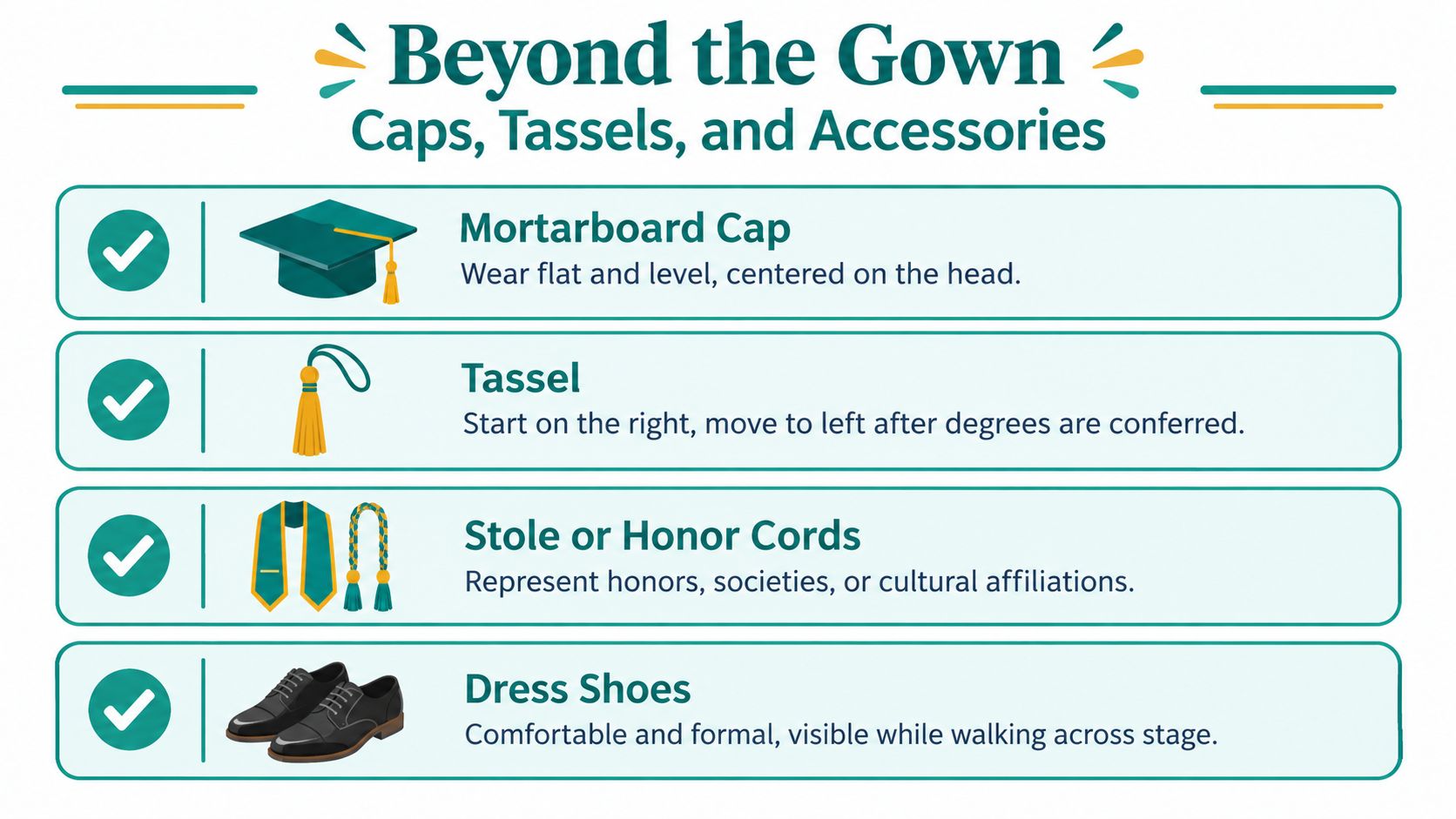
The mortarboard should sit level and centered. The elastic edge generally belongs at the back, while the pointed section faces forward. If the cap shifts during walking, discreet bobby pins can help, but check whether your commencement staff has specific rules about securing it.
The tassel typically begins on the right side before the degree is conferred. After conferral, many institutions move it to the left. That movement marks the transition from candidate to graduate, but ceremony instructions take priority if your university uses a different procedure.
Stoles, honor cords, and medals carry additional meaning, yet they aren't automatically universal parts of a bachelor's set. A student organization may issue a stole, while an academic department may authorize a cord. Ask who may wear each item, which colors are approved, and whether the accessory should be collected before the ceremony or added at home.
The safest accessory is the one you can explain with confidence: who issued it, what it represents, and whether your commencement office permits it.
Dress shoes deserve practical attention. They'll be visible as you walk, and you may stand in them for a long time. Choose formal shoes that you've tested, rather than wearing a new pair that could distract you during the procession.
Before the ceremony, practice putting on the full set. The guide to wearing graduation regalia can help you review the order of the garments and accessories.
Watch the demonstration only as a general reference. Your university's instructions still control tassel movement, approved accessories, and any ceremony-specific procedure.
Mastering Fit and Fabric Choices
Could a gown that looks correct on the hanger still fail at the ceremony? Yes. Bachelor's gowns commonly use height and weight bands, while vendors may adapt the same pattern for extended and plus-size ranges. This system serves large graduating classes without individual alterations, but it makes the size chart more important than your usual clothing size. University requirements define the acceptable appearance; the seller's chart helps you choose the garment that meets those requirements comfortably.
Measure in the order the chart expects
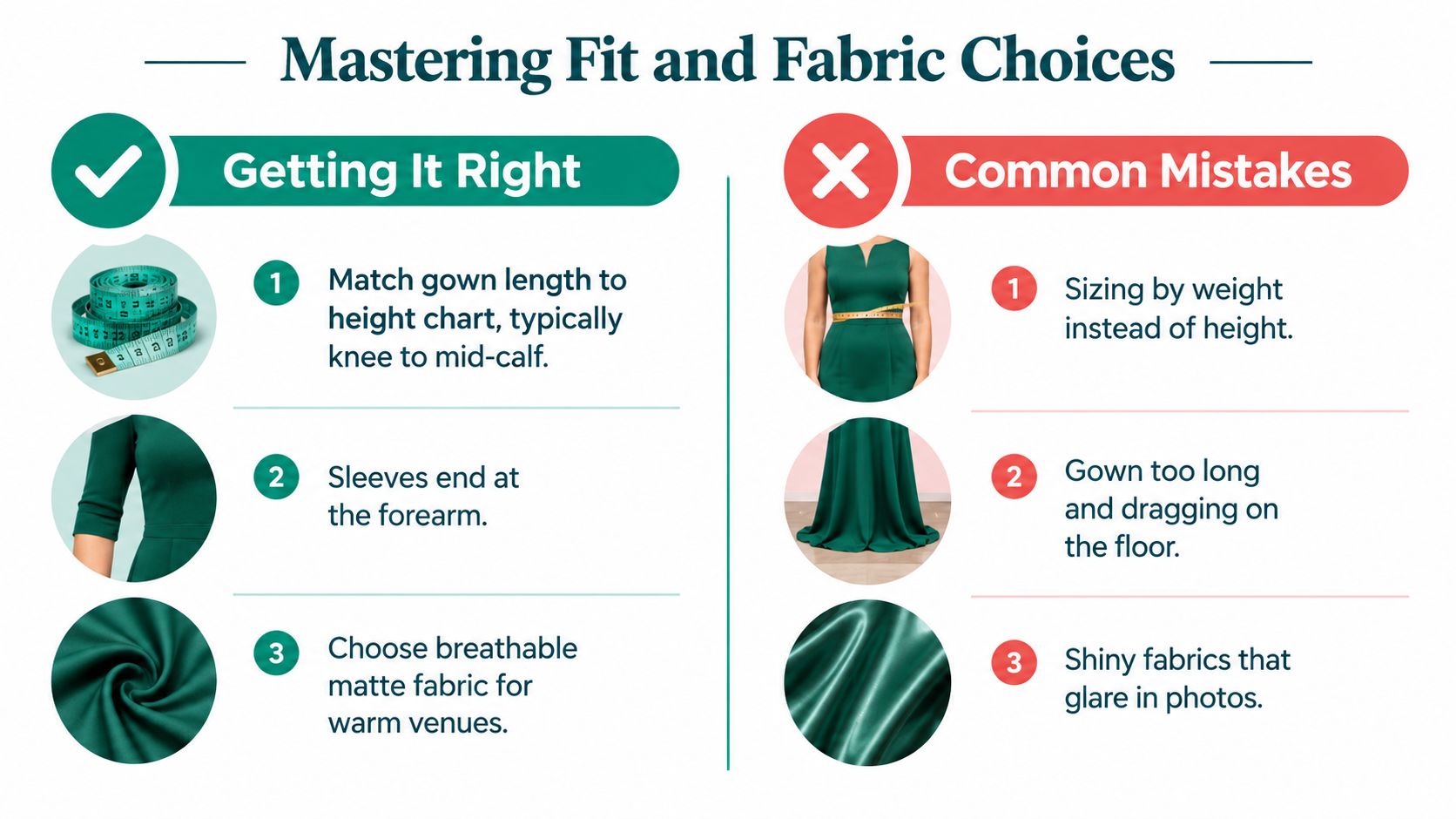
Start with your height while wearing the footwear you expect to use. Then compare your weight with the seller's range and read any notes about body shape or fit. Use the seller's height chart and the size, color, and fabric guide together with your university's instructions. If your measurements fall near a size boundary, contact the vendor or university bookstore before ordering, especially if the gown will cover formal clothing.
Check the finished fit in this order:
- Length: The hem should look deliberate and allow you to walk without stepping on the fabric.
- Sleeves: Your hands and forearms should move naturally through the intended openings. Decorative hanging fabric is not a substitute for the sleeve opening.
- Shoulders: The yoke should rest securely without pulling across your back.
- Closure: Zip or fasten the front before the ceremony. Strain at the closure indicates that you need another size, not time for the fabric to loosen.
A gown that is too large may catch on chairs or shoes. A gown that is too small can limit movement and make the closure uncomfortable. Try the complete outfit at home, including the clothing and shoes you plan to wear underneath.
Choose fabric for the venue
Material affects how the gown hangs, wrinkles, dries, and appears in photographs. Guidance for bachelor's gowns commonly favors 100% polyester or textured polyester because these fabrics are lightweight, resist wrinkles, dry quickly, and retain color, according to the Deluxe Black Bachelor's Gown specifications.
A lighter matte fabric may feel more comfortable in a warm venue than a dense or highly reflective textile. If you plan to reuse the gown, wrinkle resistance and color stability can reduce maintenance between ceremonies. Request a fabric swatch if the surface or shine is difficult to judge online.
The right size is the one that follows the chart, preserves mobility, and keeps the gown's proportions consistent with the university's formal requirements.
Smart Ordering Timelines and Strategies
A successful order depends on more than selecting the right black gown. It must arrive early enough for inspection, fit testing, and correction. Your university may publish a firm deadline, while a retailer may show a different processing or shipping window. Treat both dates as important.
Use a simple sequence:
- Research first. Save the official commencement page and identify the required pieces.
- Confirm details. Ask about color, hood policy, accessories, sizing, and whether the school requires a particular supplier.
- Order before the deadline. The infographic supplied with the university-requirements guidance recommends ordering 6 to 8 weeks before the ceremony, but your school's stated deadline should take priority.
- Inspect immediately. Open the package, check the color and components, try everything on, and preserve packaging until you're satisfied.
- Create a contingency. Keep the bookstore, registrar, and vendor contact details available in case an item is missing or the fit is wrong.
Group ordering can simplify coordination when a department, student organization, or cohort is buying together. One person should collect the official specifications, another should verify individual sizes, and everyone should receive a written record of the order and delivery arrangements.
Ask vendors whether they offer expedited fulfillment, tracking, exchanges, or fabric swatches. Those services matter most when a student discovers a sizing issue after the nominal deadline. A fast shipment doesn't help if the replacement process is unclear, so read the returns policy before purchasing.
Customizing and Upgrading Your Regalia
Customization should begin only after you've secured the required uniform pieces. A standard bachelor's set gives you the formal foundation. A stole, honor cord, medal, or approved sash can then communicate an affiliation or achievement without changing the gown's essential design.
Compare your options by purpose:
| Option | Best suited to | What to verify |
|---|---|---|
| Standard set | Students who want the required attire | Included cap, gown, tassel, and color |
| Add-on accessories | Recognized honors, societies, or affiliations | Authorization and approved colors |
| Premium fabric or detailing | Graduates who prioritize finish or keepsake value | Material, trim, lining, care instructions |
| Rental set | Students who don't want long-term storage | Return process, fit availability, and condition |
A premium gown may use a different finish, lining, or decorative accent, but a richer appearance doesn't override university rules. If your school specifies a particular color or construction, treat that requirement as fixed.
Personal expression usually works best through details that don't interfere with the official silhouette. Wear meaningful clothing underneath, select approved cords, or decorate the cap only if the commencement office permits it. Avoid attaching anything that blocks your name, degree, or university marks.
Before ordering an upgrade, ask whether you'll use the garment again. If the answer is no, renting or choosing a simpler set may be more practical. If you plan to preserve the regalia as a family keepsake, prioritize durable construction, accurate school colors, and storage requirements over decorative extras.
Embracing Sustainability in Academic Dress
A student who orders a gown for one ceremony may think only about delivery and fit. A commencement coordinator sees a larger logistical question: what happens to the garment after the photographs are taken? Rental loops and recycled materials give graduates ways to respect the tradition without treating academic dress as disposable.
The sustainability case is becoming more visible. Independent market coverage reports that demand for organic cotton and recycled polyester is growing about 12.5% annually, and a market estimate projects that 31% of institutions offer rental options in 2026, compared with 18% in 2022. These figures come from the academic regalia market report, so treat them as market-report estimates rather than a universal count of every institution.
Rental can also reduce the need for each graduate to store a garment that may rarely be worn again. One university sustainability brief cited in the same market coverage says a single rental gown can save 391 bottles from landfill over its lifespan. That claim depends on the garment's material, reuse history, and disposal assumptions, but it illustrates why a return system can matter beyond one ceremony.
Ask practical sustainability questions
Before choosing a rental or recycled option, confirm that it still meets your university's requirements. Then ask:
- Material: Is the fabric recycled, blended, or conventional polyester?
- Reuse: Does the provider clean and recirculate returned gowns?
- Fit: Can you exchange the garment if the first size doesn't work?
- Return: When and how must you send it back?
- Condition: Will the garment arrive pressed, clean, and ready for photographs?
A student who rents through an approved campus program may have fewer decisions because the school has already validated the design. A direct purchase can make sense when no rental exists, when you need an unusual size, or when preserving the regalia matters to your family. Either choice can be responsible if you confirm the specifications and plan for the garment's next use.
You've earned the ceremony, and you shouldn't have to spend it wondering whether your robe is correct. Verify the university rules, select a measured fit, test every accessory, and choose a purchase or rental path that matches your plans after commencement.
Grad Store offers bachelor's regalia sets, caps, gowns, tassels, stoles, and university-specific options, along with size guidance, fabric swatches, group-order coordination, and expedited shipping support. Review your university's requirements, then visit Grad Store to compare an appropriate set and prepare for commencement with fewer surprises.