

Three days before commencement, you find the cap still in its shipping box. The gown might be the wrong length, the mortarboard may slide backward, and you aren't sure whether your tassel should match your college, your major, or the university's official colors. A last-minute search for a bachelor's degree cap and gown can make every detail feel more complicated than it looked online.
The online order is only the beginning. On stage, the gown must fit well enough for you to move, the cap must stay level, and every stole, cord, and tassel must follow your institution's rules. This guide focuses on the details that cause trouble in real ceremonies, including sizing traps, school-specific accessories, accessibility planning, and legitimate ways to participate when buying a complete set isn't practical.
Table of Contents
- The Moment Your Regalia Matters Most
- What Makes Up a Bachelor's Degree Outfit
- Sizing Your Gown and Cap Correctly
- Navigating Tassels, Stoles, and Honor Cords
- Purchasing Versus Renting and Borrowing Options
- Ordering Timeline and Preparation Checklist
- Final Preparations Before You Step on Stage
The Moment Your Regalia Matters Most
You place an online order, open the package, and discover that the gown length, cap fit, or tassel color does not match what your ceremony requires. At home, these details may seem minor. In the procession, you may be walking with your college, waiting for your name, and adjusting your cap without stopping the line. A small sizing or accessory mistake becomes harder to fix once you are on stage.
A bachelor's academic outfit communicates more than degree completion. The gown's shape identifies the degree level, colors may identify a field of study, and accessories can represent honors or institutional affiliations. Online product photos often show a general version. Your university may require a specific gown design, tassel color, or stole, and may restrict decorations accepted at another school.
Practical rule: Treat your university's commencement instructions as the final authority, not a generic product photo or a friend's regalia from another school.
The scale of commencement helps explain why ordering systems can feel standardized while the rules remain local. U.S. postsecondary institutions conferred 2,015,035 bachelor's degrees in the 2021–22 academic year, according to the National Center for Education Statistics bachelor's degree data. Suppliers serve a large recurring audience, but a convenient checkout page cannot determine your school's exact colors, approved accessories, or acceptable fit.
Fit matters for more than appearance. A gown that is too long can catch under your shoes, while one that is too tight can restrict arm movement. A cap that sits loosely may tilt during the walk. Check these details before the ceremony, then confirm what your school permits if buying a complete set is difficult. Borrowing, renting, or financial aid alternatives may solve the budget problem, but they do not replace the school's requirements.
Arrive knowing that your regalia fits, follows the rules, and will stay in place while your degree is conferred.
What Makes Up a Bachelor's Degree Outfit
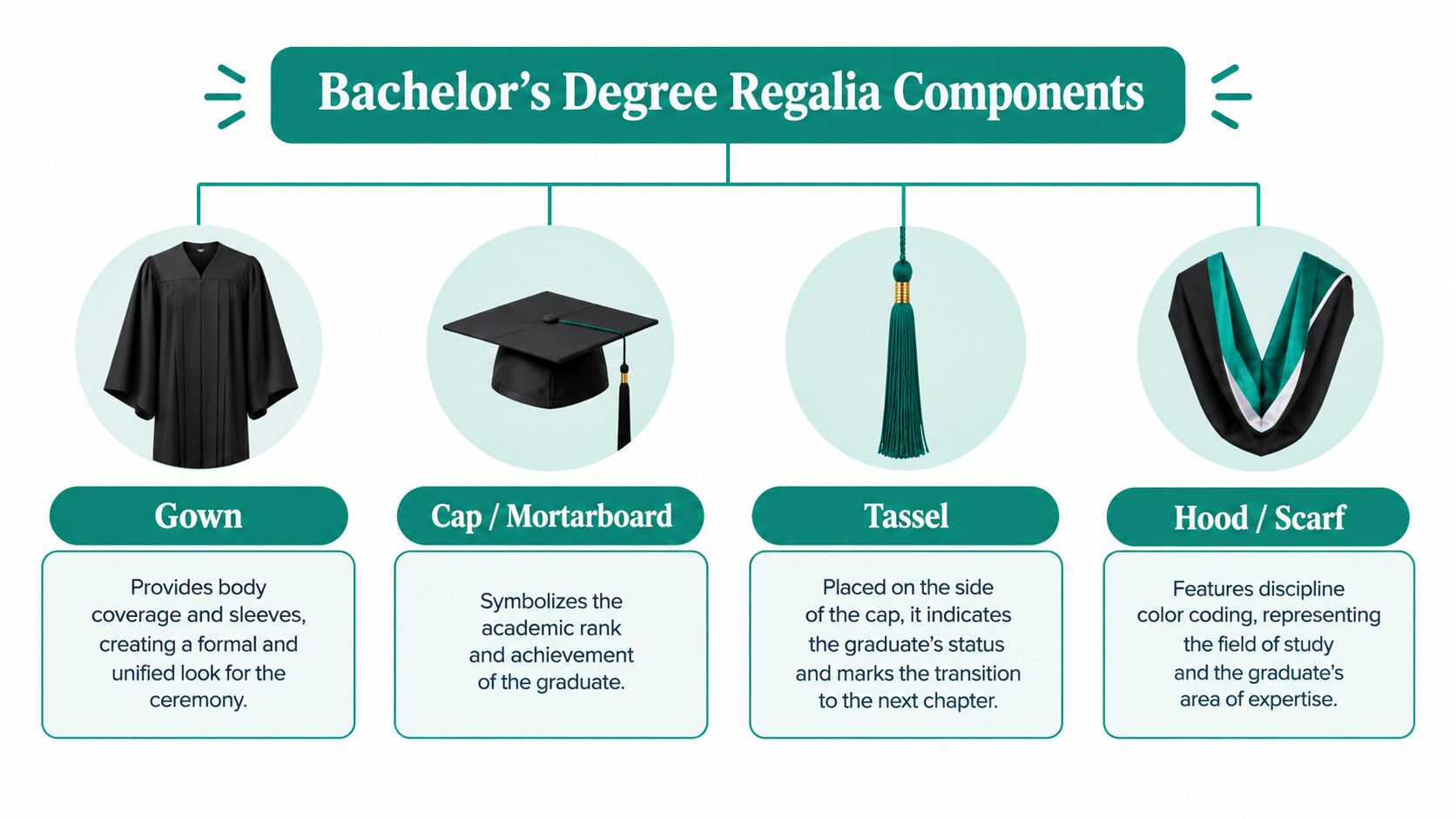
A standard bachelor's set usually includes a gown, mortarboard cap, and tassel. Some institutions add or authorize stoles, cords, or other accessories, while a hood may be used only under particular university or program rules. Confirm the contents of your school's approved set before assuming that every visible item belongs with a bachelor's degree.
Modern American academic dress follows a long-standing standardization tradition. Representatives of leading American institutions adopted a uniform code of academic dress in 1894, and the history of academic dress from Valdosta State University explains that the framework was later revised by the American Council on Education in 1932 and 1959. Another historical account identifies 1895 as the year American colleges and universities adopted a definite national code, so institutional references may describe the milestone slightly differently.
The gown identifies the degree level
A bachelor's gown generally has pointed sleeves and usually doesn't include the substantial velvet trimmings associated with doctoral attire. That distinction helps ceremony staff and guests recognize the academic level without relying on the graduate's program name.
The gown should also support practical movement. You'll zip it correctly, walk in a procession, sit, stand, and cross the stage while wearing it. Construction details aren't merely decorative, because sleeve openings, length, and closure affect how confidently you move.
The cap and tassel complete the formal outline
The typical bachelor's cap is a black mortarboard, a flat, square cap with a central tassel. The cap should sit level rather than angled backward, and its point should face forward near the forehead. The tassel begins on the wearer's right in many formal ceremonies and moves to the left after degree conferral.
Color conventions add another layer of meaning. The academic system associates fields with colors, including white for arts and letters, drab for business, light blue for education, and golden yellow for science. Institutional colors appear mainly through hood linings and related decorations, so your university's instructions still matter more than a general field-color chart.
For a visual explanation of how hoods differ from other components, see this guide to bachelor graduation hoods. Don't add a hood just because it appears in a generic illustration. Follow the regalia list issued for your ceremony.
Sizing Your Gown and Cap Correctly
A gown that looks acceptable on a hanger can fail when you walk. If it's too short, it may look unfinished and expose more of your clothing than intended. If it's too long, it can catch under your shoes or restrict your stride. University guidance commonly places the hem around the ankle or just above it, so height and body measurements matter more than street-clothing size.
Start with the university's sizing chart, then measure in the way the chart requests. Wear light clothing, stand naturally, and ask someone else to record the measurements so you aren't bending or pulling the tape.

Use measurements instead of guesswork
Check these points before placing an order:
- Height: Measure without shoes if the chart specifies it. Compare your result with the gown-length range rather than selecting your usual clothing size.
- Relevant circumference: Record the chest or other circumference requested by the supplier. A gown that is difficult to zip can restrict breathing and arm movement.
- Sleeve position: Make sure your arms can pass through the intended openings. Extra fabric on some sleeves can look like an opening but isn't designed for your hands.
- Head circumference: Measure around the part of your head where the cap will rest. A cap that is too loose may shift during the procession, while one that's too tight can become painful before the ceremony ends.
A correct fit lets you focus on your name, your walk, and your photographs instead of tugging at the hem.
Put the gown on fully before commencement. Zip it, sit down, stand up, walk across a room, and raise your arms enough to test the sleeves. The mortarboard should sit flat, with the point centered near your forehead. If you need additional measurement or fabric guidance, use the Grad Store size, color, and fabric guide.
A short demonstration can also help you check the cap and gown before the event.
If you use a pin or another cap-securing method, confirm that it won't damage the mortarboard or create discomfort. Instead, ask your commencement office whether any modification is permitted, particularly if you need an adaptive solution.
Navigating Tassels, Stoles, and Honor Cords
You order a cap and gown online, open the package, and find several tassel colors, cords, and stoles that appear to match. On commencement morning, the stage rules may tell a different story. Accessories often carry specific institutional meanings, so a product photo cannot confirm that every item is permitted.
A tassel may identify the university, degree field, or ceremony status. An honor stole can mark an approved distinction or affiliation. Honor cords may represent academic achievement, membership, or another officially recognized status. The same color can mean different things at different schools.
Check each accessory against your university's current commencement instructions, bookstore guidance, or registrar notice. Confirm the official tassel color before ordering, since a favorite shade or field color may not be acceptable. Find out whether a stole is required, optional, limited to one, or restricted to an official version. Ask which cords are recognized, who may issue them, and how many you may wear.
Tassel placement also deserves attention. In the usual formal sequence, the tassel hangs on the wearer's right before degree conferral and moves to the left afterward. Stage staff may use another procedure, so follow the directions given at your ceremony.
| Item | What it may communicate | What you must verify |
|---|---|---|
| Tassel | Institution, degree field, or ceremony status | Approved color and placement |
| Stole | Honor, affiliation, or institutional recognition | Whether it is required, limited, or optional |
| Cord | Honor or approved membership | Who may issue it and how many are allowed |
Treat the online listing as a menu, not as permission. A school may allow multiple honor cords while limiting graduates to one stole. Another may require a school-colored tassel or official stole. Verify the rules before buying extras, especially if the supplier groups several accessories into one attractive package.
Comfort matters on stage, too. A cord that slips beneath the gown or a stole that twists can distract you in photographs. Secure approved accessories without adding patches, pins, or fabric that the school prohibits.
Accessibility arrangements should be confirmed before you order. A cap fastener, adaptive garment, medical device, or mobility aid may need coordination with commencement staff and accessibility services. The approved setup should work with the gown and remain comfortable throughout the ceremony.
Purchasing Versus Renting and Borrowing Options
The online checkout may take minutes, while the wrong gown can remain obvious through every stage photograph. Before paying for a set, ask the registrar, commencement office, financial-aid staff, or bookstore whether your institution offers a loan, rental, grant, or approved borrowing option. A generic gown may resemble the required version yet fail a school rule on color, sleeves, or accessories.
Financial support can take different forms. Lake-Sumter State College's commencement information states that a limited number of caps and gowns are available to students with financial need. Connecticut State Community College reported that caps and gowns were provided at no charge for its 2025 graduates. Moore College distributed gowns for the ceremony and required graduates to return them the same day, with a fee if they were not returned.
A purchase gives you control over fit and keeps the outfit available for photographs, future ceremonies, or family use. It may be required when a school specifies official regalia. Lehman College, for example, required eligible students to wear its official cap and gown and listed an $84 purchase price for 2025 in its commencement information. An online bargain helps only if its design matches the institution's requirements.
Renting reduces storage after commencement, but it shifts attention to inspection and return rules. Open the package as soon as it arrives. Check the gown, cap, and tassel, then confirm whether the rental includes approved accessories. Ask where and when the set must be returned, whether cleaning is expected, and what happens if an item is damaged or late.
Borrowing from a graduate, campus office, or community program can remove the purchase cost. Confirm the source, measurements, color, and school approval before accepting it. A borrowed black gown can look close to the official version while having the wrong sleeve shape or lacking a required tassel.
Use this question before clicking “buy”: Does this option meet my university's ceremony rules, and what happens if the size or color is wrong?
Start with financial aid options, including need-based loans, grants, bookstore assistance, and no-cost distributions. Then confirm whether used or borrowed regalia is accepted and protect enough time for an exchange. Affordability and compliance belong together. The right choice is the one that lets you participate comfortably, in approved attire, without an avoidable return problem.
Ordering Timeline and Preparation Checklist
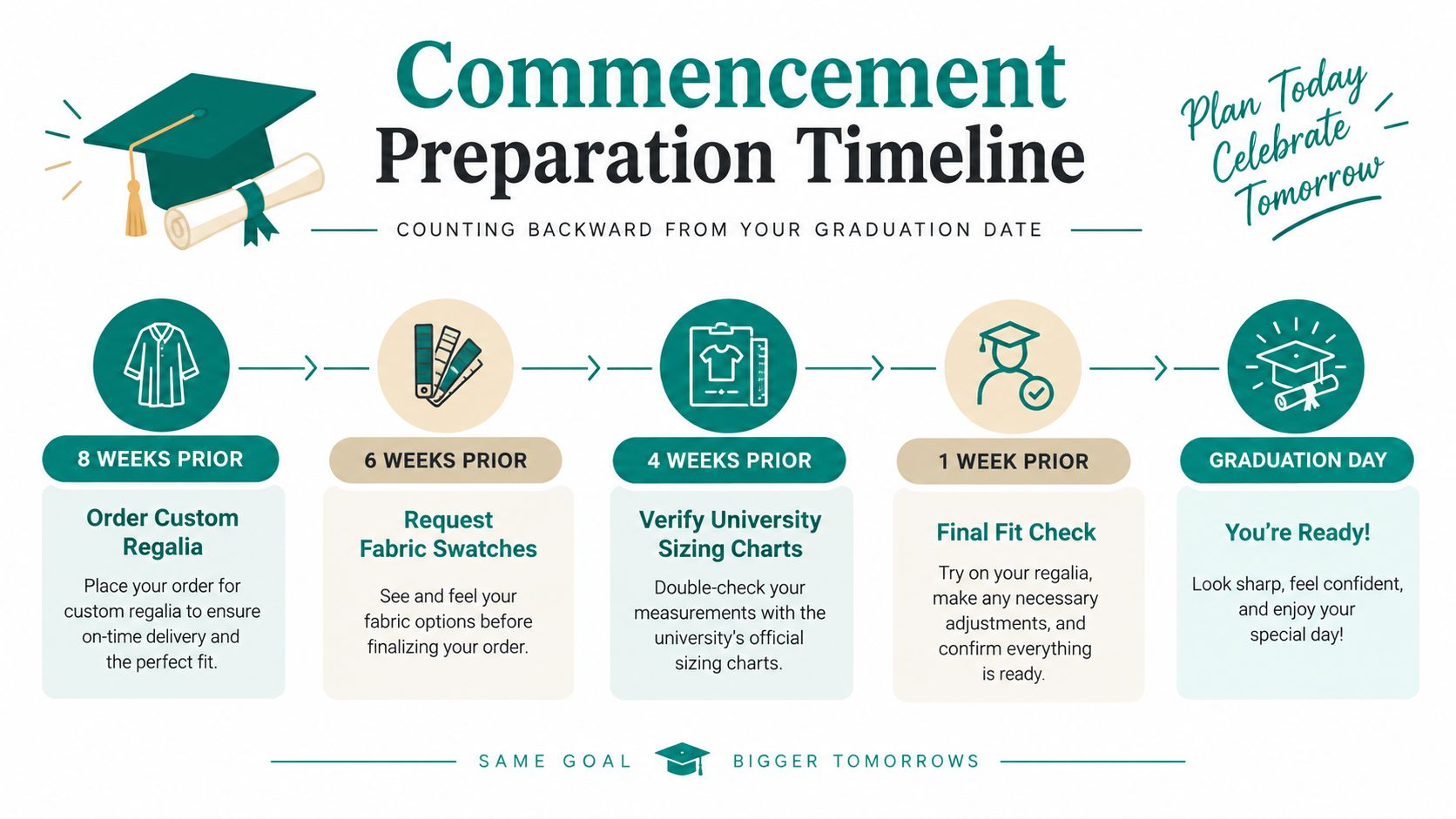
An online order can arrive before the deadline and still fail on stage. A gown that fits the chart but catches at your shoes, a shade that looks right on a screen but misses the school color, or a tassel chosen from a generic menu can create problems when there is no time to correct them. Work backward from the ceremony date and build in time for verification.
Use the deadline as a checkpoint
Start with the official commencement page. Record the required gown design, cap type, tassel color, stole policy, and ordering deadline. If a supplier offers fabric swatches, request one before choosing a color tied to the university's specifications.
Use this backward schedule:
- Several weeks before: Confirm the approved design, colors, accessories, and deadline.
- After measuring: Match your height, circumference, and head measurement to the supplier's chart. Keep the chart with your order confirmation.
- When the set arrives: Try on every piece indoors with the shoes and clothing you plan to wear.
- Before ceremony week: Request an exchange if the gown restricts movement, will not zip, or hangs at an unsafe length.
- At the final check: Compare the tassel, stole, and cords with the latest university instructions, rather than another graduate's outfit.
A group order organizes shared details, but it cannot confirm your individual fit. Test the completed set and report a problem as soon as you find it.
Place accessibility requests on the same calendar. Contact accessibility services and commencement staff early if you need stage assistance, accessible seating, captioning, interpretation, assistive listening equipment, service-animal access, or permission to wear the gown in an adaptive way. University notice requirements differ, and event-day staff may not be able to approve a complex adjustment immediately.
Final Preparations Before You Step on Stage
At the venue, an outfit that looked correct online can behave differently in motion. Put on the complete set before ceremony day. Zip the gown, level the cap, attach the tassel, add approved accessories, and walk enough to find snagging, loose fabric, or restricted movement.
Check these details:
- Institutional specification: Compare the sleeve design, official color, cap, and tassel with your university's latest instructions. A generic product photo cannot settle a school-specific rule.
- Functional fit: Recheck your height and circumference selections, then test zipping, sitting, standing, and walking. Online sizing charts guide the order, but only a full try-on reveals whether the hem, sleeves, and closure work together.
- Accessory compliance: Confirm each stole and cord, whether you may wear more than one, and where each item belongs. Tassel placement may also follow a school rule rather than a general tradition.
Suppliers and university teams handle a large recurring flow of graduates, so firm deadlines and color specifications help organize ceremonies. Your order still requires personal review because institution rules, measurements, and delivery timing vary. If the gown restricts movement or the color is wrong, request an exchange promptly.
For the correct order of the pieces, follow this guide to wearing graduation regalia. Keep the cap, gown, approved accessories, and required ceremony documents together. Arrive early enough to ask staff for help.
If purchase cost remains a concern, ask commencement staff about rental, loaner, or campus assistance options before ceremony week. A group order may simplify logistics, but it cannot check your fit.
Grad Store offers school-specific bachelor's regalia, caps, gowns, tassels, stoles, sizing guidance, fabric swatches, and shipping options. Review your university's requirements first, then visit Grad Store to compare an appropriate set and request support before ordering.