

You're standing in line with your cap balanced carefully on your head when a classmate suddenly asks, “Which side does the tassel go on?” Your gown is zipped, your diploma cover is ready, and the ceremony is about to begin, but this small detail can create surprising uncertainty at exactly the wrong moment.
The answer depends on two things, not one: your degree level and the stage of the ceremony. Bachelor's candidates generally begin with the tassel on the wearer's right and move it left when the degree is officially conferred. Master's and doctoral candidates generally wear it on the left from the beginning. Your university's instructions always take priority over the general convention.
Table of Contents
- The Commencement Moment When the Tassel Moves
- How Bachelor Candidates Position Their Tassel
- What Graduate and Doctoral Students Should Know
- The History Behind Tassel Placement Rules
- Final Checklist for Ceremony Day Success
The Commencement Moment When the Tassel Moves

At a U.S. commencement, the tassel records a change in status. A bachelor's candidate begins with it on the wearer's right, then moves it to the left when the institution formally recognizes the class as graduates. The ceremony's official instructions determine exactly when that movement happens.
The cue may come during the ceremony, at its conclusion, after the president's announcement, or after graduates cross the stage. It does not necessarily coincide with receiving a diploma cover. Syracuse University's guidance on regalia etiquette describes the right-to-left movement for bachelor's candidates and separates that practice from the regalia procedure for advanced-degree candidates.
Confusion usually starts when students compare different ceremonies. A university may hold a general commencement, a college convocation, and a departmental event, each with its own announcement or stage procedure. Another student's tassel, a photograph, or casual advice about moving it after receiving the diploma does not establish the correct cue for your ceremony.
Why the timing matters
The movement is a symbol of institutional recognition. It does not change your academic level during the event. It marks the school's transition of bachelor's candidates from degree status to graduate status. Graduate and doctoral students may follow a different convention, so degree level must be checked before applying the familiar right-to-left rule.
Use this pre-ceremony check:
- Confirm your degree level and read your university's regalia instructions.
- Identify the announcement or ceremony point that authorizes the move.
- Attach the tassel to the mortarboard's center button and confirm the side from your own viewpoint.
- Wait for the official cue, even if nearby graduates move theirs earlier.
- If staff instructions differ from the general convention, follow the staff direction.
Practical rule: Start with the general convention, then follow your university's exact announcement. Ceremony staff, not classmates or social media photos, have the final say.
For a bachelor's outfit, review the cap, gown, and accessory guidance in how to wear a bachelor graduation gown. Correct tassel placement works best when the entire set of regalia is assembled before you join the lineup.
How Bachelor Candidates Position Their Tassel
For a bachelor's ceremony, the standard procedure is straightforward once you separate attachment, placement, and timing. The tassel attaches to the small button at the center of the mortarboard. It doesn't attach to a corner, the edge, or the elastic band inside the cap.
The correct starting position
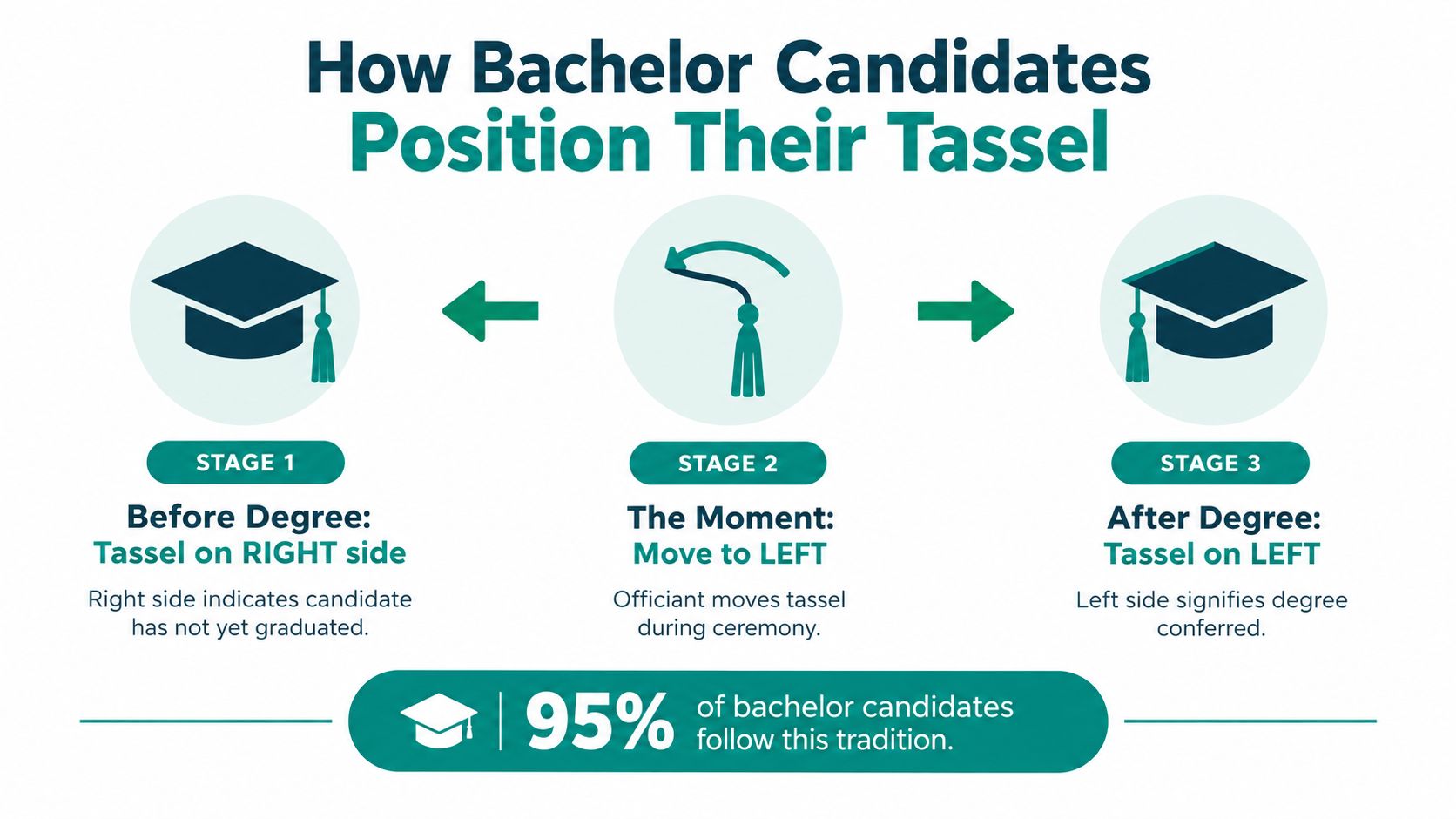
Before the degree is conferred, place the hanging fringe on the wearer's right side. The cap's center button should remain in place throughout the ceremony, and the tassel should hang freely from it.
A reliable setup process looks like this:
- Find the center button. Locate the button sewn into the middle of the mortarboard.
- Attach the loop. Place the tassel loop securely over that button.
- Check your viewpoint. Stand in front of a mirror and confirm that the fringe falls on your right.
- Leave it there before the ceremony. Don't move it just because other graduates are wearing theirs differently.
- Listen for the official cue. Wait for the president, dean, or ceremony leader to direct the class.
- Move the fringe to your left. Transfer the hanging portion across the front of the cap while leaving the tassel attached to the center button.
This procedure reflects the guidance published by Kansas State University for wearing commencement regalia. The right-side position identifies you as a candidate before conferral. The left-side position follows the institution's recognition of the degree.
The cue may not be the diploma
Some universities direct graduates to move the tassel after the president formally confers the degrees. Others use a signal connected with crossing the stage, while some place the movement near the end of the ceremony. That's why “move it after you get your diploma” is an unreliable universal instruction.
The University of Louisiana's academic regalia guidance describes the general U.S. sequence as right before conferral and left afterward. It also reinforces the practical point that ceremony stage matters. If staff tell you to wait until the announcement, wait, even if you've already walked across the stage.
A quick rehearsal prevents most errors. Put the cap on, identify the wearer's right, practice moving the fringe across the front without removing the loop, and then return it to the starting position until the official moment.
What Graduate and Doctoral Students Should Know
A master's or doctoral candidate can arrive at commencement expecting the bachelor's rule, then see that the tassel should already be on the other side. Degree level controls the usual placement. Graduate and doctoral candidates typically wear the tassel on the wearer's left side from the beginning through the end of commencement, rather than moving it from right to left during the ceremony.
The distinction comes from the degree category, not just the cap style. A master's candidate may wear a square mortarboard, while a doctoral candidate may wear a university-approved tam. The headwear changes, but the usual tassel position remains on the left.
Master's regalia
Before lineup, check the university's ceremony instructions. Identify the front of the cap, attach the tassel to the center button, and place the fringe on the left. Once the placement is correct, leave it there unless commencement officials give a different direction.
The University of North Dakota's graduate regalia information explains that master's and doctoral candidates normally wear the tassel on the left throughout commencement. It also distinguishes placement from color. A tassel's color may reflect the discipline, college, degree, or the institution's own practice.
A shared instruction for every graduate can cause mistakes. Undergraduate candidates may be told to move their tassels, while master's and doctoral candidates generally are not. Confirm which ceremony and degree category apply before following a group announcement.
Doctoral regalia and tams
Doctoral candidates commonly wear an eight-sided tam or another institution-approved tam instead of a square mortarboard. The tassel still normally hangs on the wearer's left from the start.
Use this pre-ceremony check:
- Confirm the headwear. Make sure the tam or mortarboard matches the university's instructions.
- Find the center attachment point. Secure the tassel to the approved central button.
- Check the wearer's left. Judge the position from the candidate's perspective, not the audience's.
- Inspect the color. Doctoral tassels may be gold or institution-specific, and the university may restrict decorations.
- Follow the ceremony guide. Staff instructions override the general convention.
For the rest of the outfit, consult this practical guide to how to wear doctoral regalia. It covers the tam, gown, hood, and other details that may vary by institution.
Graduate-level candidates should not move the tassel just because bachelor's candidates move theirs. The degree category determines the convention.
Hooding can add another point of confusion. Hooding and commencement may be separate events, and wearing a hood does not automatically mean the tassel should move. Read the instructions for each ceremony separately, then confirm the placement before joining the procession.
The History Behind Tassel Placement Rules
The tassel tradition feels ancient because it appears alongside academic robes, hoods, and caps that draw on medieval European university dress. The specific American right-to-left movement, however, is a more recent ceremony practice layered onto that older heritage.
Academic dress developed from clothing associated with medieval European universities. In the United States, common academic-costume guidance was formalized through the Intercollegiate Code of Academic Costume in 1895, as described in this historical account of graduation tassel etiquette and traditions.

A standardized American ritual
Historical accounts place the adoption of the right-to-left movement in American practice by 1909. That doesn't mean every institution immediately treated it as mandatory or universal. Academic-dress guidance revised in 1935 questioned the ritual, including the practical observation that wind could move a tassel naturally.
The convention persisted because commencement benefits from shared visual cues. A whole class can begin in one position and respond to one collective instruction. The movement takes only a moment, but it gives the ceremony a visible marker that photographs and attendees can easily understand.
Tradition is not the same as universal law
The historical record explains why students encounter variations. This isn't a single global rule applied identically by every country, university, or degree program. It's a recognizable U.S. convention shaped by institutional practice.
Arizona State University has described the bachelor's tassel movement as a possible substitute for hooding, a ceremony more commonly associated with advanced degrees. That comparison helps explain why bachelor's candidates often have a visible transition while master's and doctoral candidates generally begin with the tassel already on the left.
The practical conclusion is more useful than memorizing dates. Treat the tradition as a starting point for preparation, not as permission to ignore your commencement guide. University officials may specify a different cue, cap orientation, tassel color, or approved decoration. Historical custom provides context, but the ceremony instructions determine what you should do on the day.
Final Checklist for Ceremony Day Success
Before lineup, identify your degree level and the ceremony format. The question is not only, “What side does the tassel go on?” Confirm whether you are receiving a bachelor's, master's, or doctoral degree, then check whether your institution has announced a specific conferral cue.
The usual U.S. sequence appears in official academic regalia guidance from the University of Louisiana, but your university's instructions control the ceremony.
Tassel Placement Quick Reference
| Degree Level | Before Conferral | After Conferral |
|---|---|---|
| Bachelor's | Wear the tassel on the wearer's right side. | Move it to the wearer's left when university officials give the cue. |
| Master's | Normally wear the tassel on the wearer's left side. | Keep it on the left unless staff direct otherwise. |
| Doctoral | Normally wear the tassel on the wearer's left side, including on an approved doctoral tam. | Keep it on the left unless staff direct otherwise. |
The final inspection
Use this checklist before leaving for the venue:
- Verify your degree category. Bachelor's, master's, and doctoral candidates may follow different tassel procedures.
- Check the cap or tam. Find the front and make sure the headwear sits securely.
- Attach the tassel centrally. Use the center button, not an edge or corner.
- Confirm the side from the wearer's viewpoint. Bachelor's candidates generally begin on the right. Graduate and doctoral candidates generally begin on the left.
- Inspect the color and decoration. Match institutional requirements and remove unapproved additions.
- Listen for the cue. Do not move a bachelor's tassel early because another group has already moved theirs.
- Practice once. Move the fringe across the front while keeping the loop attached.
The guide to wearing graduation regalia can help you check the cap, gown, and related pieces. Fix a loose tassel or unclear cap position before lineup, not while walking toward the stage.
A general commencement, convocation, hooding, or departmental event may use different directions. Save the official ceremony guide on your phone, ask staff at rehearsal when an instruction is unclear, and follow the university's announcement for the exact moment.
Grad Store offers institution-specific bachelor's, master's, and doctoral regalia, including caps, gowns, hoods, tams, tassels, and stoles aligned with university requirements. Visit Grad Store to confirm degree-level pieces, review sizing and color support, or coordinate a group order before commencement.