

Princeton's regalia follows the Intercollegiate Code established in 1895, with distinct hoods for bachelor's, master's, and doctoral degrees. The correct Princeton academic dress depends first on your degree level, then on your discipline and the ceremony's specific instructions.
You're standing in front of an open order form, trying to decide whether the hood in your cart is really the right one. The gown looks close enough, the colors seem familiar, and the ceremony is approaching quickly. Then you notice that one product description says “Princeton,” another lists your degree field, and a third includes accessories you're not sure you're allowed to wear.
That uncertainty is common. Academic regalia carries several types of information at once, including degree level, academic discipline, and university identity. A careful order prevents a disappointing surprise when your hood drapes differently from everyone else's or your accessories compete with the official dress.
Table of Contents
- Why Getting Princeton Regalia Right Matters
- Understanding Degree Levels and Regalia Types
- Decoding Princeton Hood Colors and Patterns
- Sizing and Accessories for a Perfect Fit
- Ordering Your Princeton Regalia with Confidence
- Frequently Asked Questions About Princeton Regalia
Why Getting Princeton Regalia Right Matters
A graduate once arrived at a fitting appointment with a gown that looked acceptable on a hanger but had the wrong hood construction for the ceremony. The problem wasn't the graduate's effort. They had searched for Princeton regalia, selected a familiar color, and assumed that a university-branded set would automatically match their degree. The missing step was checking how Princeton uses the hood to distinguish academic information.
That check matters because Princeton has a direct connection to the modern intercollegiate system. In June 1893, Princeton trustees appointed John J. McCook to lead a formal academic-costume committee. Princeton's work helped produce the Intercollegiate Code of Academic Costume, adopted on March 16, 1895, which established a common system for black gowns, mortarboard caps, and discipline-colored hoods. Princeton sources note that its intercollegiate statutes have remained in force today almost without alteration. Read the historical account in Princeton Alumni Weekly's coverage of the university's role in standardizing academic dress.

The three checks that prevent most mistakes
Before you order, confirm these items in this order:
- Degree level: Identify whether you're receiving a bachelor's, master's, or doctoral degree. The hood, gown details, and headwear can vary by level.
- Academic discipline: Confirm the field associated with the degree, not just the department where you studied or the color you personally prefer.
- Ceremony instructions: Check the official information supplied for your commencement or hooding ceremony. A product page can describe a standard set, but your event may have its own requirements for accessories, photographs, or doctoral headwear.
The most reliable approach is to treat the gown as only one part of the outfit. The hood is the item that carries the most specialized information, while the cap and gown establish the shared ceremonial foundation. If you're unsure, ask the commencement office or regalia coordinator before paying for a custom item.
Practical rule: Never choose a hood by color alone. Match the degree level and discipline first, then verify the Princeton lining and ceremony instructions.
Princeton's history makes this especially important. The system was designed to create a visual language that works across institutions, so a garment can communicate information to people who don't know you personally. Ordering the right set respects that system and saves you from making a correction when replacement options are limited.
Understanding Degree Levels and Regalia Types
Start with the credential printed on your graduation documents. Don't begin with your major, the color you saw in a photograph, or the accessories worn by a friend. Princeton regalia is organized around bachelor's, master's, and doctoral degree levels, and each level has its own place in the academic costume system.
Bachelor's regalia
Bachelor's dress is generally the most straightforward combination. It typically uses a gown and cap, with the exact hood or other components determined by Princeton's ceremony instructions. A bachelor's candidate should therefore avoid ordering a master's or doctoral hood just because it looks more elaborate.
Check the product description for the degree level before selecting a size. If a listing groups several academic levels together, read the included-items list carefully. A cap and gown set may not include a hood, tassel, stole, or other accessory unless the description says so.
Master's regalia
Master's candidates need a set designed for the master's level, including the appropriate hood when the ceremony requires one. The master's hood has the same basic academic function as a doctoral hood, but its proportions are different. Princeton's official program explains that master's hoods are approximately one foot shorter than doctoral hoods, creating a visible distinction in drape and geometry. See the Princeton Hooding and Recognition Ceremony program for that specification and related ceremony information.
That difference is practical, not merely decorative. A shorter hood sits and photographs differently, and substituting a doctoral hood can make the outfit look disproportionate even if the lining and border colors seem correct.
Doctoral regalia
Doctoral regalia is the most specialized option. Confirm whether your ceremony calls for a doctoral gown, hood, and tam, or for another approved combination of academic dress. Doctoral candidates should also verify the discipline color rather than assuming that all doctoral hoods use the same velvet border.
Use a university-specific collection such as the Princeton University academic regalia collection as a starting point, then compare the listed components with your ceremony instructions. The safest order has three matching details: the credential level, the academic field, and the Princeton institutional lining.
If the order form asks you to choose between degree levels, stop and confirm the credential before choosing a color. A correct color on the wrong hood is still the wrong order.
Decoding Princeton Hood Colors and Patterns
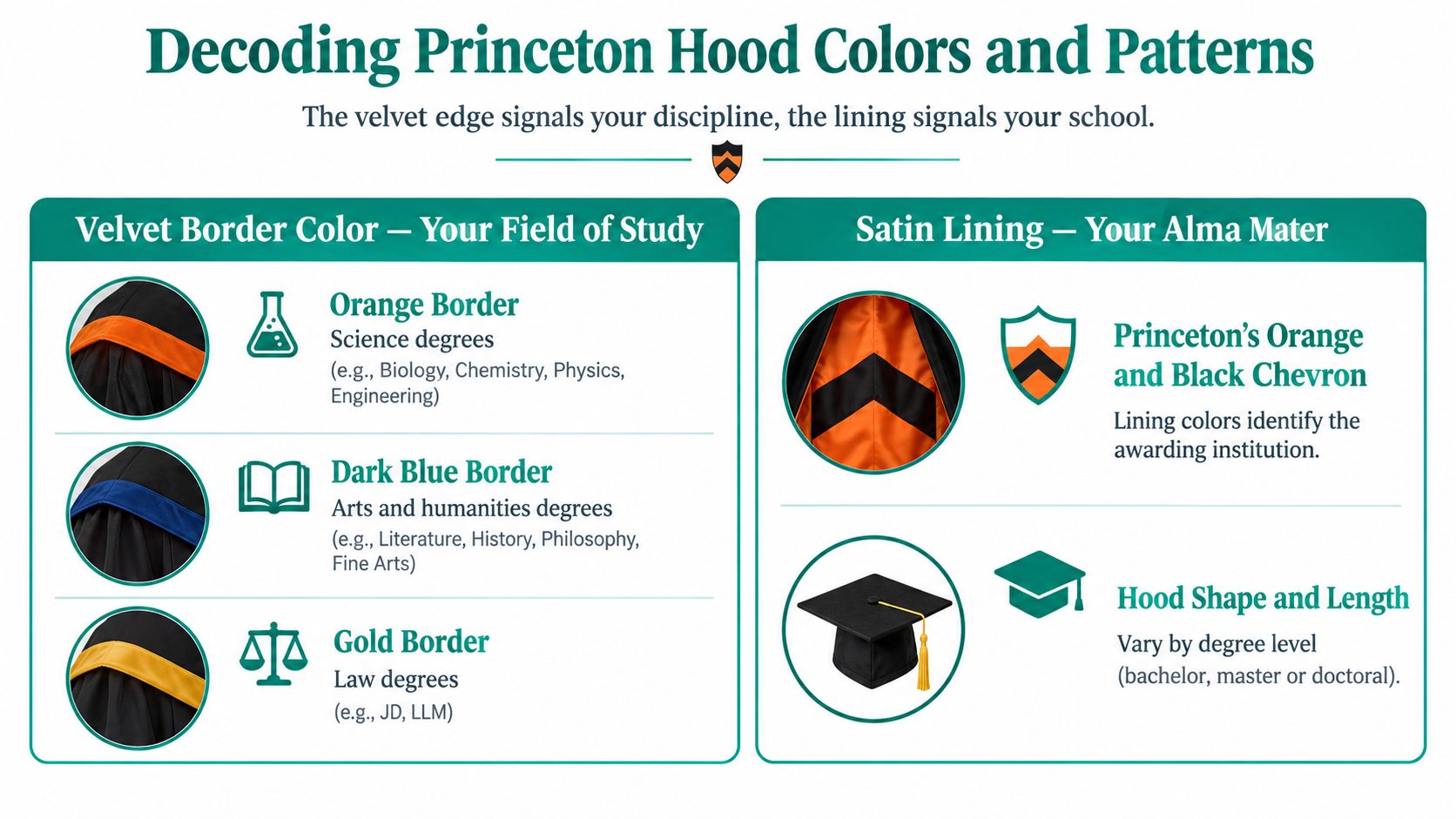
A Princeton hood does two jobs at once. Its velvet border identifies the academic field, while its lining identifies Princeton as the awarding institution. That division helps viewers read the garment without confusing a student's discipline with the university's colors.
Princeton's advanced-degree regalia uses orange with a black chevron in the hood lining. The velvet border changes according to the academic field. Princeton's museum explains that the mapping includes blue for philosophy, peacock blue for public affairs, gold or orange for engineering, white for arts and letters, brown for architecture, and light brown for finance. Review the Princetonianam Museum artifact record for advanced-degree hood construction and color conventions.
Read the hood in layers
Think of the garment as a compact identification system:
| Hood feature | What it communicates |
|---|---|
| Velvet border | The academic discipline associated with the degree |
| Hood lining | Princeton's institutional identity, shown through orange and black |
| Hood length and shape | A visible distinction associated with degree level |
| Gown and cap | The shared academic costume framework |
The lining and border shouldn't be treated as interchangeable. A Princeton lining doesn't tell you that the border color is correct for your field, and the correct discipline color doesn't prove that the hood has the proper Princeton interior. You need both.
The construction also explains why close matches can be misleading. Two hoods may look similar in an online photograph because the product image compresses the border, lining, and fold into a small area. Ask for the exact field selection and inspect the interior color pattern when the listing provides that information. If you're comparing doctoral options, a guide such as PhD regalia colors and their academic meanings can help you understand the broader color system, but Princeton's instructions should control your final choice.
A short video can also help you recognize how the hood sits on the shoulders and how the lining appears during a ceremony.
Don't confuse official hoods with identity accessories
Students now often wear stoles, cords, or club regalia to express affiliation, identity, and extracurricular pride. Princeton coverage distinguishes those items from the hood, which communicates degree rank and discipline, with orange and black identifying the university. That distinction is useful when a photo shows several colors across one graduate's outfit.
The hood is the academic requirement to verify first. A stole or cord may be permitted and meaningful, but it doesn't replace the required hood or alter the discipline color. Check the ceremony guidance before adding anything that could cover the velvet border or interrupt the Princeton lining.
Sizing and Accessories for a Perfect Fit
The right color won't rescue a gown that catches on your shoes, a hood that slips backward, or a cap that becomes uncomfortable before the ceremony ends. Fit affects movement, photographs, and the way the hood hangs, so take measurements before you open the order form.
Measure before selecting a size
Use the seller's measurement instructions rather than guessing from your everyday clothing size. Pay attention to height, garment length, and any listed weight or chest guidance. Wear the shoes you expect to use for the ceremony when checking length, and leave enough room for formal clothing underneath without making the sleeves excessively long.
A gown should allow you to walk naturally and raise your arms without pulling across the shoulders. Try it on before the event if possible. Look for twisted fasteners, a hood that refuses to stay in place, and sleeves that hide your hands. Those are easier to fix at home than in a procession line.
The size, color, and fabric guide can help you compare measurements and materials before selecting a set. If you're between sizes, contact the seller with your measurements and ceremony date instead of choosing solely by instinct.
Treat headwear and accessories separately
Your cap or tam needs to sit securely without pressing painfully against your head. Adjust it before the ceremony, especially if you'll be wearing hair accessories, pins, or a hairstyle with significant volume. Keep the tassel placement consistent with the ceremony instructions, and don't add decorative pieces that could fall into the aisle or distract from the official dress.
Stoles and cords require a different decision. Princeton's coverage describes them as ways students express affiliation and pride, not as substitutes for the academic hood. Before ordering, ask:
- Is it approved: Confirm that the ceremony permits the stole, cord, or organization-specific item.
- Will it cover the hood: Choose placement that leaves the discipline border and Princeton lining visible.
- Does it identify a real affiliation: Wear only items connected to an organization, honor, or role you're entitled to represent.
- Will it stay secure: Test the accessory with the gown so it doesn't slide, twist, or catch on the hood.
A polished outfit is one you can walk, sit, shake hands, and pose in without adjusting it every few minutes.
Ordering Your Princeton Regalia with Confidence
There are two practical ordering routes, and the better choice depends on how many people need regalia and how much coordination the ceremony requires. A department arranging dress for a cohort has different priorities from one graduate replacing a damaged hood.
| Ordering route | Best suited to | What to verify |
|---|---|---|
| Group order | Departments, programs, and graduating cohorts | Shared degree-level instructions, field colors, measurements, delivery point, and inspection plan |
| Individual order | A single graduate or a replacement purchase | Exact credential, discipline, size, included components, and delivery date |
| Custom order | Unusual specifications or a need for particular detailing | Approval, swatches, production timing, return terms, and personalization details |
| In-stock order | A compressed preparation schedule | Stock status, color selection, shipping method, and fit information |
For a group purchase, appoint one coordinator who collects the information and keeps a written order record. Separate people by degree level and discipline before submitting the request. Do not place every graduate under one generic “Princeton” selection if the hoods need different velvet borders.
Group orders reduce individual confusion
A group order can make distribution easier because one person receives and checks the shipment. It also creates a single point for questions about delivery, missing components, and inconsistent color selections. The tradeoff is that one incorrect spreadsheet entry can affect several orders, so review the list before submitting it.
Create columns for:
- Degree level
- Academic discipline
- Height and other requested measurements
- Hood requirement
- Cap or tam requirement
- Approved stole or cord
- Delivery contact
- Ceremony date
For an individual purchase, compare the item description with your own checklist. Confirm whether the price includes the hood, cap, gown, and tassel, rather than assuming that the product photograph shows everything included.
Request material information before committing
Screen colors can make orange, black, and discipline borders appear different from the physical fabric. If a seller offers fabric swatches, request them when color accuracy matters, particularly for a custom or group order. Grad Store lists free fabric swatches and regalia ordering support, along with fulfillment choices and customer service information, but you should still compare the final selection with Princeton's ceremony guidance.
Build in time for inspection. When the package arrives, check the degree level, hood length, border color, lining, fasteners, cap or tam, and accessories. Try everything on together. If something is wrong, contact the seller while replacement or exchange options remain available, rather than waiting until the morning of commencement.
Frequently Asked Questions About Princeton Regalia
Where should I begin if I don't know what to order?
Begin with the degree level listed by Princeton, then confirm the academic discipline and ceremony requirements. The university-specific description should identify whether the set is for bachelor's, master's, or doctoral use and whether a hood is included.
Is the Princeton lining enough to confirm that a hood is correct?
No. Princeton's orange-and-black lining identifies the institution, but the velvet border must also correspond to the academic field. Check both features, along with the hood's length and construction.
Can I wear a stole or cord with the official hood?
Often, students use stoles and cords to show affiliation or extracurricular pride, but those items are separate from the academic hood. Confirm permission with the ceremony coordinator, and position accessories so they don't hide the discipline border or Princeton lining.
What should I do if my size is unavailable?
Don't substitute a different degree level or order a hood based only on a similar color. Ask the seller about restocking, exchanges, in-stock alternatives, or expedited fulfillment, then confirm that any substitute still matches Princeton's requirements.
What is the final inspection checklist?
Before ceremony day, verify:
- Credential: The set matches your bachelor's, master's, or doctoral degree.
- Discipline: The velvet border corresponds to your academic field.
- Institution: The hood lining uses Princeton's orange-and-black identity pattern.
- Proportion: The hood length and shape suit the degree level.
- Fit: The gown, cap, or tam is comfortable and secure.
- Accessories: Every stole and cord is permitted and properly positioned.
- Logistics: You've inspected the shipment and know how to resolve a problem.
Princeton regalia becomes much easier to order once you stop treating it as a single black outfit. Verify the information encoded by each garment, keep optional accessories separate from official requirements, and inspect the complete set before the ceremony.
Grad Store offers Princeton-specific bachelor's, master's, and doctoral regalia, along with hoods, caps, tams, stoles, tassels, sizing guidance, swatches, and group-order support. Use the Grad Store catalog to compare the correct degree level and components, then place your order early enough to review the fit and colors before commencement.