

You're probably looking at a vendor page, a school FAQ, and a department email that don't quite agree. You need to know whether regalia is required, which package matches your degree, whether the new blue-and-gold design applies to you, and whether renting is sensible if you want to keep the outfit. In 2026, that confusion has a clear cause: UC Berkeley has moved to a new university-wide regalia arrangement, but the practical buyer guidance still leaves important gaps.
The short version is simple. Campuswide commencement doesn't require regalia, but your department or school ceremony may have its own expectations. If you rent, you'll generally keep the cap and tassel, while the gown and other pieces follow the rental model. If you want a durable doctoral or master's ensemble for future academic events, purchase deserves serious consideration rather than being treated as an unnecessary upgrade.
Table of Contents
- Navigating the 2026 Commencement Requirements
- Evaluating Rental Versus Purchase Options
- Degree-Specific Gown and Cap Requirements
- Decoding Academic Hood Colors and Velvet Rules
- Ordering Logistics and Group Coordination
- Validating Fabrics and Colors Before Purchase
- Preparing for Ceremony Day and Beyond
Navigating the 2026 Commencement Requirements
You have a department email, a vendor page, and a ceremony schedule that may not align. In 2026, that confusion comes from UC Berkeley's new university-wide regalia arrangement. Berkeley announced a 10-year exclusive partnership with Herff Jones in January 2026, making the company the designated graduation-regalia provider for the campus-wide program. Read the partnership announcement to confirm the arrangement before placing an order.
The change creates a standardized program, updated university branding, rental-first instructions, and separate expectations from schools and departments. Treat those as different layers. Your school or department may set requirements that do not appear in the campus-wide guidance.
Start by separating ceremony eligibility from clothing requirements. Berkeley's campuswide commencement permits blue or black regalia, business casual clothing, or cocktail attire, so regalia is not mandatory for that event. A department ceremony can follow different practices, and some programs strongly recommend official academic dress. Confirm the rules for your specific ceremony before spending money on a gown or hood.
Deadlines that create pressure
For the 2026 program, the free pickup pre-order deadline is March 27, 2026. Shipping orders remain available through April 10, 2026, with shipping costs starting at $18.10. Those dates affect both renters and buyers who need campus-approved items on time. Waiting can turn a routine order into a store-availability problem.
The university's regalia guidance says late rentals are available only at the Cal Student Store. That fallback may help if you miss the online window, but it gives you fewer choices and less time to correct sizing. Do not assume your preferred degree package will be in stock.
Practical rule: Confirm the ceremony requirements first. Then choose rental or purchase before the campus pickup deadline.
The core 2026 decision
The vendor shift supports a consistent official look and a straightforward rental process. It creates friction for graduates who want to compare fabrics, keep a complete set, or reuse regalia at future academic events. Berkeley's public instructions explain where and when to order, but they leave the ownership question to you.
Rent when you need attire for one event and want the lowest immediate commitment. Compare a custom purchase when the degree is part of a longer academic career, when fit and fabric matter, or when the garment should remain a keepsake. A purchased doctoral or master's set can also serve at later academic ceremonies, so do not treat ownership as an unnecessary upgrade.
Evaluating Rental Versus Purchase Options
The 2026 vendor shift makes the rental choice straightforward for a single ceremony, but less suitable for graduates building a complete academic wardrobe. Berkeley's published pricing lists bachelor's gowns from $50.94, master's gowns from $96.92, and doctoral gowns from $132.92. The university regalia page also explains that rental packages let graduates keep the cap and tassel, while stoles are sold separately.
That ownership detail changes the calculation. A rental covers the ceremony essentials, but it may not leave you with the gown, hood, and other pieces needed for later academic events. Purchasing costs more upfront in many cases, yet gives you control over fit, fabric, storage, and future use. Custom regalia also lets you inspect construction and select materials instead of accepting whatever rental inventory is available.
Regalia acquisition decision matrix
| Factor | Official Rental Route | Custom Purchase Route |
|---|---|---|
| Immediate commitment | Lower commitment and designed for a single commencement cycle | Higher upfront commitment, with ownership after delivery |
| What you keep | Cap and tassel, with stoles sold separately | The complete items you order, subject to the seller's product terms |
| Fit control | Depends on the available rental sizing and package | You can select sizing, construction, and finish before ordering |
| Future academic use | Limited unless you separately acquire additional pieces | Practical for later ceremonies, academic processions, and institutional events |
| Financial hardship support | Berkeley lists a limited no-cost gown borrowing option | Purchase requires payment, so it may not suit every budget |
| Deadline risk | Late rental access is restricted to the Cal Student Store | You must manage production and delivery time yourself |
| Best fit | One-time ceremony needs and simple logistics | Doctoral or master's graduates who value ownership and repeat use |
For many bachelor's graduates, renting remains the sensible default. The gown may serve one ceremony, and the cap and tassel already provide a lasting memento. Purchase makes more sense when you need a precise fit, care about a particular fabric, or want a complete keepsake instead of accessories alone.
Master's and doctoral graduates should make the decision more deliberately. Their regalia includes more visible degree-specific elements, especially the hood and, for doctoral candidates, velvet detailing and a tam or other approved headwear. A custom order can preserve those details for future academic participation, rather than forcing you to rebuild the outfit later.
When budget changes the recommendation
Financial hardship does not have to prevent participation in commencement. Berkeley says a limited number of gowns may be borrowed at no cost for graduates facing financial hardship. Availability is limited, so contact the relevant campus or program office early instead of waiting for the rental deadline.
The practical recommendation is clear: rent when your priority is immediate affordability and one-time use, purchase when your priority is control and repeat use. Do not buy a custom set merely because it looks better. Buy it when its construction, ownership, and future utility address a need the rental package leaves unresolved.
Degree-Specific Gown and Cap Requirements
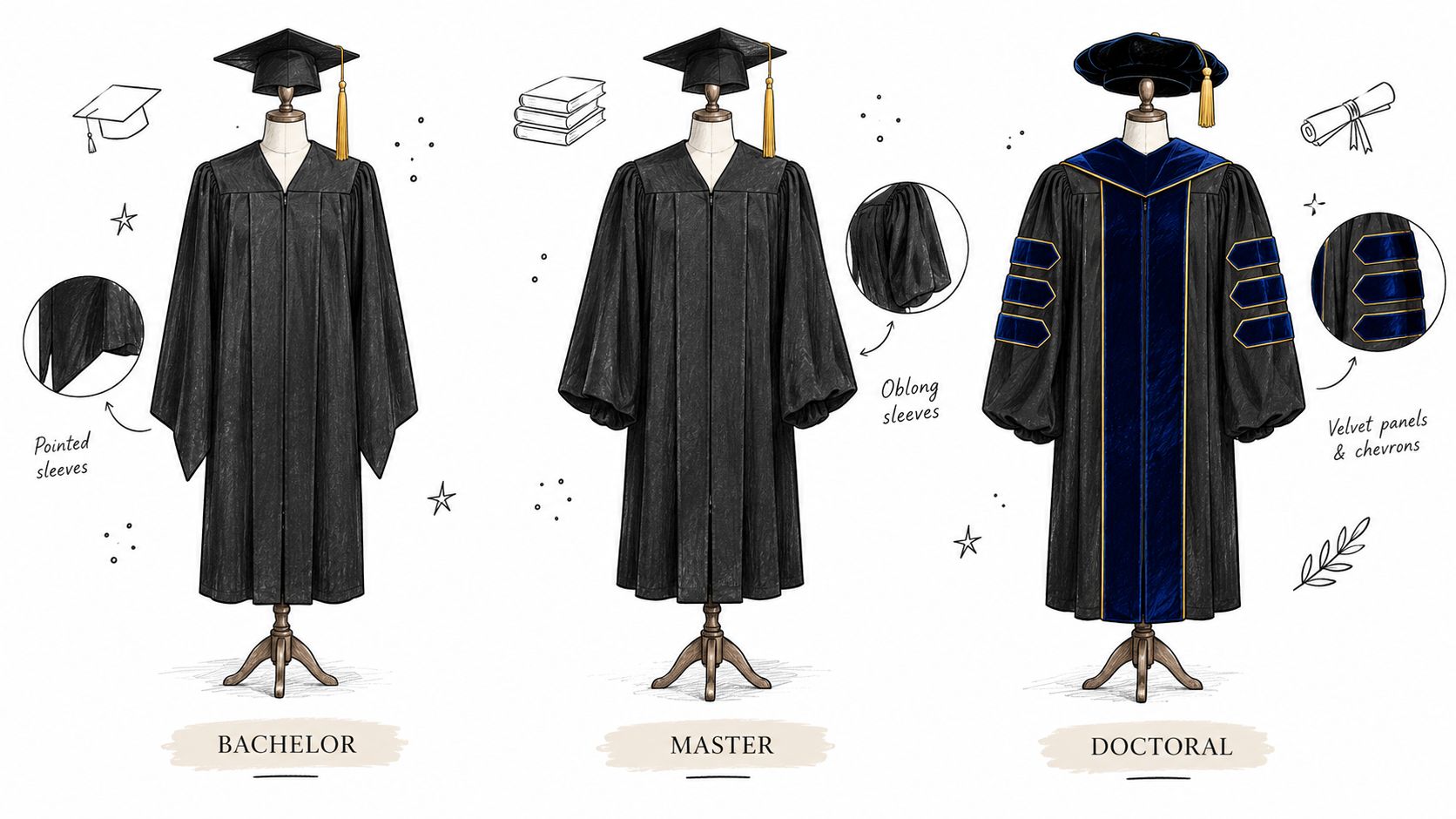
Academic dress changes by degree level, and choosing the wrong silhouette can make an otherwise correct outfit look careless. Bachelor's gowns traditionally use pointed sleeves. Master's gowns use longer, oblong sleeves that are closed at the bottom and open near the forearm. Doctoral gowns are more elaborate, with velvet panels and bell sleeves that signal the highest degree tier.
Those distinctions matter more than decorative preference. Start with the degree printed on your academic record, then match the gown to that degree. Don't select a master's package because the subject sounds similar, and don't assume every graduate package uses the same headwear.
Match the garment to the degree
A bachelor's package generally centers on the gown, mortarboard, tassel, and any separately selected stole. The gown should hang cleanly without swallowing the wearer, and the sleeves should retain their pointed shape rather than bunching around the hands.
A master's outfit adds a more structured sleeve treatment and a hood. Check the hood separately from the gown. A package can look correct in a product thumbnail yet still use the wrong degree title or color specification for your program.
Doctoral regalia requires the closest inspection. Look for velvet panels, bell sleeves, a properly shaped hood, and doctoral headwear. A mortarboard may be used in some contexts, but a doctoral tam is the more recognizable choice for many doctoral ceremonies. The tam's shape and side count should follow your program's instructions rather than a generic online assumption.
For a degree-specific bachelor's set, review the UC Berkeley bachelor's cap and gown package against your ceremony guidance before ordering.
Construction affects the final appearance
Academic garments hang differently from ordinary clothing. Look for a clean yoke, controlled shoulder fluting, a hidden zipper where appropriate, and material that resists heavy creasing. These details affect photographs and comfort during a long ceremony, especially when the gown sits over formal clothing.
Berkeley has also moved toward a more identifiable university look, with blue gowns, gold braiding, and the UC Berkeley seal replacing older solid-black designs for at least some programs. A previous black gown may still be accepted in contexts where the ceremony allows blue or black attire, but it won't create the same coordinated appearance as the current design.
Use the video below as a visual reference for how the degree-level silhouettes differ, but defer to your school's written instructions for the final package selection.
Before checkout, verify four items: degree level, hood inclusion, headwear type, and school-specific color instructions. That checklist catches most ordering errors before they become ceremony-day problems.
Decoding Academic Hood Colors and Velvet Rules
The hood causes more Berkeley regalia mistakes than the gown. Graduates often search by broad subject, find a familiar color chart, and order without checking the exact degree title or school. That shortcut fails because Berkeley guidance shows that hood colors can vary by degree title, not only by academic discipline.
A Master of Science, Master of Engineering, and PhD may require different hood treatments even when the graduates work in closely related fields. Some Berkeley units also warn that their rules may differ from the purchasing website. The correct question isn't, “What color is engineering?” It's, “Which degree title and school rule govern my hood?”
Read the hood as three separate components
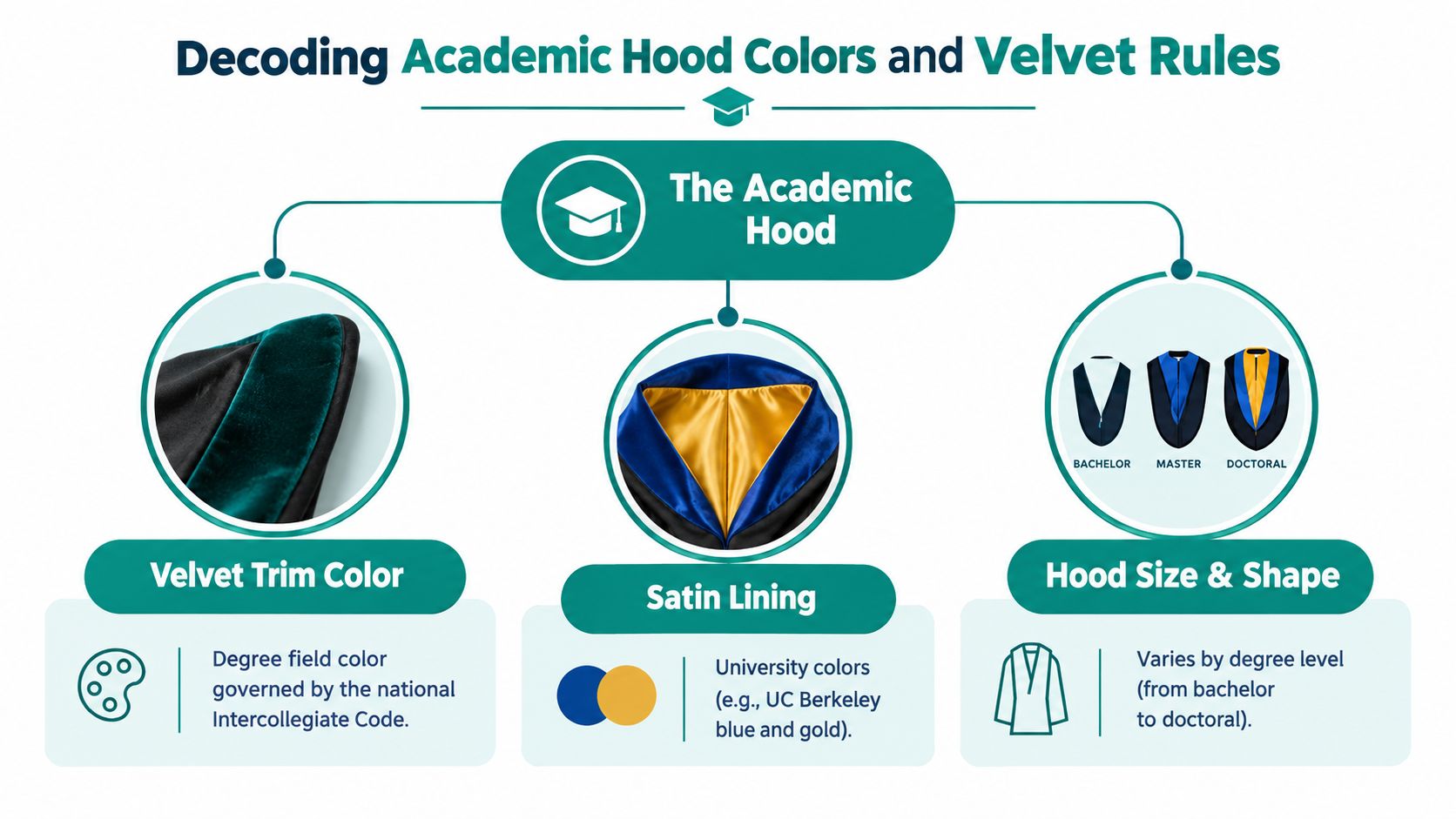
The velvet trim is the part most people mean when they discuss hood color. It identifies the academic field or degree classification under the applicable academic-dress conventions, but Berkeley's school-level guidance can modify how that convention is applied.
The satin lining displays institutional colors. For Berkeley, that means the university's blue-and-gold identity is central to the visual design. The shape and length of the hood also change with degree level, so a doctoral hood shouldn't be treated as a larger version of a bachelor's accessory.
Berkeley's historical colors carry more meaning than a branding choice. The university says its official colors were established by students in 1873. Berkeley Blue is tied to Yale Blue because Yale graduates were among Berkeley's founders and early leaders, while California Gold reflects California's mining heritage and the golden poppy. Those origins are documented in the university's commencement materials.
The reliable verification sequence
Use this order:
- Identify the exact degree title. Don't substitute a field name for the formal degree.
- Check your school or department guidance. A unit-specific instruction can override a general vendor chart.
- Confirm the hood with the vendor. Ask for written confirmation if the website and school material appear inconsistent.
- Verify the lining and trim separately. A correct Berkeley lining doesn't guarantee a correct velvet trim.
- Inspect the delivered hood before the ceremony. Compare its colors, shape, and attachment points with the approved instructions.
Do not order a hood from a generalized color chart until your degree title and school rule agree.
For doctoral candidates, the hood should coordinate with the velvet panels and any sleeve chevrons on the gown. For master's graduates, the hood remains the most visible degree-specific piece, so a mismatch is easy to notice in group photographs. If you're buying rather than renting, the UC Berkeley doctoral hood is one example of a university-specific component that should still be checked against your program's requirements before purchase.
Ordering Logistics and Group Coordination
Treat regalia ordering as a project with fixed decisions, deadlines, and backup plans. The 2026 vendor shift adds friction for graduates who want to buy custom, high-quality pieces for keepsakes or future academic use while the university rental framework directs others toward a standard process. Decide which route you need before collecting measurements or placing a group order.
A four-step ordering workflow
Start with the early order window. Confirm whether you're renting through Berkeley's official arrangement or purchasing a complete set. For a group, collect names, exact degree titles, heights, and hood requirements before anyone checks out. This prevents doctoral students from choosing master's packages and professional-degree graduates from relying on generic discipline labels.
Protect the free pickup deadline. Berkeley's 2026 free pickup pre-order deadline is March 27, 2026, published in the university's campus logistics announcement. Place the order before that date if pickup is your preferred route.
Use shipping deliberately. Berkeley lists shipping through April 10, 2026, with costs starting at $18.10, according to the same official notice. A shipping cutoff does not guarantee that a late or custom item will arrive without problems. Leave time to inspect the order, request an exchange, and steam the garments.
Coordinate cohorts centrally. Departments and student groups should ask about consolidated orders, group-order forms, and bulk pricing. Use one restricted spreadsheet to track each person's degree level, hood requirement, size, order status, and delivery location. Assign one coordinator to resolve discrepancies instead of leaving each graduate to interpret vendor options alone.

Sizing and contingency planning
Measure against the vendor's guide, not your usual clothing size. The gown must accommodate clothing underneath, while excessive length can cause tripping and awkward photographs. Ask customer support about unusual height, broad shoulders, doctoral sleeve volume, or a hood that sits incorrectly.
Buying custom regalia requires more delivery time than accepting a standard rental package. If you miss the primary ordering window, official guidance directs late renters to the Cal Student Store. Treat that option as a fallback with limited choice. Expedited or overnight shipping helps only when the item is available and the seller confirms the timeline.
For a group order, one verified package list is safer than dozens of individual guesses.
Validating Fabrics and Colors Before Purchase
Online photographs are a poor final authority for academic fabric. Screens display blue and gold differently, lighting changes velvet's appearance, and a gown that looks structured on a model may drape differently in person. If you're buying a master's or doctoral set, request a physical swatch before committing whenever the seller offers one.
A swatch lets you inspect the Berkeley Blue tone, the gold braid, the velvet's pile, and the fabric's weight under ordinary light. It also gives you a practical comparison point if your school has supplied a reference image or sample. This step is especially valuable for doctoral regalia, where the velvet panels occupy a prominent part of the garment.
What to inspect in a sample
Run your hand across the fabric and check whether it falls smoothly or feels overly thin. Fold it briefly to see how readily it creases, then examine the trim for clean stitching and consistent color. You're not trying to turn a graduation outfit into a laboratory test. You're checking whether the material matches the appearance and durability you expect to keep.
Ask support specific questions. Confirm the garment's degree level, hood compatibility, lining colors, closure type, and expected production time. A useful representative should explain the difference between a stock item and a custom item without pushing you toward a package you don't need.
The size, color, and fabric guide can help you organize those questions before ordering. Use it alongside your school's instructions, not as a replacement for them.
Why swatches matter most for custom orders
A rental gives you a defined package and a short-term decision. A custom purchase creates a long-term object, so mistakes become more expensive to ignore. If the blue is wrong, the hood sits poorly, or the sleeves feel restrictive, you'll notice those flaws every time you bring the set out of storage.
Request the sample early enough to act on what you learn. If the fabric looks right but the size guide leaves you uncertain, contact support before submitting measurements. A few minutes of direct clarification can prevent a rushed exchange close to commencement.
Preparing for Ceremony Day and Beyond
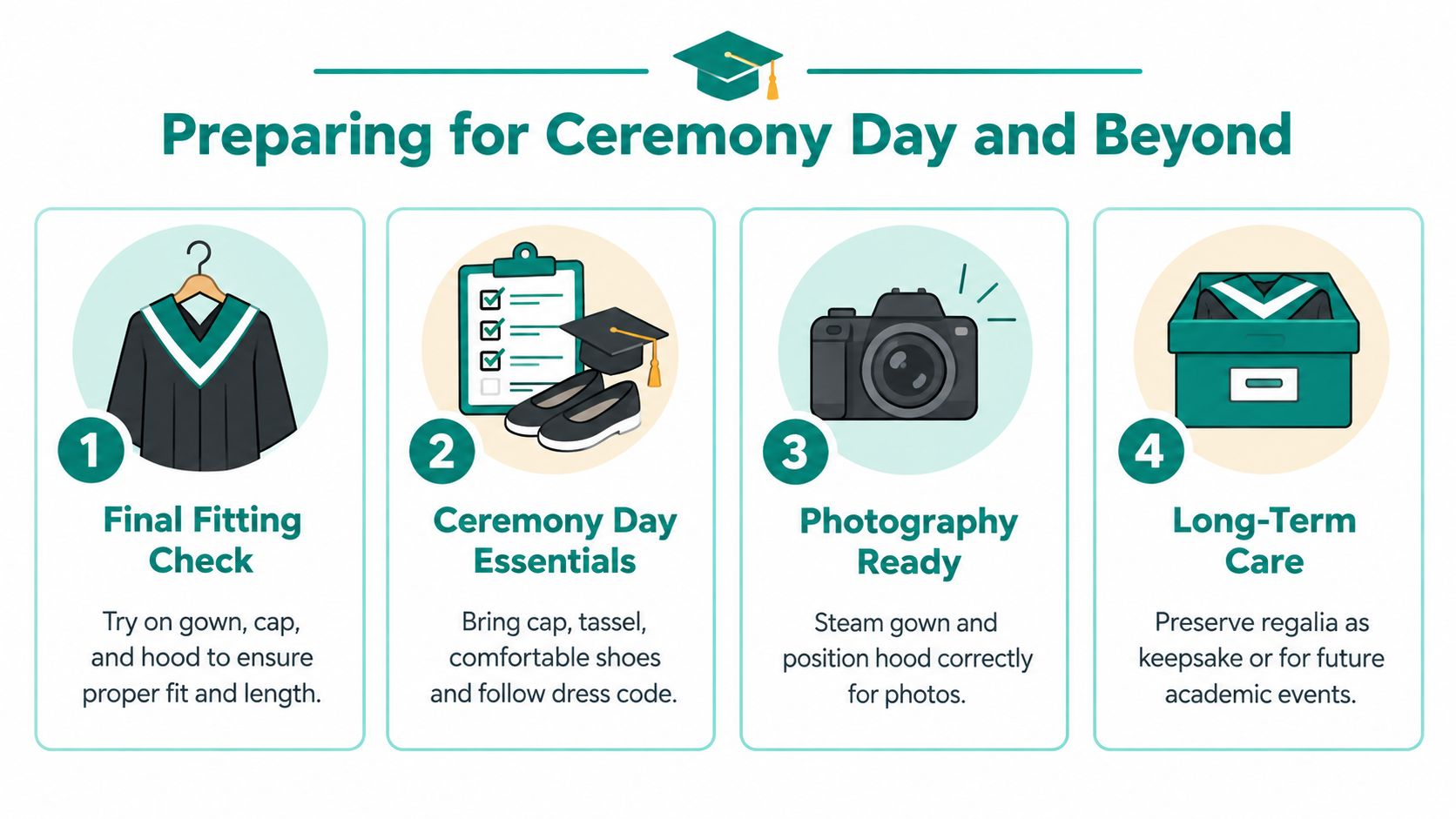
The week before commencement is when small regalia problems become visible. Pull the gown from its packaging, try on every piece, and check the hem, sleeves, zipper, hood attachment, cap, tassel, and any stole. Don't wait until the staging area to discover that the hood twists or the cap sits too loosely.
Use gentle steaming to relax creases, following the garment's care instructions. Avoid pressing directly over velvet or decorative braid. Lay the pieces out together so you can confirm that the gown, hood, cap, and tassel belong to the same degree package.
A ceremony-day checklist
- Fit everything early: Walk, sit, and raise your arms while wearing the complete outfit.
- Secure the hood: Use the back neck button or approved attachment so the hood stays centered.
- Pack the essentials: Bring your cap, tassel, ceremony ticket, phone, and comfortable shoes.
- Prepare for photographs: Smooth the gown, check the hood lining, and keep the tassel positioned according to your ceremony instructions.
- Store it properly: Let the garments dry and air out before placing them in a breathable garment bag or suitable storage container.
The tassel position can depend on ceremony protocol and degree-conferral status, so follow the instructions from your school or commencement staff rather than relying on a universal rule. Keep the hood's front edge visible, especially for photographs. A twisted hood can hide the very color and lining details that distinguish your degree.
Make ownership useful
A purchased set shouldn't live crumpled in a closet. Store it clean, dry, and protected from pressure that could flatten velvet or distort the tam. Label the package with your degree, school, and hood specification so you won't have to reconstruct the order years later.
Future academic conferences, faculty processions, inaugurations, alumni events, and university celebrations may call for formal academic dress. A well-maintained Berkeley set can serve those moments without another rushed search through vendor charts. That's the strongest argument for ownership: not sentiment alone, but readiness for the next occasion.
Grad Store offers university-specific bachelor's, master's, and doctoral regalia, plus hoods, tams, stoles, fabric swatches, sizing guidance, group coordination, and expedited shipping options. Review the available Grad Store options against your Berkeley degree and school instructions, then order early enough to inspect and prepare every piece before commencement.