

You're staring at a Stanford ordering page with a gown, hood, cap, tassel, and several color choices in front of you. You know the ceremony is approaching, but one practical question keeps getting in the way: what do you need, and which details must match Stanford requirements?
That uncertainty affects bachelor's, master's, and doctoral graduates alike. It also affects department staff and commencement coordinators ordering for a group. Stanford regalia combines tradition with a practical dress code, so a set can look broadly academic and still have the wrong hood construction, field color, headwear, or fit.
This guide gives you a clear route from terminology to purchase. You'll learn when academic dress is required, what each garment does, how to interpret a hood, how degree level changes the silhouette, and how to verify sizing, fabric, delivery, and return details before ordering.
Table of Contents
- Introduction to Stanford Regalia and What to Expect
- How Academic Regalia Works at Stanford
- Stanford Colors Hood Details and Degree Trimmings Explained
- Gown and Cap Styles for Bachelors Masters and Doctoral Graduates
- Confirming Specs Sizing Fit and Swatches Before You Order
- Ordering Options Group Orders Shipping Timelines and Returns
- Stanford Regalia Tradition and Your Confident Next Steps
Introduction to Stanford Regalia and What to Expect
A graduate often begins with a simple plan: find a black gown, add a cap, select a hood, and place the order. The trouble starts when the ceremony type changes the answer. Stanford's commencement materials require academic attire for participation in Commencement and Baccalaureate, while an Electrical Engineering commencement FAQ explains that students who aren't walking don't need regalia. The same FAQ also indicates that return timing should be confirmed separately.
That distinction matters because “graduating” and “walking in a ceremony” aren't always the same event. A student attending a formal ceremony needs a complete, approved outfit. A student not participating in the procession may not need to buy anything for that occasion. Department ceremonies and other academic events can introduce their own instructions, so the ceremony notice should come before the shopping cart.
Start with the participation question
Before comparing hood colors, answer these questions:
- Which event are you attending? Identify Commencement, Baccalaureate, a department ceremony, or another gathering.
- Are you walking? Participation requirements may differ from attendance or degree conferral.
- Does your department add instructions? Confirm whether the department specifies a hood, cap style, return process, or other accessory.
- Are you buying for yourself or a group? Individual orders and cohort orders often follow different approval and fulfillment paths.
For example, a doctoral graduate walking at Commencement should verify the complete doctoral set, including the gown, hood, and appropriate headwear. A graduate who isn't walking should first confirm whether regalia is unnecessary rather than purchasing a full outfit by default.
Treat the order as a specification check
The safest approach is to separate required pieces from optional choices. The gown and headwear establish the academic level. The hood identifies institutional and disciplinary details. Stoles, cords, decorative additions, and alternate accessories may depend on ceremony instructions.
You don't need to memorize academic-dress jargon. You do need to know what each option represents, confirm the details with Stanford or your department, and allow enough time for fitting and corrections. Once those decisions are made in the right order, the ordering page becomes much easier to read.
How Academic Regalia Works at Stanford
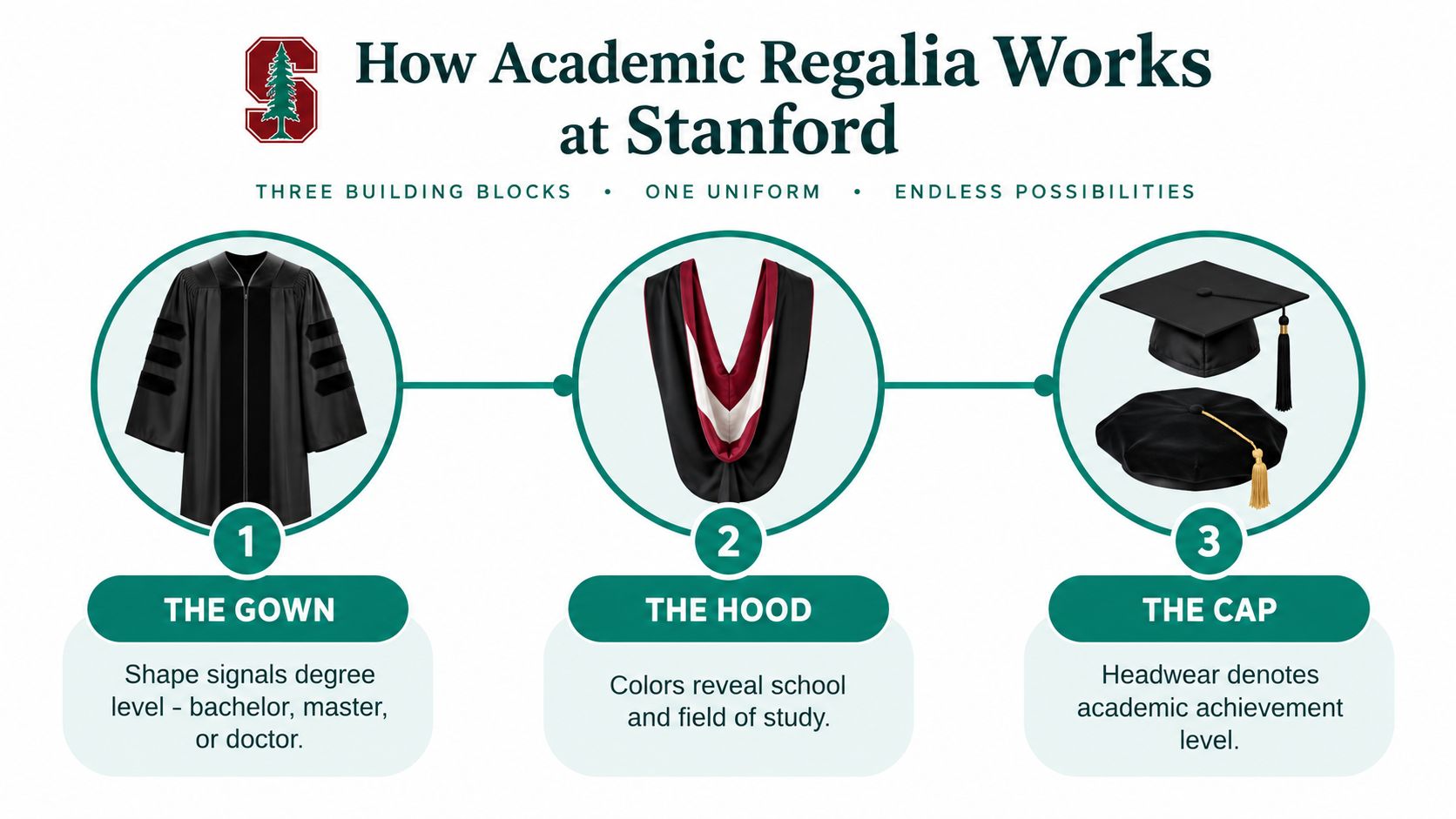
Stanford regalia works like a formal uniform with insignia. The gown gives the outfit its overall shape, the hood carries institutional and field information, and the cap completes the academic silhouette. Color matters, but construction and placement matter just as much.
The system Stanford initially followed grew from the Intercollegiate Code of Academic Costume, which established a standardized approach to academic dress in the United States. That framework helps explain why degree level changes the gown and why field color belongs on the hood rather than being treated as a general decoration.
The gown sets the academic level
A bachelor's gown is generally the least elaborate silhouette. A master's gown introduces more distinctive sleeve construction, while a doctoral gown uses velvet features and a fuller presentation. Those differences help viewers recognize the level of achievement from a distance.
Think of the gown as the uniform jacket. Its length, sleeves, panels, and velvet treatment communicate more than the base fabric color does. A generic black gown may be wearable, but it can still be the wrong garment if it lacks the features expected for the graduate's degree.
The hood carries the identifying details
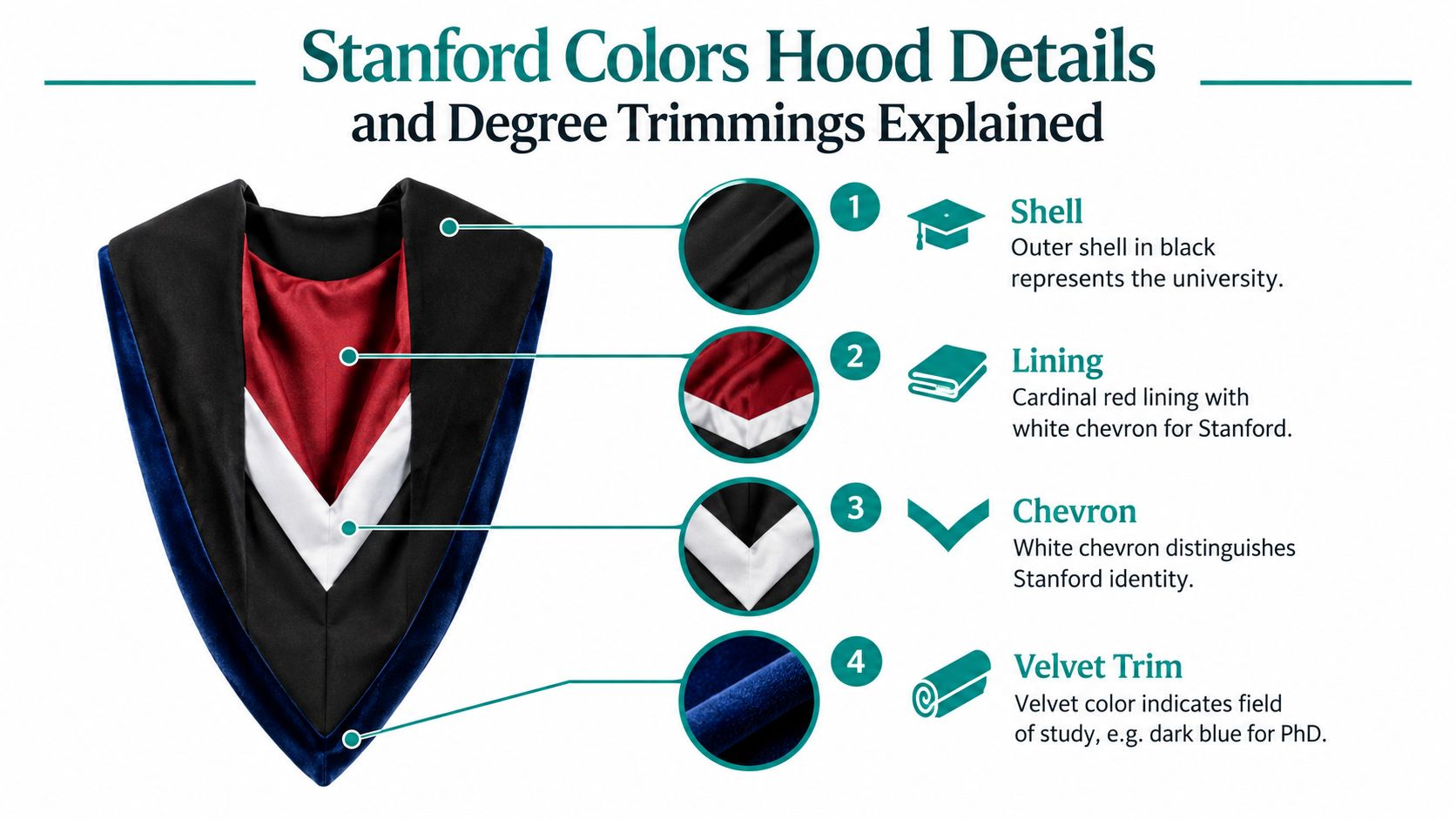
The hood is not just a colorful shoulder piece. It has a shell, lining, chevron, and velvet trim, and each part performs a different job. The lining and chevron help identify the institution, while the velvet trim corresponds to the academic field.
A useful comparison is a suit with a school crest and department insignia. The black outer garment creates the formal foundation, but the hood provides the visual information that distinguishes one academic path from another. That's why a hood selected only by a broad color description can be incorrect.
The cap finishes the set
Bachelor's and master's graduates commonly wear a mortarboard, while doctoral graduates may wear a doctoral tam where the ceremony or specification calls for it. The cap should match the degree-level set rather than being chosen independently for appearance.
Practical rule: Choose regalia as a coordinated set. Don't start with the hood color, then add whichever gown and cap look similar.
The basic decision sequence is simple: identify the ceremony, confirm the degree level, verify the hood specification, select the correct headwear, and then solve fit and delivery. That sequence prevents the most common mistake, buying a generic package that looks academic but doesn't match Stanford's required details.
Stanford Colors Hood Details and Degree Trimmings Explained
The hood deserves careful attention because it combines several colors and materials in one garment. A buyer who sees only “Stanford colors” may assume every visible color has the same meaning. It doesn't. The hood's components work together, and the field trim can be the decisive detail for a correct order.
Independent academic hood guidance describes four color elements: the shell, lining, chevron, and velvet trim. It also explains that velvet corresponds to the degree field and cautions that a complete public list of current school colors may not always be available, so buyers should confirm exact specifications with the institution.
Read the hood from outside inward
The shell is the outer hood fabric. In a traditional academic set, it provides the dark formal frame around the more visible interior colors.
The lining appears when the hood is arranged over the shoulders. For Stanford, the lining is associated with the institution's cardinal identity.
The chevron is the V-shaped element inside the lining. It adds a distinct Stanford marker rather than leaving the interior as a single uninterrupted color field.
The velvet trim runs along the hood's edge. This is the part buyers most often confuse with the university color. The trim represents the graduate's degree field, so two Stanford graduates can wear institutionally related hoods while having different velvet colors.
Use the trim as a field check
Suppose a doctoral graduate sees a hood description that correctly mentions Stanford's lining but lists a velvet trim for another discipline. The hood may look close in an online product image, but the field detail is still wrong. Ask the seller to confirm the degree field, velvet color, lining, and chevron as separate specifications.
For a doctoral order, review the Stanford University doctoral hood as a product reference, then compare the listed construction with Stanford's current instructions. Product images can help you understand placement, but institutional confirmation should resolve any uncertainty about an exact color match.
A fabric swatch is especially useful when a screen makes cardinal red, white, black, or velvet shades difficult to judge. The swatch won't replace official approval, but it can reveal whether the material and color look suitable beside the rest of the set.
Before ordering, send one precise question instead of a vague request for “Stanford colors”: “Can you confirm the shell, lining, chevron, and velvet trim for my Stanford degree and field?” That wording makes the seller address each color job individually.
Gown and Cap Styles for Bachelors Masters and Doctoral Graduates
Degree level changes the garment's shape more visibly than most buyers expect. A bachelor's set is relatively straightforward, a master's set adds sleeve and hood distinctions, and a doctoral set introduces the most formal detailing. Headwear follows the same progression.
The table below is a quick orientation. It isn't a substitute for Stanford or department instructions, but it helps you identify which product description deserves closer review.
Stanford Regalia by Degree Level at a Glance
| Feature | Bachelor | Master | Doctoral |
|---|---|---|---|
| Gown silhouette | Simpler academic gown with a clean, less elaborate appearance | More developed sleeve shape and a longer academic hood presentation | Formal gown with velvet panels and piping |
| Hood | Degree and institution details should be confirmed for the ceremony | Hood length and field trim require careful verification | Full doctoral hood with field-specific velvet trim |
| Headwear | Mortarboard is the usual reference point | Mortarboard is commonly used unless instructions say otherwise | Doctoral tam or specified doctoral headwear |
| Tassel or finish | Standard tassel coordinated with the set | Tassel selected according to the approved package | Bullion tassel may accompany a doctoral tam |
| Main buying risk | Choosing a generic set without checking school details | Ordering the wrong sleeve, hood, or length | Mixing a doctoral gown, hood, and cap from incompatible specifications |
Bachelor's regalia
A bachelor's gown emphasizes a clean silhouette. The mortarboard and tassel complete the outfit, and the tassel should come from the approved Stanford or vendor specification rather than from a color chosen for personal preference.
Master's regalia
A master's gown is more distinctive at the sleeve. The hood also deserves attention because its length, lining, chevron, and velvet edge make the degree field visible. Don't assume that a bachelor's gown with a separate hood creates a correct master's outfit.
Doctoral regalia
Doctoral gowns use velvet panels and piping to create a more formal appearance. The hood is fuller, and doctoral headwear may be a tam rather than a mortarboard. Tams can have four, six, or eight sides, and bullion tassels are available as a more traditional doctoral finish, but the ceremony's instructions should decide which option belongs in the order.
If you're comparing sets or coordinating a cohort, use the Stanford University regalia collection to organize the options by degree level, then verify the final specifications against Stanford guidance. The goal isn't to add every accessory. It's to assemble the exact silhouette expected for the person's degree.
Confirming Specs Sizing Fit and Swatches Before You Order
A correct regalia order has two parts: the specifications are right, and the garments fit well enough to move, sit, and cross the stage comfortably. A hood can have the right colors and still drape poorly if the gown size, shoulder placement, or fastening position is wrong.
Begin with official guidance
Open the Stanford commencement instructions for the specific event. Confirm whether regalia is required for participation, whether a department adds requirements, and whether the university or school identifies an approved supplier or construction detail.
Then write down the answers. A short specification note might include:
- Ceremony: Name the event and whether you're walking.
- Degree: Record bachelor's, master's, or doctoral level.
- Field: Identify the academic discipline used for velvet trim.
- Pieces: List gown, hood, cap or tam, and any required tassel.
- Timing: Note the ceremony date, delivery window, and return conditions.
This turns an open-ended shopping task into a checklist a seller or coordinator can review.
Measure for movement, not only appearance
Use the vendor's size chart and measure as instructed. Gown length should fall appropriately on the body without creating a tripping hazard, and sleeves shouldn't interfere with the hands or academic documents.
A tam should sit securely without creating pressure. Universal bands can make doctoral headwear easier to adjust, but the band still needs to be checked against the wearer's head measurement. Try the complete set with the shoes planned for the ceremony. A gown that seems acceptable while standing barefoot can feel too long once the graduate is moving through stairs, seating, or a processional.
Check fabric before committing
Color can look different on a screen than it does in a room or under ceremony lighting. Requesting fabric swatches is a practical way to compare material, black fabric, cardinal tones, white details, and velvet trim before the order is final.
A swatch is a risk-control tool, not a luxury. It lets you evaluate the actual fabric before you rely on a product photograph.
Leave time for a fitting while exchanges are still possible. If the hood sits unevenly, the gown pulls across the shoulders, or the headwear shifts, contact support with the order details and measurements. Early correction is easier than trying to repair a mismatch on ceremony day.
Ordering Options Group Orders Shipping Timelines and Returns
The right fulfillment path depends on three facts: how soon the ceremony is, whether the item is custom or in stock, and whether one person or a whole cohort is ordering. A custom set may offer more tailoring and specification control, while an in-stock set can serve a compressed deadline. Neither option is automatically right for every graduate.
Match the product path to the deadline
If the ceremony is comfortably ahead, compare custom and in-stock choices, request a swatch, and leave room for an exchange. If the date is close, focus on confirmed inventory, available sizes, and a shipping method with tracking. Don't choose overnight delivery until you've verified that the selected gown, hood, and headwear are available for the required specifications.
A practical decision flow looks like this:
- Early planning: Review custom options, validate colors, and allow time for fitting.
- Tight deadline: Select an in-stock set only after confirming the correct degree and field details.
- Single graduate: Keep the order simple and confirm every component before checkout.
- Cohort order: Gather degree, field, measurements, and delivery information in one coordinated file.
Coordinate group orders carefully
A department coordinator should establish one approval point for specifications. Ask graduates to submit their degree level and field in a consistent format, then check that doctoral, master's, and bachelor's orders haven't been mixed.
Group-order forms and bulk-discount programs can reduce repetitive communication, but they don't remove the need for individual measurements. One incorrect field entry or missing hood detail can affect only one graduate while the rest of the order is correct.
Protect the ceremony date
Shipping speed matters only after the product is ready to leave the warehouse. Review the vendor's shipping and tracking information for available delivery methods, tracking practices, and any cutoff information. Keep the tracking record and inspect the package as soon as it arrives.
Returns and exchanges should be checked before ordering, especially for custom garments. Confirm whether custom pieces can be returned, whether size exchanges are permitted, and who pays return shipping. If the deadline is close, ask support whether a same-day or next-day fulfillment option applies to the exact item, size, and color combination you need.
Stanford Regalia Tradition and Your Confident Next Steps
You are standing in line before commencement, holding a hood that looks close to the right one but has the wrong trim. A quick check now prevents a visible mismatch later. Stanford's academic dress tradition began after the university's founding in 1891: its first commencement was in 1892, academic dress appeared in 1899, and adoption expanded through 1903, 1907, and 1909, according to the history of Stanford academic regalia.
The tradition also clarifies what regalia communicates. A gown, hood, and headpiece work like a visual identification system, showing academic level, institution, and field through their cut, colors, and materials.
Regalia is required when your ceremony instructions require it and you are participating in the procession or ceremony. If you are not attending, not walking, or your event gives different instructions, you may not need to order a set. Confirm that point before comparing products.
Use this checklist:
- Confirm participation: Check the ceremony instructions and whether you're walking.
- Identify degree level: Select the bachelor's, master's, or doctoral style.
- Verify hood construction: Review the shell, lining, chevron, and velvet trim as separate details.
- Match the field: Confirm the velvet color with Stanford or your department.
- Check headwear: Choose the required mortarboard or doctoral tam.
- Test the fit: Review gown length, sleeve movement, hood drape, and tam security.
- Request a swatch: Compare physical fabric and color when available.
- Protect the deadline: Match custom or in-stock fulfillment to the ceremony date, then review tracking and return terms.
A correct purchase meets the ceremony requirement, uses the right degree and field details, fits comfortably, and leaves time to inspect each piece.
Grad Store offers Stanford-specific bachelor's, master's, and doctoral regalia, plus hoods, tams, mortarboards, accessories, sizing guidance, swatches, group-order support, and tracked shipping options. Visit Grad Store to compare sets and confirm specifications before ordering.