

You're probably staring at a browser tab right now, wondering whether you need a gown, a hood, a tam, a stole, or some combination that only makes sense if you already know Johns Hopkins' rules. Don't treat this like a souvenir purchase. Johns Hopkins regalia is a compliance decision with a deadline, and the wrong color or the wrong degree-level set can leave you with a pile of expensive fabric that looks fine from far away and wrong up close.
The good news is that Hopkins publishes enough detail to keep you from guessing. The bad news is that the details matter, especially when you're ordering late, coordinating for a cohort, or trying to figure out whether your program uses a hood, a stole, or doctoral velvet trim. Order the correct set once, verify the color, and stop making this harder than it needs to be.
Table of Contents
- What Johns Hopkins Regalia Actually Is
- Official Colors and Specifications by Degree
- Bachelor's, Master's, and Doctoral Sets Compared
- Ordering Your Regalia Step by Step
- Sizing, Fit, and Swatch Confidence
- Shipping, Rush Options, and Group Orders
- Quick Checklist Before Commencement Day
What Johns Hopkins Regalia Actually Is
A graduate sitting at a laptop six days before commencement does not need a speech about tradition. They need to know what to click, what to ignore, and what will get them bounced by the photo line if they get it wrong. That is the job of Johns Hopkins regalia, because Hopkins doesn't treat this as a loose costume system. It's a defined academic uniform tied to university rules, not a generic black gown with a crest added later.
Hopkins traces its regalia standard back to a Board of Trustees specification approved on June 6, 1892, which required Ph.D. graduates to wear a black gown of the prescribed shape and a black silk hood lined with scarlet silk and edged with gold, and the university's own history materials still point to Old Gold and Sable as the academic colors visible in commencement dress today. Those are not decorative notes. They're the foundation for how the university signals degree and discipline at commencement. Johns Hopkins regalia history and colors and school color mappings for hood trim make that plain.
What that means in practice
If you order the wrong hood color, you haven't just made a style mistake. You've broken the visual code Hopkins uses to identify field of study, and that shows up immediately in photos, lineup, and stage presentation. The university maps disciplines to hood trim colors, including medicine, engineering, science, public health, and philosophy, so the hood is not optional decoration. It's the signal.
Practical rule: buy for the degree you're earning now, not the diploma you hope to add later.
That's where people get burned. They shop by “black gown” and miss the fact that the hood, the sleeve cut, the lining, and the headwear all change by degree level. If you're ordering for a department, sort everyone by degree first, then by school or discipline. That one move prevents most ordering mistakes.
Official Colors and Specifications by Degree
Treat the regalia chart as an ordering checklist, not a style guide. Degree level determines the gown construction, hood length, and cap format. Field of study determines the relevant color. Check both before placing the order, especially if commencement is approaching and a correction would require a return or replacement. The Grad Store's Johns Hopkins doctoral hood page provides a useful product cross-check, but Hopkins' specifications should control the final selection.
| Degree Level | Gown Fabric & Cut | Hood/Stole Color | Cap Style | Key Spec |
|---|---|---|---|---|
| Bachelor's | Black gown with long straight-bottomed sleeves | School color on the stole or hood trim, depending on order format | Standard cap | Hood length is 3 feet |
| Master's | Black gown with traditional slit-sleeve construction | Lined hood in the school's academic color | Standard 7-inch mortarboard | Hood length is 3.5 feet |
| Doctoral | Black gown with bell-shaped sleeves, velvet front facings, and three velvet sleeve bars | Black hood lined in scarlet and edged with gold, with discipline-specific velvet trim where applicable | Soft velvet tam, six- or eight-sided | Hood length is 4 feet |
Read the gown first, then the color
The gown cut identifies the degree level fastest. Bachelor's gowns have the simplest construction. Master's gowns use the slit-sleeve shape. Doctoral gowns add bell sleeves, velvet front facings, and three velvet sleeve bars. Those differences are visible in formal photographs and help confirm that the set matches the degree before it ships.
The doctoral set belongs to a separate specification category, so do not substitute a master's gown because both appear black in a product photo. Check the full description, including sleeve construction and headwear, before approving an individual or group order.
Color is the second check. Hopkins uses velvet trim to identify the field of study, and its guide maps disciplines to those trim colors. Medicine uses green, engineering orange, science golden yellow, public health salmon pink, and philosophy dark blue. Select the listed discipline color rather than matching a screen image or indoor lighting. A near match can still be the wrong academic designation.
Degree-level fit decisions
Hood length changes with the degree: bachelor's hoods are 3 feet, master's hoods are 3.5 feet, and doctoral hoods are 4 feet. The pieces are not interchangeable. For a department order, separate graduates by degree level first, verify each field color second, and submit the order before the vendor's cutoff. Mixing tiers creates incorrect inventory and avoidable returns.
Hopkins also specifies that a graduate with multiple degrees wears the gown and hood for the highest degree held. Order that higher-degree set rather than purchasing lower-degree pieces for a possible future ceremony. That rule resolves the choice before payment and keeps the order aligned with the ceremony requirements.
Bachelor's, Master's, and Doctoral Sets Compared
From ten feet away, most regalia looks like the same black uniform. That's exactly why people order the wrong thing. The differences are not dramatic in a casual glance, but they're obvious to anyone who knows the rules, and they matter most at the doctoral tier.
What changes as the degree rises
Bachelor's sets are the most stripped down. The gown is simple, and the field signal comes through the school color in the stole or trim. Master's sets step up to the lined hood and the rounded sleeve arc, which is the visual cue most families miss when they assume all black gowns are the same. Doctoral regalia is the only set that fully changes shape, fabric, and headwear.
Simple test: stole means bachelor's, hood with the master's cut means master's, velvet facings plus tam means doctorate.
For departments, the cleanest way to manage a group order is to separate names by degree tier before you do anything else. Don't sort by department title alone. One lab may have a mix of master's and doctoral graduates, and their regalia sets are not close enough to swap.
| Component | Bachelor's | Master's | Doctoral |
|---|---|---|---|
| Gown | Black, straight-bottomed sleeves | Black, slit-sleeve construction | Black, bell sleeves with velvet front facings and three velvet sleeve bars |
| Hood or Stole | School-color stole or equivalent field signal | Lined hood in school color | Full doctoral hood, with discipline-specific velvet trim |
| Cap | Standard cap | Standard mortarboard | Velvet tam |
| Tassel | Standard bullion | Standard bullion | Gold bullion |
Don't improvise across tiers
The most common mistake is trying to “make it work” with a piece from another degree level. That's a bad move. A doctoral candidate wearing a bachelor's-style piece looks underdressed by protocol, and a master's candidate wearing doctoral-style items looks like they bought the wrong set altogether. Hopkins' own dimensional rules exist to stop that from happening.
If you're buying for one person, match the degree and school first. If you're buying for several, separate them by degree before you compare sizes or colors. That keeps the order clean and makes later swaps much less likely.
Ordering Your Regalia Step by Step
Your commencement date is fixed, and a wrong degree set cannot be corrected by choosing a faster shipping option. Start with the official Johns Hopkins commencement regalia page, then use the vendor path it provides. That route connects your order to Hopkins' published degree, color, and construction requirements. Generic graduation shops may show similar-looking pieces, but “close enough” is a compliance risk.

The order flow to follow
- Confirm your degree level and school. Check the JHU commencement page before opening the vendor cart. Bachelor's, master's, and doctoral orders use different gown and headwear specifications.
- Select the degree-specific set. Do not build a doctoral order from separate bachelor's or master's pieces. Choose the set that matches your degree tier.
- Match the hood trim to your discipline code. Use the Hopkins specification, not the closest-looking color in a swatch photo. The trim identifies your field.
- Check the gown construction and headwear. Confirm the sleeve style, hood or stole, cap, and doctoral tam before adding the order to your cart.
- Review the fabric swatch program. Request a swatch if the hood or trim color needs to match a department order or your school's published color.
- Set delivery around your ceremony schedule. Enter an address where you can receive and inspect the regalia, then order early enough to address a wrong tier, color, or missing component.
- Keep the order record accessible. Save the confirmation and order number so the vendor can identify the Hopkins order quickly if a correction is needed.
Treat the swatch like a quality check, not a luxury
Screen colors are unreliable for ceremonial fabric. Requesting a swatch before finalizing the order gives you a physical reference for the hood or trim and helps departments keep multiple sets consistent.
Grad Store's Johns Hopkins collection page lets you review institution-specific pieces, but the collection does not replace Hopkins' specifications. Confirm the degree, discipline color, and construction before you submit the order.
Sizing, Fit, and Swatch Confidence
A wrong size or color creates a correction problem when your ceremony date is already fixed. Measure yourself before ordering Johns Hopkins regalia, then use the vendor's chart rather than your usual clothing size. Record your standing height in socks and your chest circumference over a shirt. Check both against the size, color, and fabric guide before you commit.
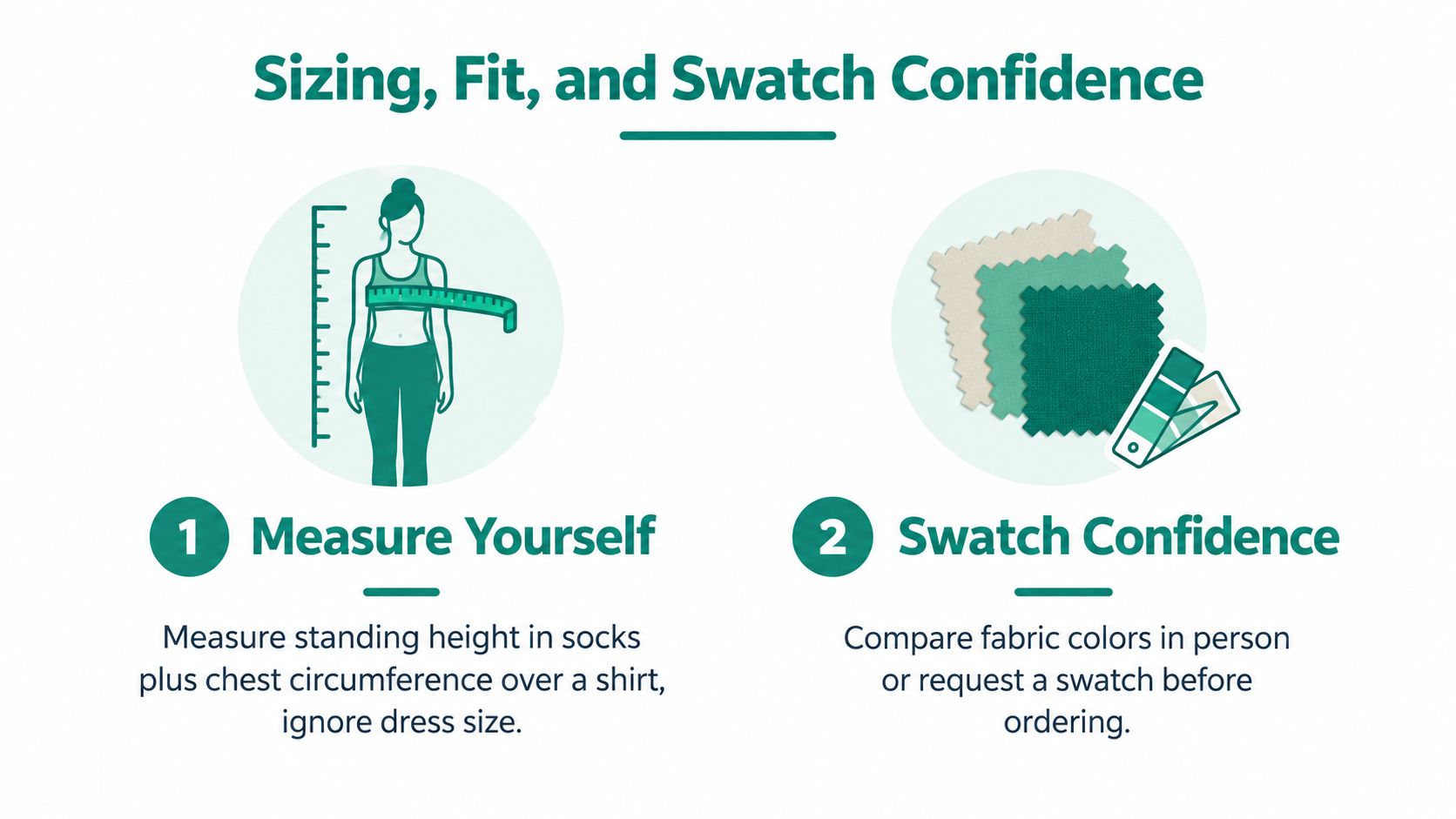
Fit mistakes are easy to avoid
If your measurements fall between gown sizes, choose the larger one. A little room looks correct on stage. A gown that is short or tight looks awkward in photographs and restricts movement. Choose the tam by your measured size. A loose tam slides out of position and disrupts the line of the outfit.
Set a doctoral tam just above the eyebrows. It should stay secure without pinching. The fit matters in every front-facing photograph, and a cap that shifts when you turn your head becomes a problem as soon as you leave your place in line.
Use the swatch before you finalize
Screen colors cannot show ceremonial fabric reliably. Request a swatch before final payment if the hood or trim color matters. Hold it beside the colors you expect and check it in daylight when possible. That physical comparison helps confirm the black and school color under real lighting, including the indoor or outdoor conditions in which Hopkins regalia is designed to be worn.
Order the swatch before submitting final payment when color accuracy matters. Once payment is complete, changing the order becomes harder.
Grad Store's Johns Hopkins collection page shows the institution-specific pieces available to review. Use the collection to check the set, then verify the degree, discipline color, construction, and fit against the Hopkins requirements before ordering. Regalia is a deadline-sensitive uniform, so make the decision from measurements and physical color evidence, not a screen preview.
Shipping, Rush Options, and Group Orders
Regalia becomes a deadline decision as soon as your ceremony date is fixed. Standard production gives you time to catch a sizing error, confirm the hood color, or correct an address. A late order removes those options. Johns Hopkins' doctoral hooding materials reinforce the need to treat regalia as a scheduled requirement, not a casual online purchase. Use the ceremony date and the vendor's production window to set your order deadline.
Choose the production method first
Standard production is the right choice for an order placed before the stated deadline. Rush production is available for late orders, but it costs more and leaves less time to correct a problem. Expedited or overnight shipping shortens transit only after the item is ready. It cannot repair an incorrect size, hood color, or address.
Use group ordering when a department, program, or cohort is buying together. One coordinated order reduces separate shipping labels, keeps the roster in one place, and gives the coordinator one receipt trail. Confirm each graduate's degree level, size, hood requirement, and delivery details before submitting the roster. A group order is useful only when those details are accurate.
| Option | Production Time | Shipping Time | Best For | Notes |
|---|---|---|---|---|
| Standard order | Regular production window | Standard delivery | Orders placed before the deadline | Leaves time for corrections |
| Rush order | Faster turnaround | Can pair with expedited shipping | Late orders | Costs more and allows less correction time |
| Overnight shipping | Depends on production status | Next-day transit | Last-minute replacements | Works only after the item is ready |
| Group order | Single coordinated production run | Single ship date | Departments and cohorts | Simplifies distribution and invoicing |
Monitor the shipment
Save the order number immediately. Watch for the tracking email and check the delivery address against the confirmation. If tracking stalls or the package misses its expected arrival, contact support with the order number ready. Waiting until the night before commencement turns a solvable delay into a replacement problem.
International buyers need extra time for customs, transit, and any required replacement. Do not build an overseas order around a narrow delivery window. Returned regalia can take time to resolve, and a replacement may not arrive before the ceremony. Place the order early enough that customs delays do not control your ceremony-day options.
For a class or department, assign one coordinator to approve the roster, receive shipping updates, and distribute the garments. That person should also record which graduates have received their sets. Clear ownership prevents duplicate orders and makes missing pieces easier to identify.
Quick Checklist Before Commencement Day
Three days before commencement, open the package and confirm every piece. A missing hood or incorrect color is an ordering problem, not a ceremony-day detail. Use this checklist before your options narrow.
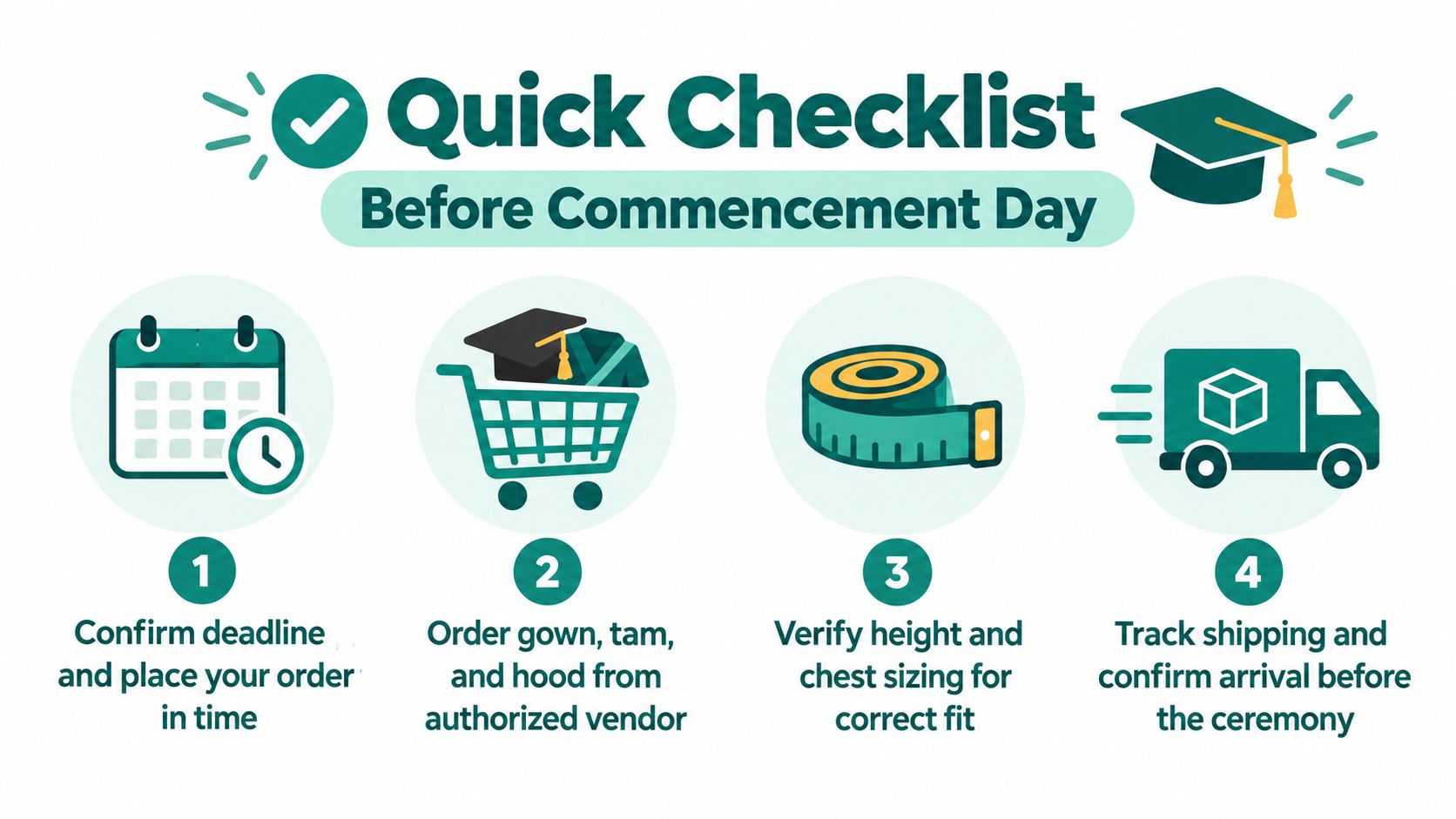
Do these four things now
- Confirm your degree-level set. Check that the gown, hood or stole, and headwear match your degree status.
- Check the color against your school or discipline. The hood trim is visible in photographs, so verify it before the package arrives.
- Verify the shipping address and save the receipt. Keep the order number available for any correction or replacement.
- Inspect the package immediately. Check for missing, damaged, or incorrect pieces and contact support promptly if anything is wrong.
Know who to contact
Johns Hopkins doctoral hooding materials direct graduates to the JHU bookstore at 443-899-1329 and ksashooding@jhu.edu for questions about regalia pickup, rentals, and ceremony coordination. Contact them before the final week, while a correction remains possible.
Use Grad Store to review institution-specific caps, gowns, hoods, and tams before ordering. Compare size, color, and delivery timing against your commencement deadline.