

The order form is open, your commencement date is approaching, and the choices seem simple until you reach the details. Which gown applies to your degree? Do you need a hood? Is Harvard crimson the same for every program? Should you rent, purchase, or pay for delivery to your home?
Those questions matter because Harvard regalia isn't generic academic clothing. The gown, hood, headwear, and field-specific details work together as a visual system. A correct set helps you meet ceremony expectations, appear consistent in photographs, and keep a meaningful piece of your academic milestone. A wrong hood length or school color can be difficult to fix once pickup and return windows are close.
This guide approaches Harvard regalia as both a tradition and a practical logistics decision. You'll learn what each piece does, how bachelor's, master's, professional, and doctoral regalia differ, how to interpret Harvard's colors and insignia, how to check fit before ordering, and how to manage deadlines and delivery. By the end, you should be able to identify the right set for your degree, verify its specifications, and place an order with fewer surprises. If you're comparing available sets, the Harvard University regalia collection can serve as one reference point alongside your school's official commencement instructions.
Table of Contents
- Introduction to Harvard Regalia and Why Details Matter
- What Harvard Regalia Includes and How Each Piece Works
- How Bachelor Master and Doctoral Regalia Differ at Harvard
- Harvard Colors Insignia and Traditions That Signal Your School
- Getting the Right Fit and Confirming True Harvard Colors
- Ordering Timelines Expedited Options and Group Orders for Harvard
- Harvard Regalia FAQs and Final Checklist Before Commencement
Introduction to Harvard Regalia and Why Details Matter
A useful way to understand Harvard regalia is to treat it like an academic uniform with a detailed identification system. The gown establishes the broad degree category, the hood shows institutional affiliation and academic level, and embroidery or velvet details can identify the field. Headwear completes the formal appearance, while accessories may be governed by university-specific rules rather than personal preference.
Harvard's approach developed gradually. The university's regalia requirements were documented at least as early as the 1807 Laws of Harvard College, which required first-degree candidates to wear a black gown or certain dark colors at Commencement and restricted conspicuous decorations such as silk nightgowns and gold or silver lace. Harvard later developed its modern visual scheme, with a major milestone arriving in 1902, when crimson hood linings had been adopted as part of the university's standardized appearance. These details are documented in Harvard Magazine's history of academic rituals.
The practical lesson is straightforward. Don't select a set only because it looks like a conventional graduation gown. Check the degree level, hood requirements, lining, field color, sleeve treatment, and approved accessories. A doctoral candidate and a master's candidate may both wear dark academic clothing, but the construction and signals aren't interchangeable.
Coordinator's rule: Treat the order form as a specification sheet, not a costume catalog.
The rest of the process becomes easier once you separate three questions. First, what must you wear to participate? Second, which design details identify your degree and field? Third, how much time do you need to receive, inspect, and return or keep the set? Answer them in that order, and the process feels manageable rather than mysterious.
What Harvard Regalia Includes and How Each Piece Works
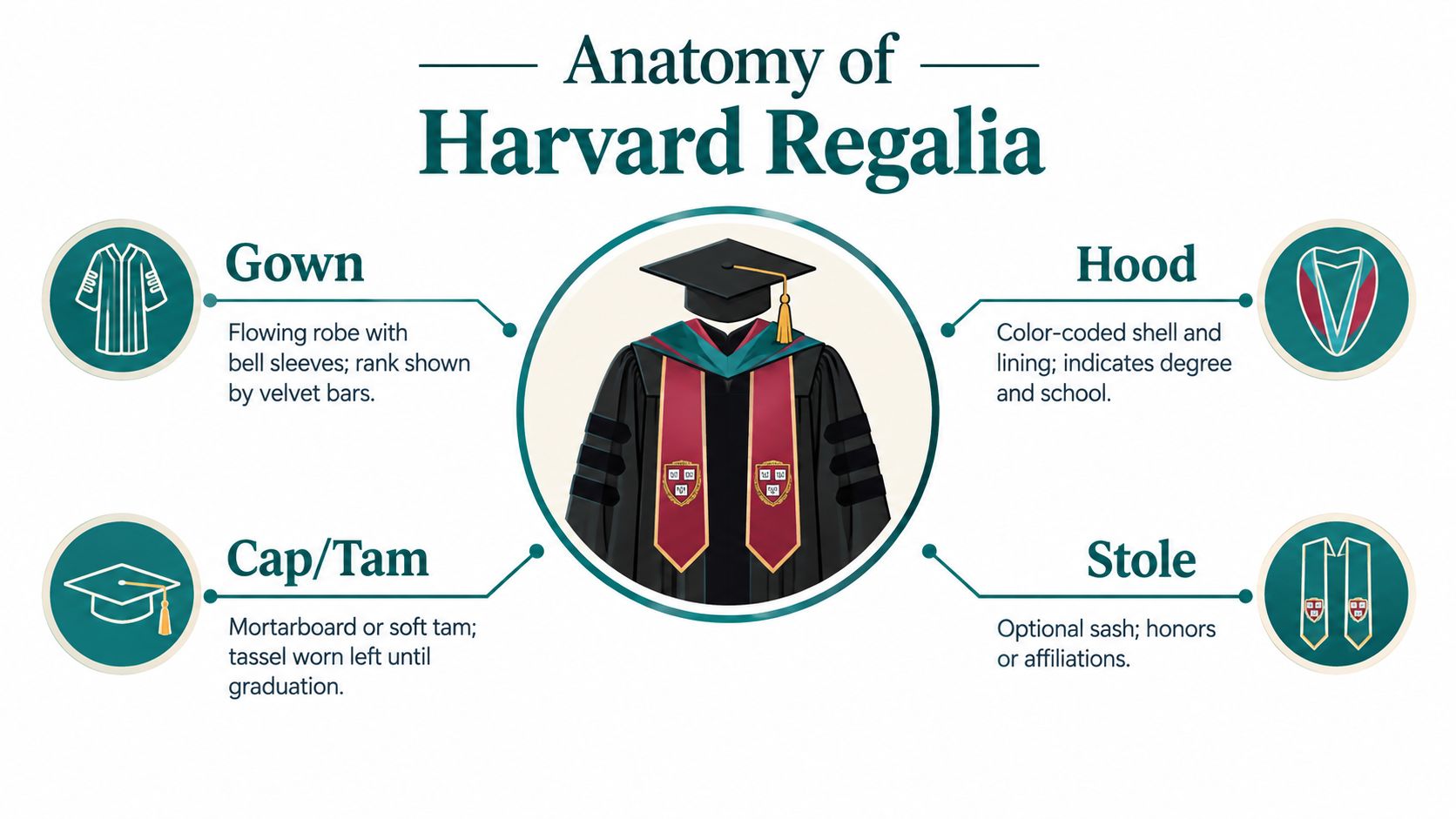
Harvard regalia consists of several coordinated pieces. Each has a different job, much like parts of a uniform that identify both rank and affiliation.
The gown establishes the degree category
The gown is the main garment and the most visible part of the set. At Harvard, gowns are black for bachelor's and master's candidates, as well as for certain professional advanced degrees. Doctoral candidates wear the distinctive crimson gown. The gown's cut, sleeves, velvet panels, and bars help distinguish one academic level from another.
Think of the gown as the large label on a file folder. It tells viewers the broad category before they notice smaller details.
The hood carries the institutional message
The hood rests over the shoulders and falls down the back. Harvard's hood system is unusually consistent in its outer appearance. Hoods are black on the outside and lined with crimson silk, while degree level is communicated primarily through length. Bachelor's candidates don't receive hoods, master's hoods are about 3.5 feet, and doctoral hoods are about 4 feet, according to Harvard Magazine's explanation of the hood system.
The hood also includes field-related color and embroidery details. That means the hood isn't merely decorative. It functions like a compact academic record, showing where the graduate belongs within Harvard's larger system.
Headwear finishes the formal set
Headwear may be a mortarboard or a soft doctoral tam, depending on the degree and the approved regalia design. The tassel is attached to the headwear and should be positioned according to ceremony instructions. Don't assume that a doctoral tam can replace a mortarboard, or that a mortarboard is correct for every advanced degree.
Stoles and accessories need verification
A stole is an optional-looking sash in many graduation settings, but Harvard ceremony rules can be more specific. University-provided accessories may be required, and student-created or unapproved stoles, cords, pins, or tassels may not be permitted at particular exercises. Confirm accessory rules with your school or commencement office before adding anything to an otherwise correct set.
The four pieces should be ordered as one coordinated decision. A correct gown with the wrong hood, or an approved hood paired with unsuitable headwear, still produces an incomplete set.
How Bachelor Master and Doctoral Regalia Differ at Harvard
The fastest way to identify the correct Harvard regalia is to start with your degree, then check the pieces attached to it. Degree level affects whether you receive a hood, how long that hood is, what color the gown uses, and which form of headwear belongs with the set.
| Degree Level | Gown | Hood | Headwear |
|---|---|---|---|
| Bachelor's | Black gown | No hood | Mortarboard or the headwear specified by the ceremony |
| Master's | Black gown | Black outer shell with crimson silk lining, approximately 3.5 feet long | Mortarboard or approved master's headwear |
| Professional advanced degree | Black gown | Degree-specific Harvard hood, with black shell and crimson lining | Headwear specified for the program |
| Doctoral | Crimson gown | Black outer shell with crimson silk lining, approximately 4 feet long | Doctoral tam or approved doctoral headwear |
Bachelor's regalia is the simplest of the three main degree categories because bachelor's candidates don't receive hoods under Harvard's documented system. The black gown and headwear create the formal silhouette, while the absence of a hood is itself part of the distinction.
Master's regalia adds the hood, but the gown remains black. The hood's length and lining identify the graduate as an advanced-degree candidate without using a separate gown color. Many graduates make an avoidable mistake here. A longer hood isn't just a larger version of a bachelor's accessory. It belongs to a different degree category.
Why doctoral regalia looks different
Harvard's doctoral gown is crimson rather than black, which makes it visually distinct from much U.S. academic dress. The tradition was formally approved in 1955, when Harvard's Corporation voted to adopt the crimson doctoral gown, as described in Harvard Magazine's account of Harvard doctoral regalia.
The doctoral hood still uses a black outer shell with crimson silk lining. In other words, Harvard places the strongest institutional color statement on the gown while preserving a consistent hood structure. Doctoral gowns also use more elaborate sleeve and velvet detailing, and doctoral candidates commonly wear a tam rather than a standard mortarboard.
Professional advanced degrees fit between the basic categories. Law and business candidates may wear black gowns, but their hood and field details still need to match the applicable Harvard specification. If you're ordering doctoral apparel, compare the exact design rather than relying on a general graduate-school label. The Harvard University doctoral gown is one example of a degree-specific product page to review, but your program's official instructions should control.
Quick decision: If your degree is doctoral, look for the crimson gown and the black hood with crimson lining. If it's master's or professional advanced, verify the black gown and the precise hood and field details.
Harvard Colors Insignia and Traditions That Signal Your School
Harvard's color system can confuse graduates because crimson appears in more than one place, while academic fields use additional colors. The safest approach is to separate institutional identity from field identification.
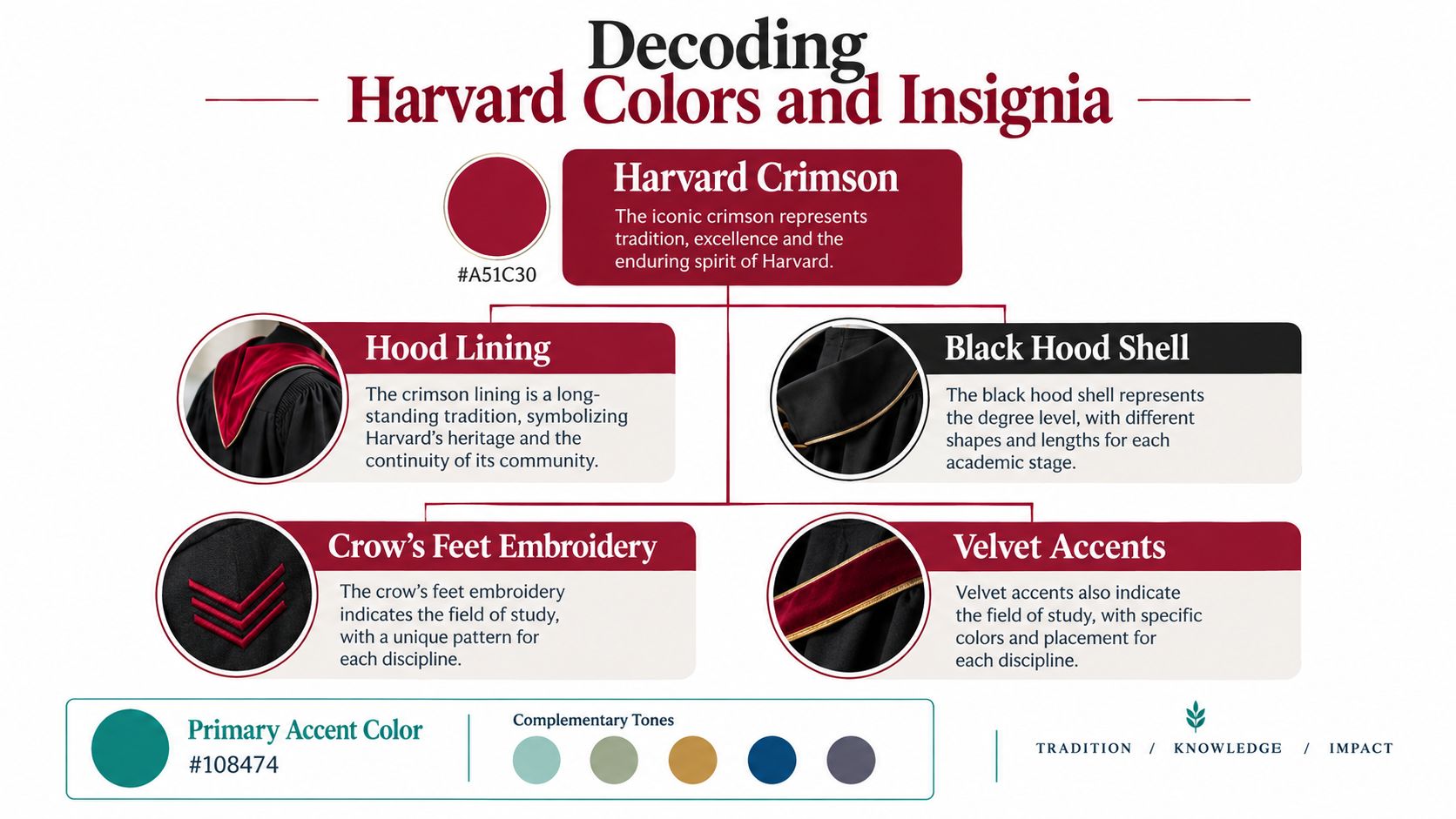
Harvard's institutional signature is the crimson silk lining inside the hood. The hood shell remains black, so the crimson becomes visible when the hood is worn correctly over the shoulders. A doctoral gown is also crimson, but that doesn't mean every crimson detail identifies the same thing. On a doctoral gown, crimson primarily signals Harvard's distinctive doctoral tradition. On a hood, the crimson lining reinforces university affiliation.
Crow's feet identify the field
Harvard uses embroidered crow's feet to identify fields of study. The embroidery color is not a general invitation to choose a favorite shade. It needs to match the field assigned to the degree.
Harvard's documented field colors include:
- White: Arts and Sciences and Extension
- Dark blue: PhD
- Drab or khaki: Business
- Lilac: Dental Medicine
- Yellow: Design
- Scarlet: Divinity
- Light blue: Education
- Peacock blue: Government
- Purple: Law
- Green: Medicine
- Salmon pink: Public Health
- Orange-gold: Engineering and Applied Sciences
These colors are summarized in the documented overview of Harvard academic regalia. Use the list as a verification aid, but check your school's current ordering instructions if your program uses a specialized degree title or ceremony-specific variation.
Read the details as a visual transcript
A Law graduate might see purple field identification, while a Medicine graduate sees green. A Business graduate uses drab or khaki, and an Education graduate uses light blue. The hood shell and lining remain part of Harvard's institutional framework, while the crow's feet provide the academic-field information.
Velvet accents and degree-level construction add another layer. They help distinguish the gown category, but they shouldn't be used to infer a field color without checking the official specification.
Color check: Crimson tells you about Harvard's institutional and doctoral identity. Crow's-feet colors tell you about the academic field. Don't substitute one system for the other.
Getting the Right Fit and Confirming True Harvard Colors
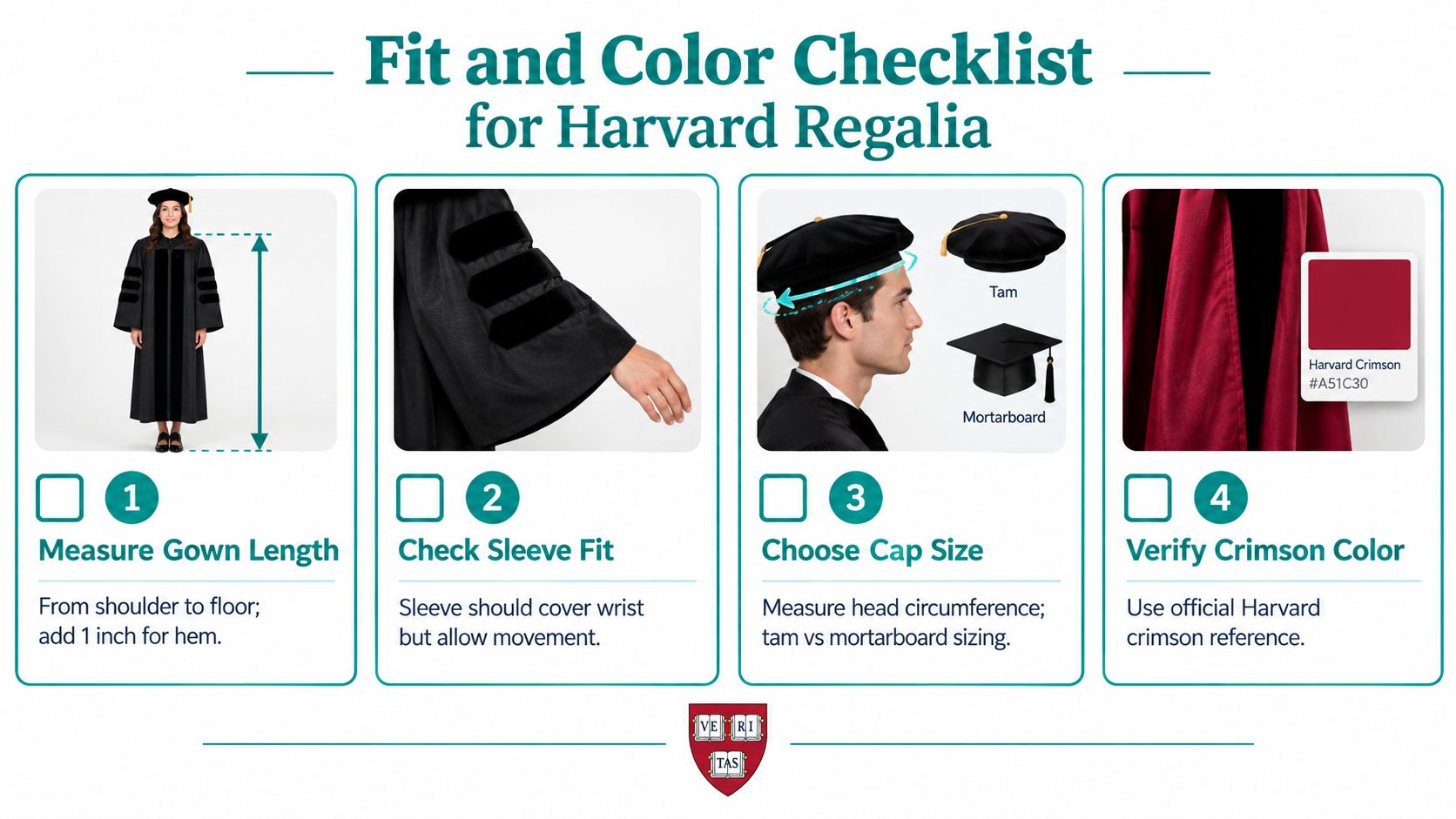
Correct regalia should look formal without restricting movement. The gown needs enough length to create a clean line, but excessive fabric can catch underfoot or hide your shoes. Sleeves should allow you to move your arms, hold a program, and adjust your hood without pulling the shoulders out of place.
Start with the measurement instructions supplied by the vendor or commencement office. Record your height and any other requested dimensions while wearing light clothing, then compare those measurements with the actual size chart. Don't choose solely by your everyday clothing size because academic gowns are cut differently from jackets, shirts, and dresses.
A practical fit inspection
Check the major points before checkout:
- Gown length: Confirm where the hem will fall and whether the size guide accounts for your height.
- Shoulders: Make sure the gown doesn't pull when you raise your arms.
- Sleeves: Verify that the sleeve opening won't cover your hands or interfere with movement.
- Hood placement: Confirm how the hood attaches and whether it sits securely at the neckline.
- Headwear: Follow the cap or tam measurement method instead of guessing from hat size.
The cap decision deserves attention. Mortarboards and tams don't fit the same way, and a tam's soft construction can feel different from a structured cap. If you have long hair, plan how you'll wear it on commencement day before taking the head measurement.
Verify color and fabric before the order is final
Screens can make crimson fabric look brighter, darker, warmer, or cooler than it appears in person. If the vendor provides fabric swatches, request one before purchasing when timing allows. Compare the swatch in natural light and against the other pieces you plan to wear.
Also check the finish. Matte fabric, satin lining, and velvet accents reflect light differently in photographs and under ceremony lighting. A photograph may make two fabrics appear similar even when their texture and sheen are noticeably different in person.
Before submitting the order, save the product description and your selected options. If the field color, degree category, or size is unclear, contact the official provider before payment rather than relying on a later exchange.
Use this short video as a visual aid for examining academic apparel and checking how the pieces sit when worn:
Ordering Timelines Expedited Options and Group Orders for Harvard
Regalia ordering works best when you treat it like event logistics. The ceremony date is fixed, but your choices about sizing, customization, shipment, inspection, and returns all happen earlier. A late order can remove your ability to compare options or correct a fit problem.
Harvard's Graduate School of Education illustrates how school-specific the process can be. It states that most students rent, while rental pricing depends on the degree and what the student keeps. PhD rental can range from $162 to $304, Ed.L.D. rental from $133 to $229, and Ed.M. regalia rental is included in the graduation fee, according to the Harvard Graduate School of Education regalia information. That page also lists an order date of April 10 for free delivery, an April 28 date for home shipment, and an additional $18.10 ship-to-home charge. These details show why one universal Harvard price or deadline doesn't exist across every school.
Build the order around four checkpoints
- Confirm the ceremony requirements. Identify the exact degree, ceremony, approved accessories, pickup method, and return instructions.
- Choose rent or purchase. Renting may suit a graduate who needs the set for one ceremony. Purchasing may make more sense when keepable pieces, future academic events, or personal preferences affect the decision.
- Allow time for correction. Order early enough to inspect the gown and hood, contact support, and exchange an incorrect size if the provider permits it.
- Track the delivery and protect the return window. Keep packaging, paperwork, and tracking details until you know whether the set will be returned.
Custom and in-stock choices require different planning. A custom doctoral gown may offer more control over construction and detailing, while an in-stock set may be more practical when the ceremony is close. Don't pay for expedited delivery until you've confirmed that the item is available and that the arrival date still leaves room for inspection.
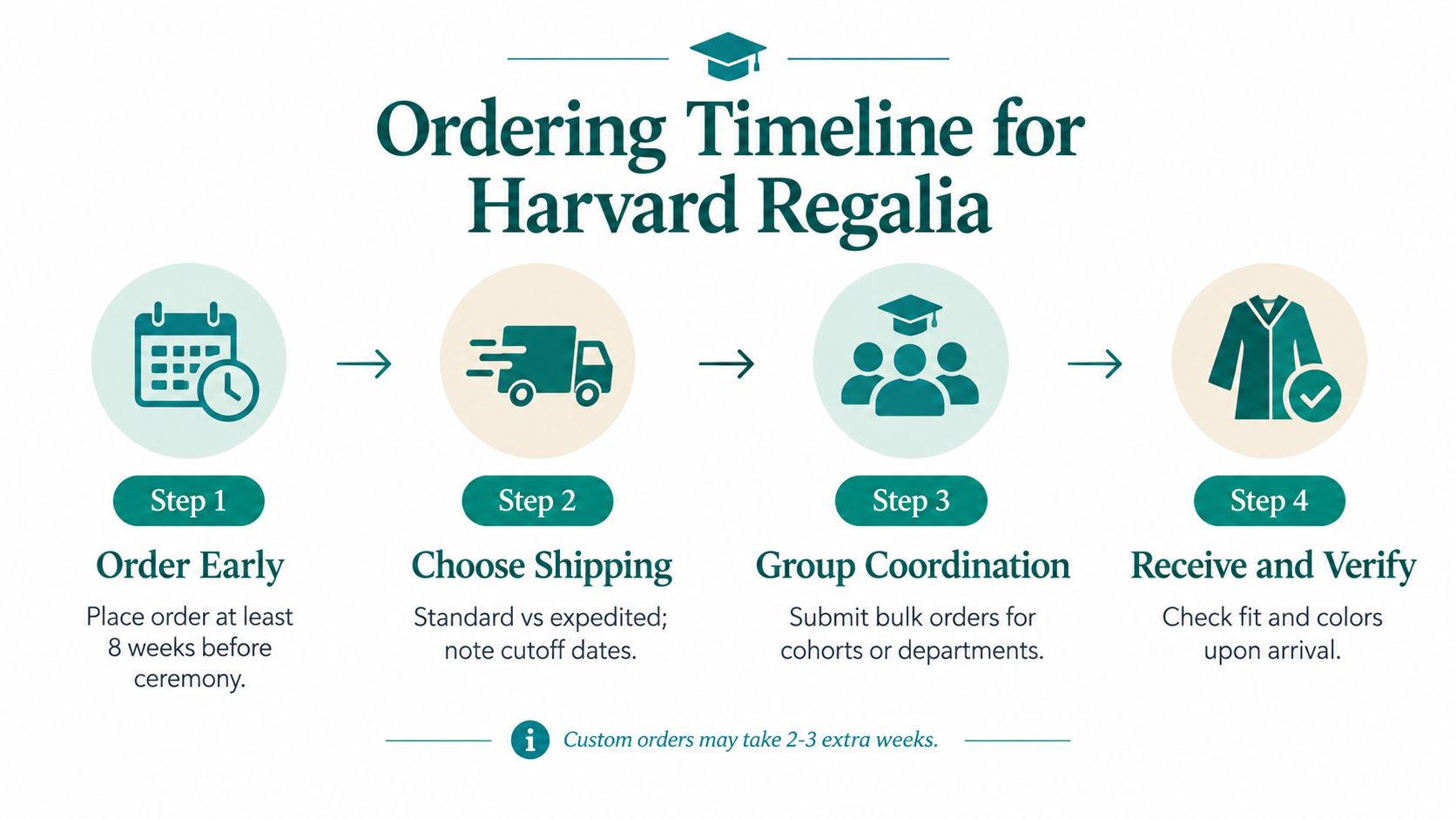
Group orders can simplify a cohort's process. A department or program coordinator can collect degree information, sizes, field colors, and delivery preferences in one workflow, then verify that each person's selection matches the correct academic category. Ask about available group-order support, bulk pricing, swatches, tracking, and the handling of late additions before submitting the combined order.
For shipment status and delivery questions, use the shipping and tracking resources provided by the seller. Harvard GSAS directs ordering and return questions to the official provider, which reinforces an important point: the ceremony office sets the requirements, while the provider manages fulfillment details.
Harvard Regalia FAQs and Final Checklist Before Commencement
Do bachelor's candidates wear hoods?
No. Under Harvard's documented hood system, bachelor's candidates don't receive hoods. Master's and doctoral candidates do, with the degree level reflected primarily through hood length.
Why is the doctoral gown crimson?
Harvard formally approved its crimson doctoral gown in 1955, creating one of the university's most recognizable regalia traditions. The doctoral hood remains black outside with crimson silk lining, so the gown and hood communicate Harvard identity in different ways.
How do I verify my field color?
Use the field-specific crow's-feet color assigned to your program, not a generic discipline chart from another university. Law uses purple, Medicine uses green, Business uses drab or khaki, and Education uses light blue under Harvard's documented system.
What if my regalia arrives close to commencement?
Open the package immediately. Try on every piece, inspect the hood lining and field details, check the headwear, and contact the provider as soon as you find a problem. Keep all packaging and records until the fit and specifications are confirmed.
Before leaving for the ceremony, confirm:
- Degree match: The gown and hood correspond to your exact degree category.
- Color match: Crimson lining and field-specific details are correct.
- Fit: The hem, sleeves, shoulders, hood, and headwear sit comfortably.
- Accessories: Every added item is permitted by your commencement instructions.
- Logistics: You know the pickup, delivery, return, or keep instructions.
- Records: You have your order confirmation and provider contact information.
You don't need to memorize every regalia rule. You need a reliable verification routine and enough time to act on what you find. Once the degree, colors, fit, and deadline are settled, the gown can return to its proper role, marking the achievement rather than creating another source of stress.
Grad Store offers Harvard-specific caps, gowns, hoods, tams, and accessories, along with size and fabric guidance, swatches, group-order coordination, and shipping support. Review the available options and request help with your degree-specific selection by visiting Grad Store.