

You've found the gown, checked the hood color, and marked the commencement date. Then you discover that your university expects a specific doctoral cap, your chosen tam has the wrong side count, and the supplier's custom-order window is closing. That's the kind of problem that appears late, when there's little time left to fix it.
A doctoral regalia hat isn't a decorative accessory. It's a highly visible part of formal academic dress, and the right choice depends on your institution, degree tradition, material, fit, tassel, and delivery schedule. This guide turns those rules into practical buying advice, especially when you're deciding between a four-, six-, or eight-sided tam.
Table of Contents
- Why Choosing the Right Doctoral Regalia Hat Matters
- What a Doctoral Regalia Hat Actually Is
- Tam Side Counts Compared 4, 6, and 8 Sided
- Materials and Tassel Options
- Sizing and Fit for a Doctoral Tam
- Ordering, Shipping, and Group Coordination
- Care and Storage After the Ceremony
- FAQs and Your Next Step
Why Choosing the Right Doctoral Regalia Hat Matters
A candidate who orders regalia close to commencement can make one expensive mistake quickly: choosing a cap that looks doctoral but doesn't match the university's specification. The problem may be the side count, velvet finish, tassel, trim, or the fact that the institution permits only a mortarboard-style cap. Once a custom item is in production, changing it may be difficult.
The American academic-dress framework was first standardized in 1895 and revised in 1932 by the American Council on Education. That framework still influences modern doctoral regalia, although individual universities set the specifications graduates must follow. The Intercollegiate academic cap guidance shows why the hat should be treated as part of a formal system rather than as a costume piece.
The university specification comes first
Start with the graduate school, registrar, commencement office, or official regalia vendor. Confirm four details before you shop:
- Cap type: Ask whether doctoral candidates must wear a tam or may wear a mortarboard.
- Side count: Confirm whether the school specifies a four-, six-, or eight-sided tam.
- Finish and trim: Check whether the cap must be black velvet, another approved fabric, or finished with gold cord or bullion.
- Tassel position: Ask whether the tassel is supplied with the tam and where the institution expects it to hang.
A wrong cap can fail inspection at robing, even if it looks close enough in a product photograph. The Northwestern regalia specifications illustrate how detailed doctoral requirements can be, including the black velvet tam, gold metallic tassel, and the doctoral gown's velvet details.
Bad choices show up in photographs
A tam that sits too low can shade the eyes. One that is too loose can slide forward as you walk, leaving the crown crooked in every stage photograph. A rigid mortarboard can create a sharper outline, while a soft tam produces the rounded doctoral silhouette traditionally associated with advanced academic dress.
Fabric changes that impression. Velvet usually gives the cap a deeper, richer appearance, while polyester reflects more light and can look flatter under strong ceremony lighting. The choice also affects how the tassel and crown trim sit against the cap.
Practical rule: Don't order from a photograph alone. Match the product specification to the school's written regalia requirement, then solve fit and finish.
The rest of your decision becomes much easier once you separate compliance from preference. First confirm what the institution permits. Then choose the material, side geometry, fit, and delivery option that will hold up through walking, hooding, seating, and photography.
What a Doctoral Regalia Hat Actually Is
A doctoral regalia hat is usually a soft, rounded, brimless cap called a doctoral tam. It's worn with the doctoral gown and hood, and it differs from the flat, square mortarboard commonly associated with bachelor's and master's ceremonies. The tam's crown may be divided into four, six, or eight panels, depending on the institution and the tradition it follows.
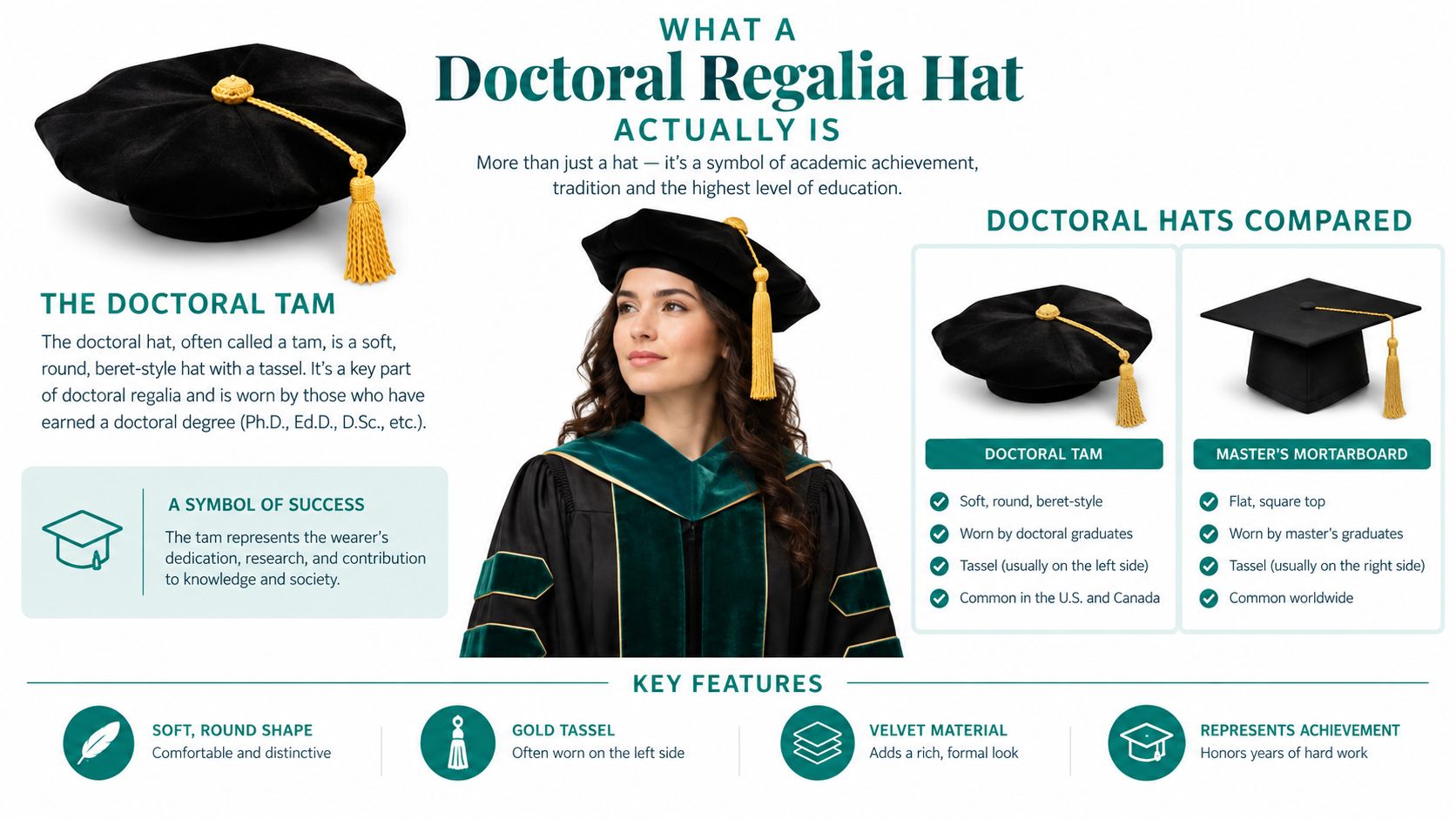
The tam's history helps explain its modern role. The mortarboard reached its current form in the 1700s, while the tam can be traced to 16th-century British lay fashion and later became strongly associated in the United States with professors holding doctorates. Both styles descend from older European dress conventions, but American academic institutions later codified their use for commencement.
Why the tam signals doctoral level
The doctoral tam's soft crown works with the fuller doctoral ensemble. Doctoral gowns commonly use velvet front panels and three velvet sleeve bars, so the cap's texture and shape reinforce the same visual language. The hat isn't standing alone. It completes a coordinated system that distinguishes doctoral dress from lower-degree regalia.
A tam also behaves differently from a mortarboard in practical use:
- Crown height: The tam has a rounded crown that sits on the upper head. A mortarboard has a flat top that must remain level.
- Brim behavior: A tam's soft edge is less rigid and can settle naturally around the head. A mortarboard keeps a firm square profile but can catch or tilt in wind.
- Tassel placement: The tassel attaches at the top of the tam and usually falls near the temple or side of the face. On a mortarboard, it hangs from the central button over one side.
Manufacturers may use “doctoral tam” and “doctoral regalia hat” interchangeably. I do as well, because the tam is the doctoral cap in the American context. That doesn't mean every university accepts every tam. The institution still controls the approved side count, color, trim, and tassel.
Some universities specify a mortarboard instead, and some allow either style. For an Oxford-style tam, university guidance may also address the wearing angle or the forward-facing corner. The University of Texas regalia guidance demonstrates why orientation and secure fit matter during procession and photographs.
Tam Side Counts Compared 4, 6, and 8 Sided
Side count is the most visible design choice after color. It changes how the crown folds, how the seams appear in photographs, and how closely the cap matches a particular academic tradition. Never choose by appearance first if your university has issued a specification.
My practical default is a four-sided tam when the school hasn't given a clear preference. It has the most familiar doctoral profile and is easier to match with commonly supplied gowns and tassels. A six- or eight-sided model can look excellent, but the extra geometry is useful only when it matches the institution's expectations or your intended long-term use.
| Side Count | Read on Camera | How Commonly Required | Typical Cost Tier | Best For |
|---|---|---|---|---|
| Four-sided | Crisp, traditional doctoral outline with clear panel definition | A common institutional specification | Standard to premium, depending on fabric | Graduates who want the safest traditional profile |
| Six-sided | Softer, more rounded visual rhythm across the crown | Required by selected institutions or academic units | Mid-range to premium | Buyers whose school specifies six sides or who prefer a gentler silhouette |
| Eight-sided | More segmented crown with visible seam structure | Usually tied to a specific institutional tradition | Premium custom or specialty option | Faculties, schools, or graduates following an eight-sided requirement |
Four-sided tams
A four-sided tam is the choice I recommend when you need a conventional doctoral appearance and the school hasn't specified another geometry. The corners create a clear silhouette without making the seams dominate the photograph. It also gives you the broadest practical starting point when comparing in-stock options, such as this four-sided doctoral tam.
Six-sided tams
Six-sided models soften the outline without losing the doctoral character. They're a good choice only when the university or faculty recognizes them, because a visually attractive alternative can still be incorrect for the ceremony. Check the school's product image and specification sheet rather than assuming that all doctoral caps are interchangeable.
Eight-sided tams
Eight-sided tams have more panel structure and can look particularly formal when made in substantial velvet with disciplined seam alignment. They're less forgiving of poor construction, however. Uneven panels or a crown that doesn't sit level will be easier to notice, especially in close-up photographs.
My recommendation: Treat four sides as the safe default, six sides as a school-specific option, and eight sides as a tradition-specific purchase. Side count is a compliance decision before it's a style decision.
Materials and Tassel Options
The material decision comes down to how much ceremony presence you want, how often you'll use the tam, and whether the cap must match a custom doctoral gown. Velvet is the formal upgrade. Polyester is the practical fallback. Neither should be selected without checking the gown fabric and the university's instructions.
Velvet absorbs light and gives the crown a dense, rich appearance. It tends to show discipline colors and gold trim with more depth, which is valuable in stage lighting and close family photographs. It also needs more careful handling. A velvet tam may arrive with a flattened crown or crushed pile and should be shaped or steamed carefully before the ceremony.
Polyester is lighter, easier to pack, and more tolerant of handling. It's a sensible choice for a one-time ceremony when the school permits it, especially if the matching gown is also made from a lightweight synthetic fabric. The mistake is pairing a glossy polyester tam with a substantial velvet doctoral gown. The cap can look like it belongs to a different set.
Match the tassel to the cap
Doctoral tassels range from traditional bullion to metallic braid and standard rayon. Bullion, whether made with genuine or synthetic metallic thread, gives the most formal appearance. Metallic braid offers some of that shine with a less elaborate finish, while rayon is usually the simplest and most economical option.
The academic bullion tassel selection is the kind of accessory to compare when the cap, gown, and hood are already formal and you want the tassel to keep pace visually.
Look beyond the hanging strands. The bullion cord around the crown and the chin strap can affect the finished appearance as much as the tassel itself. If your gown has velvet panels and strong doctoral trim, a plain rayon tassel may look underdressed. If the gown is rental-grade polyester, an elaborate metallic finish may look disconnected.
A sensible quality hierarchy
- Premium velvet with bullion: Choose this for faculty wear, repeated hoodings, formal portraits, or a custom doctoral set.
- Velvet with metallic braid: A balanced option when you want the deeper cap finish without the most elaborate accessory treatment.
- Polyester or cotton blend with rayon: Choose this for permitted one-day wear, lighter packing, and a restrained budget.
- Synthetic velvet with metallic trim: Useful when the institution requires the visual language of velvet but your timeline or budget rules out a fully premium build.
Don't buy the cap and gown as unrelated pieces. The doctoral tam should read as part of one ensemble from the back of the auditorium to the close-up photograph.
Sizing and Fit for a Doctoral Tam
A doctoral tam should stay in place without squeezing your head. The correct measurement is taken around the fullest part of the head, approximately half an inch above the eyebrows and ears, where the tam will rest. Don't measure the lower brim line of a baseball cap. That produces a different circumference and often leads to an oversized doctoral cap.
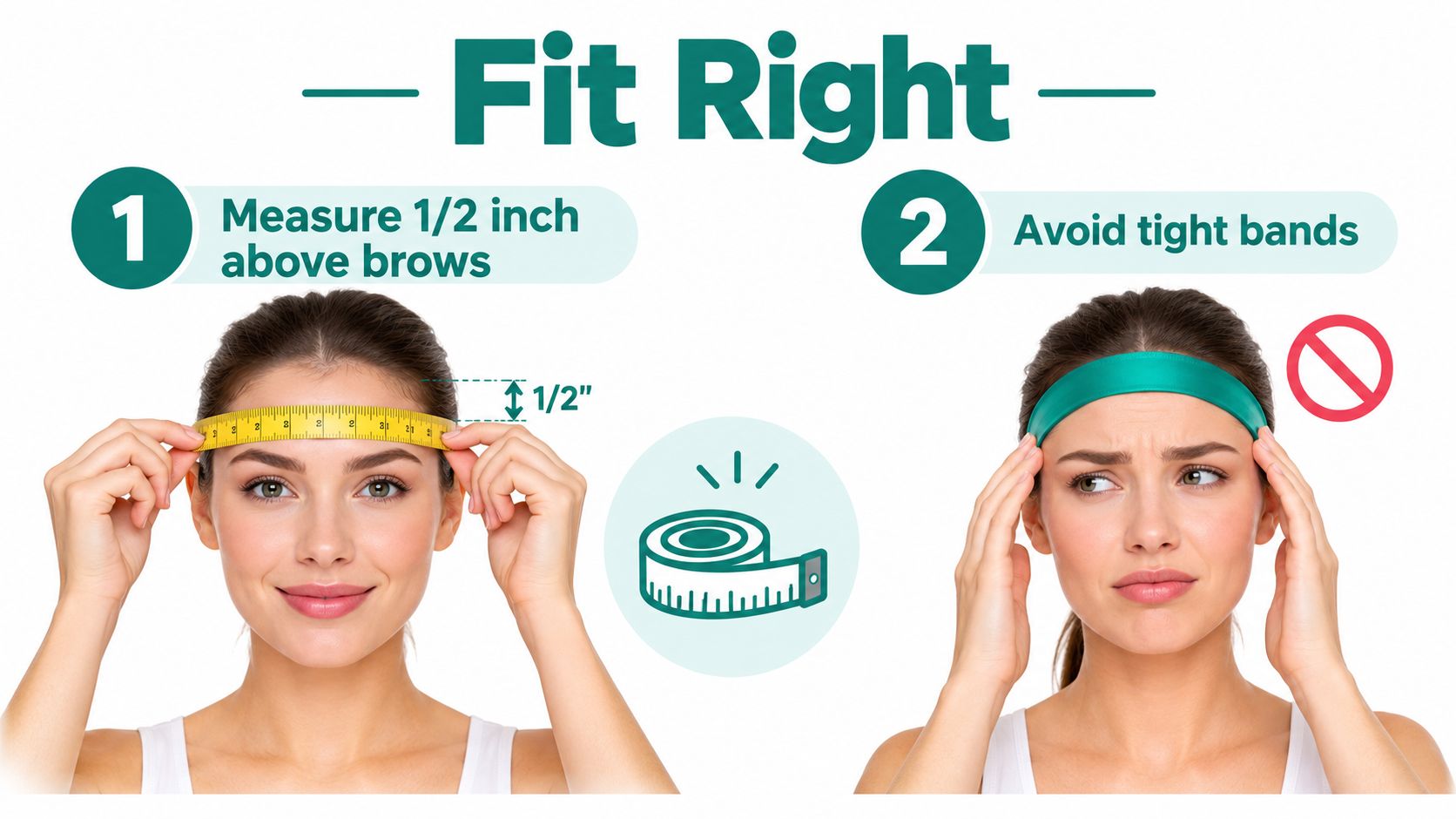
Use a soft tape and keep it level. Record the measurement without pulling the tape tight, then compare it with the manufacturer's chart. A tam usually sits higher on the upper crown than a mortarboard, so the fit should be secure at the resting point rather than loose enough to slide.
Two mistakes cause most fit problems
Ordering up “just to be safe” is the first. An oversized tam can move forward as you walk, cover the eyebrows, and force you to keep adjusting it. A slightly generous crown doesn't create comfort if the inner band can't hold the cap in place.
The second mistake is ignoring ceremony-day hair. Braids, extensions, curls, hairpieces, and a formal updo can change the way the cap sits. Measure with the hairstyle or hair volume you expect to wear, or discuss the difference with the supplier before ordering.
Look for an interior grosgrain band, an elasticized back, or a small adjuster tab. Those features help the tam remain stable during hooding and movement, but they shouldn't replace accurate measurement. The size, color, and fabric guide can help you compare construction details before selecting a size.
A practical fitting test is simple. Put the tam on the upper crown, walk, sit, turn your head, and look down. If it shifts toward your eyes or needs constant correction, it's too loose or incorrectly positioned.
Ordering, Shipping, and Group Coordination
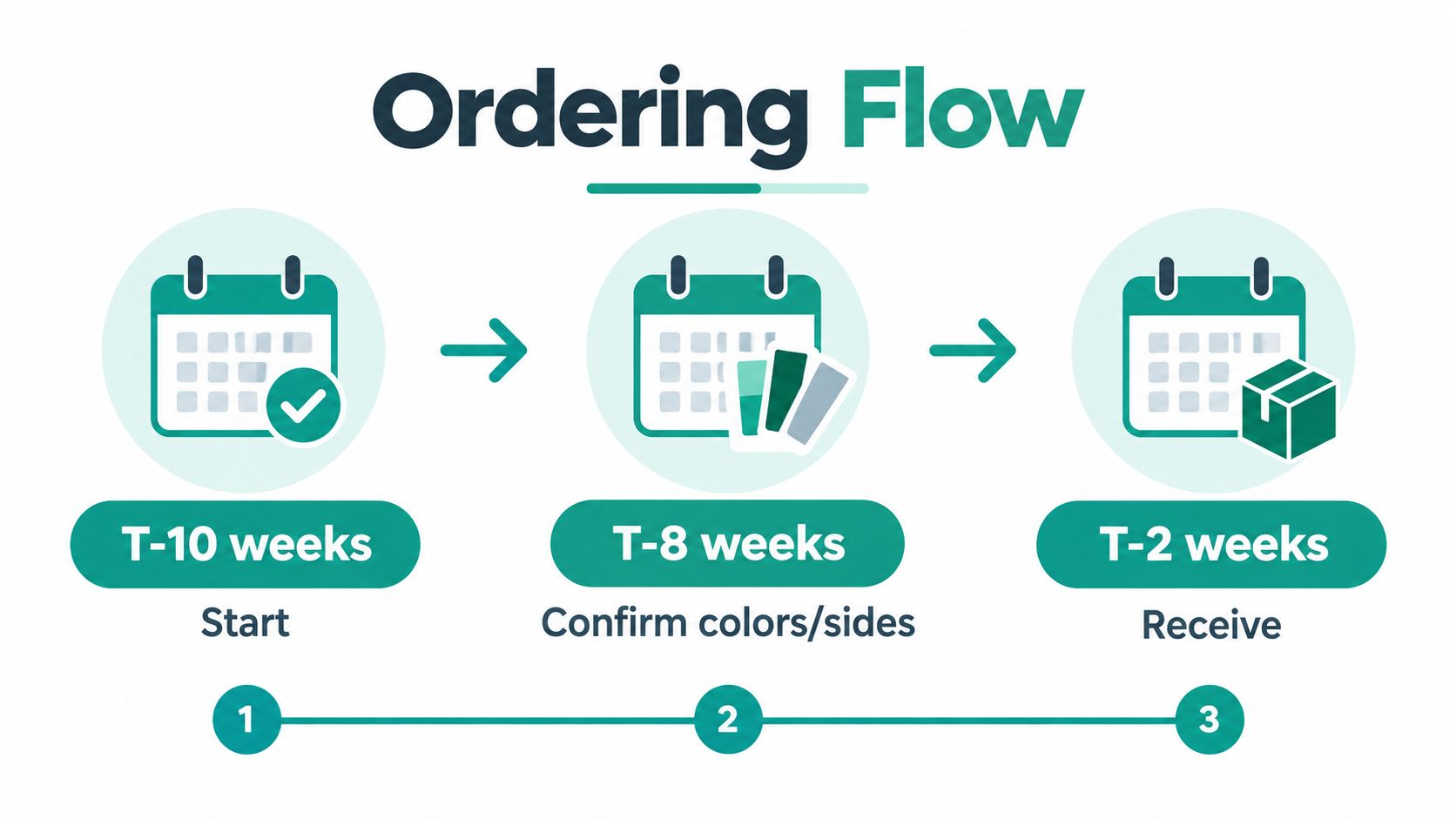
The safest way to buy doctoral regalia is to work backward from the ceremony, not forward from the day you happen to start browsing. Custom doctoral hats may require personal measurements, approved colors, individual production, and careful matching with the gown. Country and institution matter too. A “doctoral hat” can mean a standard U.S. tam in one market and an individually commissioned ceremonial item in another, as explained in this regalia buying guide for different academic traditions.
A workable ordering sequence
Start as soon as the ceremony date is confirmed. Request the official specification sheet and ask about side count, fabric, tassel, trim, and whether the cap must be ordered through an approved supplier. If the discipline color is unusual, request a physical swatch rather than trusting a screen.
Once the specification is settled, place the order while there's enough production and shipping room to absorb a correction. Ask whether the actual cap can be inspected or photographed before dispatch, especially for custom velvet, unusual colors, or eight-sided construction.
When the parcel ships, track it actively. International buyers should confirm customs responsibility and ask about an expedited domestic option after the parcel enters the destination country. A fast service can't correct a wrong specification, so verify the product before paying for speed.
When the hat arrives, inspect the side count, color, tassel, trim, seams, and size immediately. Try it on with the gown if possible. If it needs pressing or shaping, handle that before the final ceremony week, not on the morning of commencement.
Group orders need one owner
Departments and labs should appoint one coordinator. That person collects each graduate's head measurement, degree information, school, color requirement, delivery address, and approval status before submitting one consolidated order.
A single group order can simplify swatch handling, shipping administration, and volume pricing where the supplier offers it. It also reduces the risk of one graduate receiving a different shade or trim because everyone ordered separately.
- Use one delivery address: Sending pieces to personal addresses creates avoidable tracking problems and makes it harder to confirm the complete order.
- Request swatches before finalizing: Don't wait until the group has paid if a color is difficult to match.
- Keep a sizing form: Every graduate should submit their own measurement. Coordinators shouldn't guess sizes from names or previous orders.
- Build in correction time: Open every package promptly so an exchange or replacement doesn't collide with the ceremony.
The worst last-minute outcome is discovering that a group has the right gown color but inconsistent caps. One coordinator, one approved swatch, and one written specification prevent that.
Care and Storage After the Ceremony
Handle the tam properly from the moment it arrives. Don't leave it compressed in a shipping box until commencement morning, because the crown can develop folds that are difficult to remove without damaging the finish.
For a velvet cap, use a soft brush to remove surface dust and spot-clean only when necessary. Steam wrinkles lightly from a safe distance. Never iron velvet directly, and don't saturate it with moisture. Water can flatten the pile and leave an uneven patch that catches the light.
Polyester is more forgiving, but it still benefits from gentle steaming and a shaped resting position. Avoid pressing a hot iron onto the crown, especially if the cap contains synthetic fibers or glued trim.
What to do after the photographs
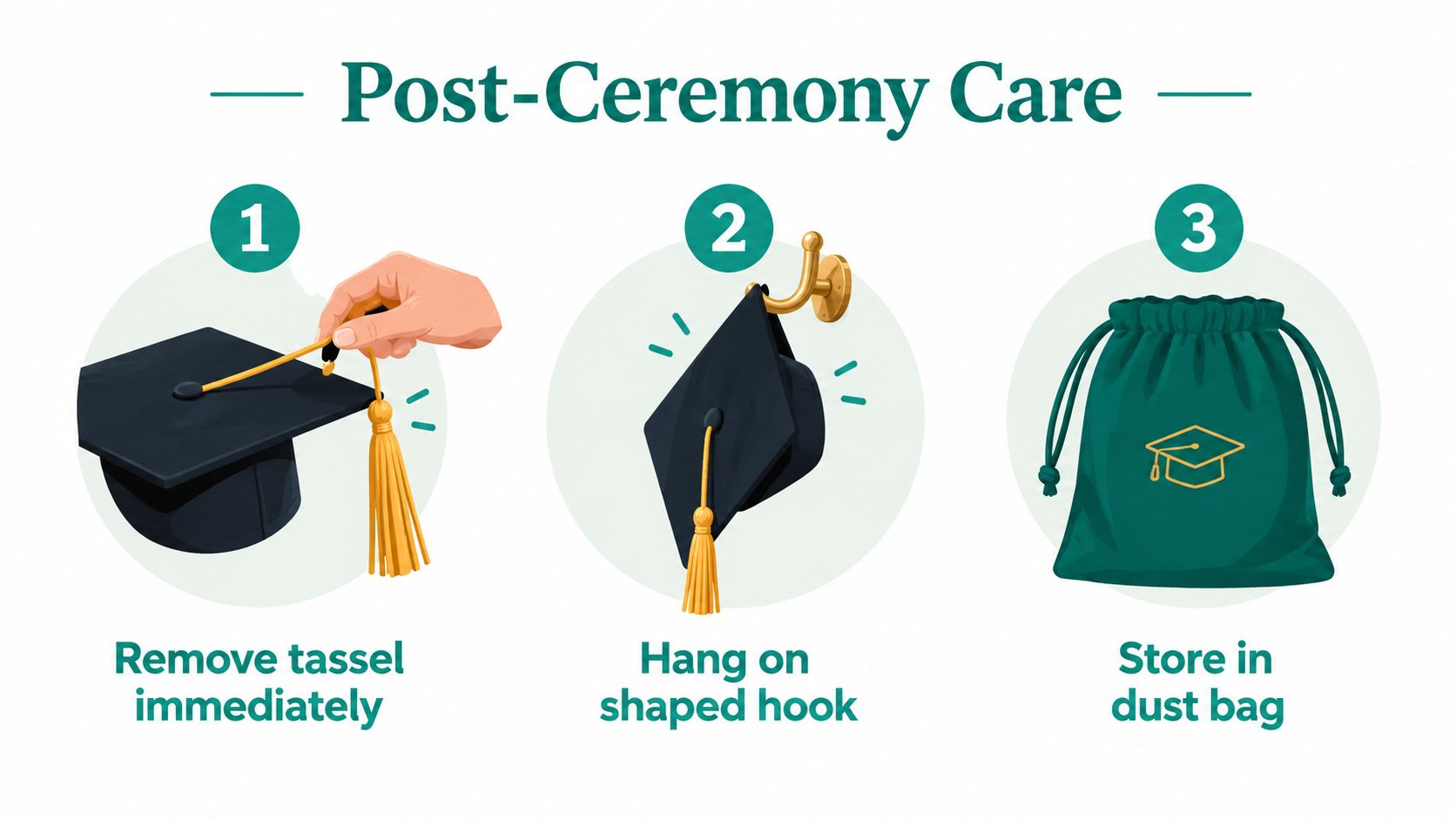
Remove the tassel before storing the hat. Lay metallic or bullion strands flat, untwist them gently, and keep them away from humidity. Don't hang the tam by the top button. The button isn't a storage hook, and using it that way can distort the crown or stress the attachment point.
Instead, support the brim on a shaped stand or fill the crown with acid-free tissue. Store the cap in a breathable dust bag, away from direct sunlight, damp areas, and heavy objects. Velvet also needs protection from moths and accumulated dust during long-term storage.
Avoid a sealed plastic garment bag for long-term storage. Trapped moisture can create unpleasant odors and harm metallic trim. If you're framing the tam or placing it in a shadow box, let the material rest in its natural shape first and use supports that don't compress the crown or crease the brim.
FAQs and Your Next Step
Can I replace only the tassel?
Usually, yes, if the replacement matches the cap's color, trim, and institutional requirement. Keep the original product details or photograph the attachment point before ordering. A doctoral tassel isn't always interchangeable with a standard graduation tassel, particularly when the university specifies bullion, metallic braid, or a crown cord.
A damaged tam may also be replaceable as an individual item, but the answer depends on inventory, construction, and the return policy. Contact the supplier quickly, send clear photographs, and state the ceremony date.
Will a U.S. tam work at an international ceremony?
Don't assume it will. The U.S. Intercollegiate Code influences American academic dress, but the host institution's rules control the ceremony you're attending. Some countries and universities use a distinct doctoral hat, require individual measurement, or treat the headwear as institution-specific ceremonial insignia. Confirm the local specification before importing a U.S.-style tam.
The same principle applies to faculty wear and later hoodings. A well-made tam can be reused when the later ceremony follows the same institutional tradition, but color, trim, side count, and cap type may change with the university or academic appointment.
What if the size or color is wrong?
Check the return and exchange terms before purchase, especially for custom, personalized, worn, or altered regalia. Keep tags attached, avoid steaming or wearing the item until you've confirmed the fit, and photograph the packaging if the product arrives damaged. A faculty mismatch or wrong discipline color should be reported immediately, not after the ceremony.
Should I rent or buy?
Rent when the institution provides a standardized package, the ceremony is a one-time event, and you don't need ownership afterward. Buy when you want reliable fit, repeated doctoral hoodings, faculty use, formal portraits, or control over the material and finish.
A mortarboard may still be permitted at some institutions. That's why the decision shouldn't begin with “Which tam looks best?” Begin with “What does my university authorize?” Then choose the best version within that permitted category.
The right purchase is the one that arrives early enough to inspect, fits the way you'll wear your hair, matches the gown, and satisfies the side-count and trim requirements. Request the school's spec sheet, verify the fabric and tassel, and leave enough time for an exchange before the ceremony deadline.
Grad Store offers institution-specific doctoral regalia, four-, six-, and eight-sided tams, bullion tassels, fabric swatches, sizing guidance, and expedited shipping options. Visit Grad Store with your school specification and ceremony date ready, then confirm the cap before placing the order.